


NERC MOD-026-2 is here: Why it's more than just another compliance update
July 30, 2026
7-min read
Search Consulting Services
Webinar
Power your plant for the future
Power plants built 20 years ago weren't optimized to achieve the operational goals of today and physics and financial challenges of the near-future. So, how can we prepare?
Podcast
Cutting Carbon - Season 2
Learn more about hydrogen-based fuels, capturing and sequestering carbon, and tangible pathways to a more decarbonized future.
Decarbonization
Explore the future of energy
See how GE Gas Power is helping to build a world that works.
Webinar
Exploring carbon capture
While the energy industry continues to prepare for the future of decarbonization, in addition to preparing for a hydrogen society, could CCS be a viable option?
While much of the required testing will be familiar to generator owners, the new standard raises the bar for model verification, documentation, and, for some facilities, model complexity. What was once largely a validation exercise has become a broader effort to prove that dynamic models accurately represent the equipment, controls, and software operating in the field.
For owners preparing for compliance, understanding these changes now can help reduce unnecessary work later.
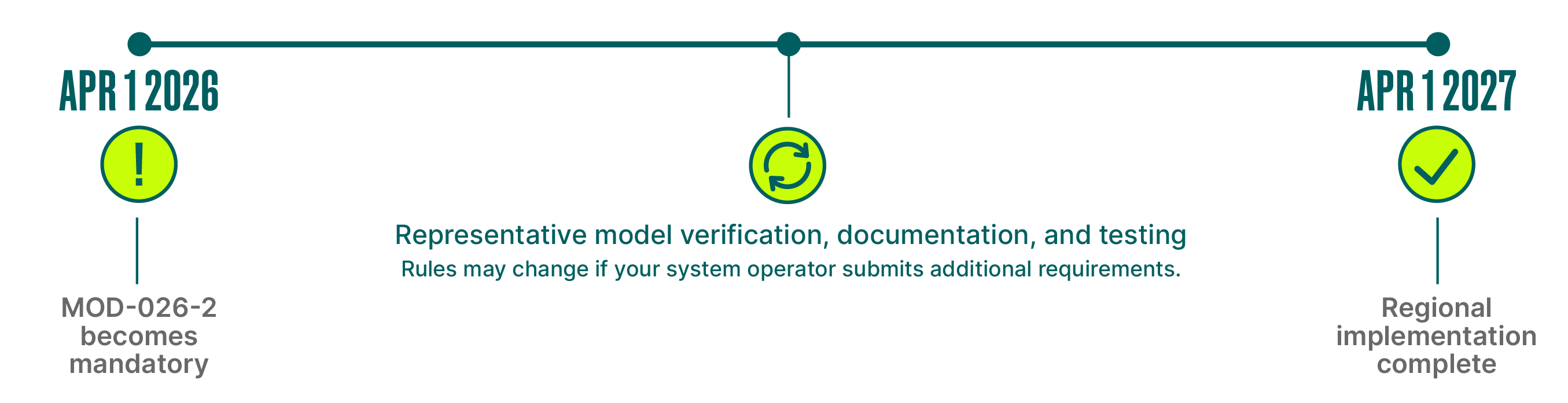
As of April 1, 2026, NERC MOD-026-2 officially became mandatory and subject to enforcement, replacing the former MOD-026-1 and MOD-027-1 standards.
The good news is that many of the core testing requirements remain unchanged.
Generator, excitation, reactive power, and voltage control models must still be validated against dynamic voltage or reactive power excursions. Likewise, governor, active power, and frequency control models must continue to be validated against dynamic frequency events.
If your organization has previously completed MOD-026-1 or MOD-027-1 testing, this portion of the process should look familiar.
The biggest changes lie elsewhere.
Historically, demonstrating compliance largely meant proving that a dynamic model accurately reproduced how a unit responded during a grid disturbance.
MOD-026-2 now goes a significant step further.
The new standard requires documentation demonstrating that the configurable, site-specific parameters within the model accurately represent the design and settings of the equipment currently operating at the facility.
In other words, the model can no longer simply produce the correct response. It must also reflect reality.
That means validating not only the model's performance, but also the generator, excitation system, turbine controls, software settings, and other configurable parameters that produced that response.
For many owners, this will represent the largest increase in engineering effort.
Locating current software versions, extracting control settings, confirming equipment revisions, and verifying that documentation aligns with installed equipment can be significantly more time-consuming than performing the disturbance testing itself—particularly for plants that have undergone multiple upgrades over their operating lives.
While every generating facility must satisfy the new model verification requirements, MOD-026-2 introduces additional expectations for facilities incorporating inverter-based technologies.
Flexible AC Transmission Systems (FACTS) and High-Voltage Direct Current (HVDC) systems, battery energy storage systems (BESS), and inverter-based resources (IBRs) must now provide electromagnetic transient (EMT) models representing the complete facility, including collector systems, auxiliary controls, power plant controllers, and associated transformers.
For conventional gas and steam generation, root mean square (RMS) models have historically provided sufficient accuracy for compliance studies.
Inverter-based resources are different.
Because RMS analysis averages electrical behavior across phases, it can miss interactions introduced by power electronics. EMT analysis models each phase independently, providing the higher level of fidelity needed to accurately represent these technologies.
The tradeoff is complexity.
EMT studies require more detailed models, substantially greater computational resources, and considerably more engineering effort than traditional RMS-based studies.
Although MOD-026-2 is now enforceable, implementation isn't complete.
Transmission planners have until April 1, 2027, to identify additional facility-specific modeling requirements.
Depending on the transmission provider, those requirements could include models representing enabled excitation limiters, over- and under-voltage protection, frequency protection, overspeed or underspeed protection, volts-per-hertz protection, and out-of-step protection.
For some owners, that means work completed today may need to be revisited as additional requirements are introduced.
Rather than waiting until testing begins, generator owners should begin preparing today by:
Reviewing current model documentation to confirm it accurately reflects installed equipment, controls, and software.
Evaluating whether EMT modeling may be required, particularly if the facility includes inverter-based resources or hybrid technologies.
Early planning can help reduce rework, improve project scheduling, and simplify the overall compliance process.
MOD-026-2 reflects a broader trend across the electric power industry.
As generating fleets become more digital and increasingly incorporate advanced controls, inverter-based technologies, and hybrid resources, regulators are asking for models that more accurately represent how facilities behave under real-world operating conditions—not simply how they're expected to behave.
That trend is unlikely to reverse.
For owners, success under MOD-026-2 depends less on responding to new requirements after they're issued and more on building compliance planning into the process from the very beginning.
The earlier these conversations happen, the less likely facilities are to repeat work later.
GE Vernova's Consulting Services team has performed model verification services on more than 2,000 generating units representing all major generator manufacturers.
Our engineers help customers gather generator, excitation system, governor, turbine control, and software data, perform testing, validate models, and prepare the documentation needed to demonstrate compliance. By becoming involved early, we help customers streamline the compliance process, reduce unnecessary rework, and adapt as transmission planner requirements continue to evolve.
MOD-026-2 represents an important step forward in improving model fidelity across the bulk power system. With the right planning and technical support, generator owners can meet these new expectations while positioning their facilities for reliable, compliant operation well into the future.
Contact us