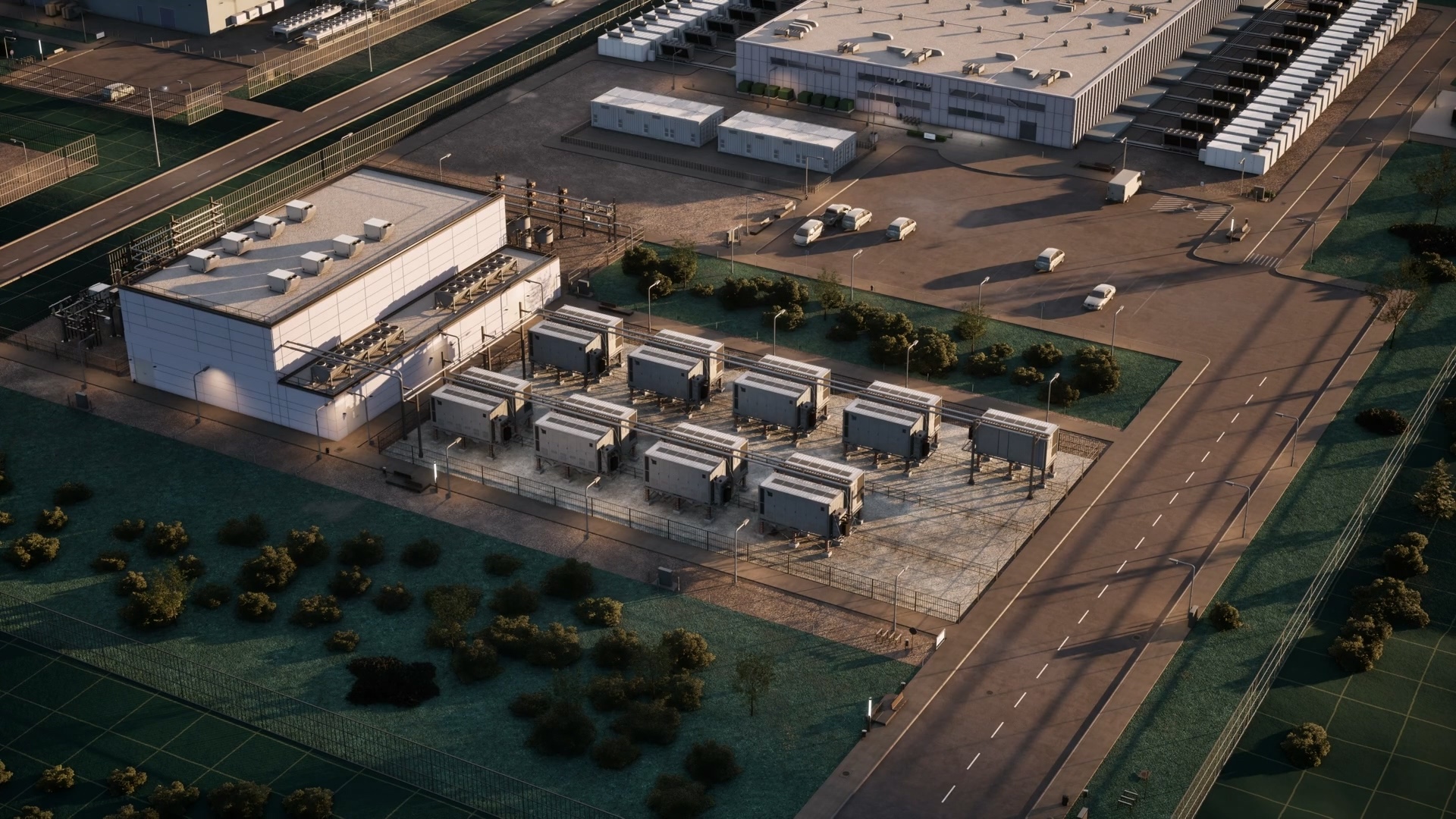
For decades, steelmakers have fought to tame their electric arc furnaces, whose power demand fluctuates wildly as they work their way through a jagged, shifting pile of scrap metal. Now a strikingly similar electrical challenge is emerging at the front line of the AI boom at large-scale data centers, where electricity demand can swing by tens of megawatts (MW) in milliseconds, making it harder to keep the grid stable.
Fortunately, the shared problem has a shared solution. GE Vernova is now applying lessons learned from decades of managing demanding industrial loads to the power challenges created by artificial intelligence (AI). The company’s new MV-UPS (medium-voltage uninterruptible power supply) stabilization system takes converter technology honed over generations of arc furnace projects and scales it up to smooth out the rapid power demand shifts of AI. Everyone stands to gain: The technology protects data centers from disturbances in the electricity coming from the grid or on-site generation, while also buffering sudden changes in AI power demand before they can affect the grid or the upstream power system.
Alpesh Saraiya, GE Vernova’s global data center solutions leader, explains that a single MV-UPS unit can protect up to 175 megawatts (MW) of computing load, enough for a large data hall of a leading-edge hyperscale AI training data center. Shoring up a gigawatt-size AI training campus would need eight to twelve MV-UPS units, depending on the system-level redundancy requirements. If the data center operator used traditional low-voltage UPS units, capable of handling 2 to 5 MW each, “they’d need to install hundreds,” he says.
The formidable shock absorber can also react faster than the blink of an eye, responding in less than 20 milliseconds to soak up sudden load variations before they reach the grid or on-site generation. That ability to instantly cushion the grid could help the world’s vast AI campuses become better neighbors. “You have to be a good citizen,” Saraiya says. With MV-UPS in place, he adds, “what the grid sees is barely a ripple, well within even the most stringent grid-operator requirements.”
Same Problem, Larger Scale
GE Vernova is bringing decades of grid management know-how to the AI boom. Its modular multilevel converters (MMCs) already power a huge new low-carbon arc furnace at SSAB’s Oxelösund steelworks in Sweden and steady the voltage at the Metalfer Steel Mill in Sremska Mitrovica, Serbia.
The AI boom has presented a similar electrical challenge to the one steel mills have long contended with, but on a larger scale. Instead of furnaces melting scrap, vast banks of graphics processing unit (GPU) chips work on the same task simultaneously, pause to chatter to each other and share results, then surge back into action. During AI training, power demand can rise sharply and then fall just as quickly, at times dropping from around 80% of several hundred megawatts to 20% within seconds. On an engineer’s screen, the demand can look like a precipitous pulse, rising and falling sharply, over and over again.
Grids were not built for these flucutations. Sudden shifts of hundreds of megawatts can affect a network’s voltage and frequency, damaging equipment and risking blackouts. The North American Electric Reliability Corporation (NERC) groups AI data centers alongside arc furnaces as large loads whose cyclical swings can set up damaging oscillations in the grid.
But the challenge also runs in the other direction. The valuable computing load needs protection from disturbances coming from the grid or on-site generation. A data center cannot simply shut down every time voltage or frequency moves outside its normal range.
A True End-to-End, Bidirectional Power Stability Solution
GE Vernova’s MV-UPS addresses both sides of the problem by sitting directly between the data center and its power supply. Unlike energy storage that sits alongside the electrical network, all power supplying the protected load passes through the MV-UPS. This means the system can control what each side sees, electrically separating, or decoupling, the source from the load.
Saraiya compares it to a seawall. Conditions can be rough on one side, but the protected waters on the other remain calm. Electrically, MV-UPS does something similar: Disturbances from the grid or on-site generation are prevented from reaching critical computing loads, while sudden changes in the data center’s own demand are buffered before they travel back upstream.
Inside the system, incoming AC power is converted to DC and then re-created as clean AC power for the data center. The batteries sit in the middle, providing or absorbing energy as needed to keep the two sides balanced. If demand suddenly rises, the batteries can provide the difference. If it falls, they can absorb the excess, while the converters continue to provide stable voltage and frequency to the protected load. When the grid hiccups, as it occasionally does, the AI servers carry on as if nothing happened.
Conventional UPS systems typically protect smaller sections of a data center at low voltage. MV-UPS moves that protection further upstream to medium voltage, at 34.5 kilovolts (kV). Crucially, the UPS function itself operates at medium voltage. That allows one coordinated system to isolate and protect, in a more efficient manner, a much larger block of the facility than traditional low-voltage UPS systems.
That larger-scale protection can also improve the footprint and economics of data centers. Traditional low-voltage UPS (LV-UPS) equipment is located in the so-called gray space of a typical campus, alongside the other mechanical and electrical hardware required to keep the site humming. By removing the need for potentially hundreds of indoor low-voltage UPS systems further down the line, the MV-UPS-centric architecture can optionally free up floor space for more revenue-generating server racks, or reduce the very expensive furnished data center hall footprint.
Building an elite squad of hyper-efficient MV-UPS units instead of an army of low-voltage buffers can reduce a site’s power distribution build costs by around 15%, explains the executive. “They can also cut cooling costs, a major expense for any data center. Every bit of energy you lose in conversion turns into heat, and that heat has to be cooled away. At 98.5% efficiency and installed outdoors, MV-UPS wastes very little, so data center operators save both CAPEX and OPEX on cooling the several-percent-less-efficient low-voltage UPS systems installed indoors and can put more of their power into computing.”
Time to First Token
GE Vernova’s MV-UPS technology can also accelerate power utility interconnection discussions for hyperscalers racing to bring new computing capacity online. For these operators, “time to first token,” the time it takes to get an AI facility up and running, has become one of the most important measures of speed to market.
The same stability block can support different campus power configurations, including grid-connected, bridged, and islanded operation, giving operators flexibility as the site’s power architecture evolves.
Addressing both sides of the problem is central to GE Vernova’s approach. The company works across the electricity system, from generation and substations to grid equipment, storage, and power conversion all the way to the server rack. That gives its engineers visibility into both the source supplying the electricity and the critical load consuming it.
The MV-UPS acts as a robust power-stability bridge, independent of the upstream power source, whether grid-tied, bridged, or islanded, and of the downstream distribution architecture to the rack, whether AC, DC, or hybrid.
With the first MV-UPS units due to ship in mid-2027, GE Vernova is applying hard-won lessons from electro-intensive, mission-critical industries to the new challenges emerging in AI data centers.
Learn more about GE Vernova’s MV-UPS here.