Making good on their nickname, Sunbelt States from Georgia to Arizona are building lots of new solar these days. Texas is currently leading the way, but plenty of other states are cranking up their growth. In the past 12 months, Mississippi has grown solar 73%, and Louisiana has been even more aggressive, hitting 90%, according to the Energy Information Administration.
Power grids have handled this fast growth pretty well over the past decade. But they are sensitive creatures too, and need tech support to help them cope as they increasingly shoulder these large volumes of fluctuating power. To maintain stability on grids as they fill up with renewables, engineers typically add a motor-generator called a synchronous condenser to the mix. Demand for these synchronous condensers — which GE Vernova has rolled out in countries from the U.K. to Saudi Arabia — is rising globally because of their ability to steady voltage and smooth out power flows. Power professionals call this grid stability factor inertia, and it provides short circuit strength and voltage dynamic support. Inertia, contrary to what it sounds like, is exactly what the system needs.
Several years ago, GE Vernova began to explore additional solutions to support grid stability challenges using power generation equipment already in service. The result was a truly novel discovery: A 7F series gas turbine actually can be augmented with synchronous condenser capability while retaining its normal generation features. Last year, the company collaborated with a utility company in the southern U.S. to roll out a first-of-its-kind project putting the sync condenser–turbine combination to work in the field.
“This is a first,” says Louis Veltre, 7F gas turbine product manager at GE Vernova’s Gas Power business. “Our aeroderivatives team can achieve this on smaller turbines, but this is the first time it’s been done on a full-scale heavy-duty gas turbine. So we’re excited about it.” Given the widespread use of these large turbines globally, the implications are very promising in a world looking to realize further cost savings while continuing to expand renewables.
Turning Turbines into Multitaskers
According to Veltre, the story gets even better. The addition of this new capability to the 7F series essentially deputizes those turbines into a different kind of work, precisely at the time of day when solar generation is peaking and they’d normally be idle. “These gas turbines are attached to massive generators ready for operation that can help to stabilize the grid. But when solar is strong, the turbine generators are just sitting idle, waiting to be dispatched for power generation only. So you have these great assets already.”
The team explored three different solutions during the project, but two of those, which both involved adding a “clutch,” were found to be expensive or time-consuming or both. Instead they went with the “clutchless” path GE Vernova had previously developed. “This whole six-month study was very collaborative,” says Veltre. “We identified all the risks, risk mitigations, and estimated all the costs. In the end, we mutually agreed that the clutchless option was the best approach.” The testing of that solution, now successful, was run on a single 7F.05 turbine, creating a proof of concept that Veltre says could be rolled out at other 7F.05 turbine sites in the region.
“When such a valuable asset is already available, the question becomes how to make the best use of it across the operating conditions that can occur throughout the day,” says Renato Yabiku, product manager for synchronous condensers in GE Vernova’s Power Conversion and Storage business.
A Perfect Symbiosis
The turbine’s new capability dovetails beautifully in Sunbelt states, which generate so much solar during peak midday hours that the grid can’t handle the surplus and it has to be curtailed or wasted — meaning that some of the electricity that’s generated has to be reduced or lost because the grid can’t use it all at that moment.
Curtailment can happen for more than one reason, Yabiku points out. In some cases, generation exceeds available demand. In others, the limitation is tied to insufficient short-circuit strength, reactive power support, or inertia in the system, which can restrict the grid’s ability to dispatch available power. In those cases, additional synchronous condenser support — if the existing gas turbine generator is located at the right point on the grid — can help reduce curtailment.
To not be able to use or charge for those low-carbon electrons is a real loss for the economics of solar, and for the environment. Veltre explains that a bit of magic takes place here, because in the future some utilities will be able to power those augmented 7Fs with surplus solar.
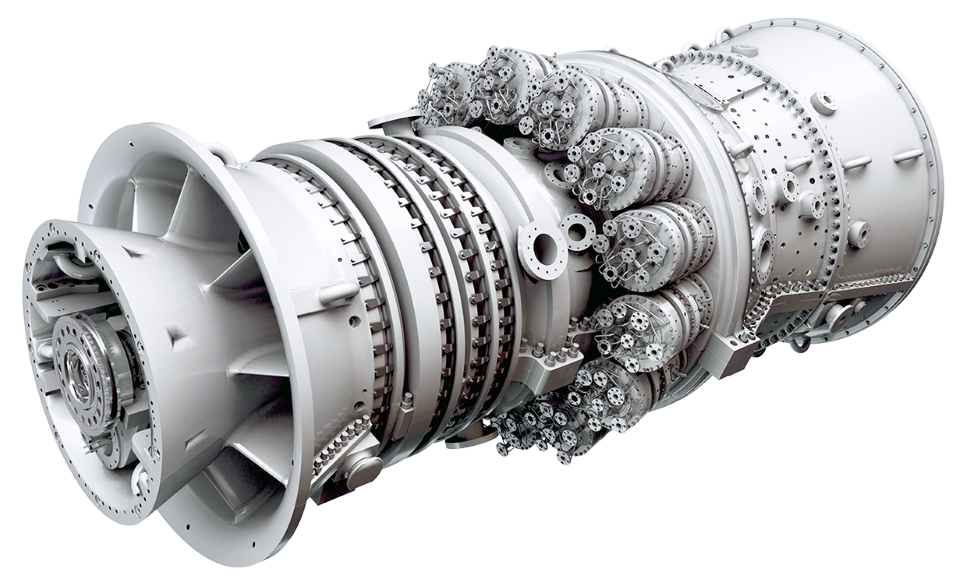
This is how that would work: When 7Fs run as turbines, they burn natural gas. But when they run as synchronous condensers, they need electrical power instead. As synchronous condensers, the 7Fs change jobs, to both receive and emit reactive power — the untamed forces in power grids that must be harnessed. But when doing so, they run “unfired” — no natural gas, no fossil fuel inputs, just electricity.
To obtain that electricity, Veltre says, there’s a perfect solution: The system needs condenser help when extra solar is on the grid, but when there’s extra solar power, the synchronous condensers can run on the surplus that solar generates. In high renewables domains, gas turbines are often used to create stability as generators. But adjusting its operating mode, says Veltre, unlocks the grid-stabilizing side of their personality and makes them even more effective.
“It is also an approach that can considerably reduce carbon emissions,” Veltre says. “So instead of burning fuel to run the gas turbines for voltage support, you can use a solar farm to drive the generator, to turn the gas turbine, and then produce or absorb reactive power at the same time.” He adds that any place in the world where renewables penetration is high enough to drive power prices low or into the negative — California, Australia, the Middle East, and some parts of Europe — can be a candidate for this new capability.