Search Consulting Services
Recommended resources

Webinar
Power your plant for the future
Power plants built 20 years ago weren't optimized to achieve the operational goals of today and physics and financial challenges of the near-future. So, how can we prepare?

Podcast
Cutting Carbon - Season 2
Learn more about hydrogen-based fuels, capturing and sequestering carbon, and tangible pathways to a more decarbonized future.

Decarbonization
Explore the future of energy
See how GE Gas Power is helping to build a world that works.

Webinar
Exploring carbon capture
While the energy industry continues to prepare for the future of decarbonization, in addition to preparing for a hydrogen society, could CCS be a viable option?
Prefer to listen?
Stream our audio version
Explore how to build internal support for planning software that helps meet the demands of a more complex grid.
Grid planning used to be predictable
Until recently, electricity demand rose incrementally, generation portfolios changed slowly, and planning tools evolved even more slowly. Over the last decade, though, grid planning has changed. Faster growth, renewable energy additions, policy changes, and weather-driven stresses are now part of the baseline. Planners can’t rely on yesterday’s approaches and tools to make confident decisions anymore.
That is why Integrated Systems Planning (ISP) has become so important. It is a necessary shift in how utilities plan, prioritize, and invest.
Why traditional grid planning feels inadequate
For many utilities, planning still happens in siloes. For example, long-term capacity planning lives in one model, while economic analysis lives in another. Each team tries to answer critical questions, but they work with different assumptions, datasets, timelines, and often different software tools. Teams spend weeks reworking outputs that should have lined up, only to discover that a small, early change in assumptions led to very different conclusions.
This results in misaligned investment strategies, longer planning cycles, higher rework costs, and increased risk. Ultimately, having separate models makes it hard to see the full picture.
Integrated Systems Planning starts with the recognition that traditional planning methods no longer work. ISP offers a unified framework that coordinates planning across analyses enabling faster, more accurate, and more collaborative analysis. It is essential for maintaining system adequacy and guiding investments that help to deliver more reliability, sustainability, and affordability.
What Integrated Systems Planning does
Integrated Systems Planning isn’t about adding another layer of software. It is about aligning datasets, economic operations, physical grid behavior, reliability analysis, and long-term capacity planning into a single framework so analyses are transparent across teams. When planners operate under the same assumptions they can make more confident decisions about the grid’s future.
GE Vernova’s PlanOS was developed to enable Integrated Systems Planning. It is one platform that allows planners to evaluate reliability, cost, resilience, and capacity analyses together rather than in isolation.
When Integrated Systems Planning is done well, the benefits go beyond speed of analysis and convenience. Capital planning aligns with reliability needs, renewable integration becomes more streamlined, scenario planning improves confidence under uncertainty, and investments are backed by unified analyses.
A six-step roadmap for winning internal support for ISP
Getting the most out of ISP takes more than streamlined planning software. It requires choosing the right software tool and building internal support for implementation and use. Winning support means addressing concerns about disruption, trust in results, and how the latest tools fit into established processes.
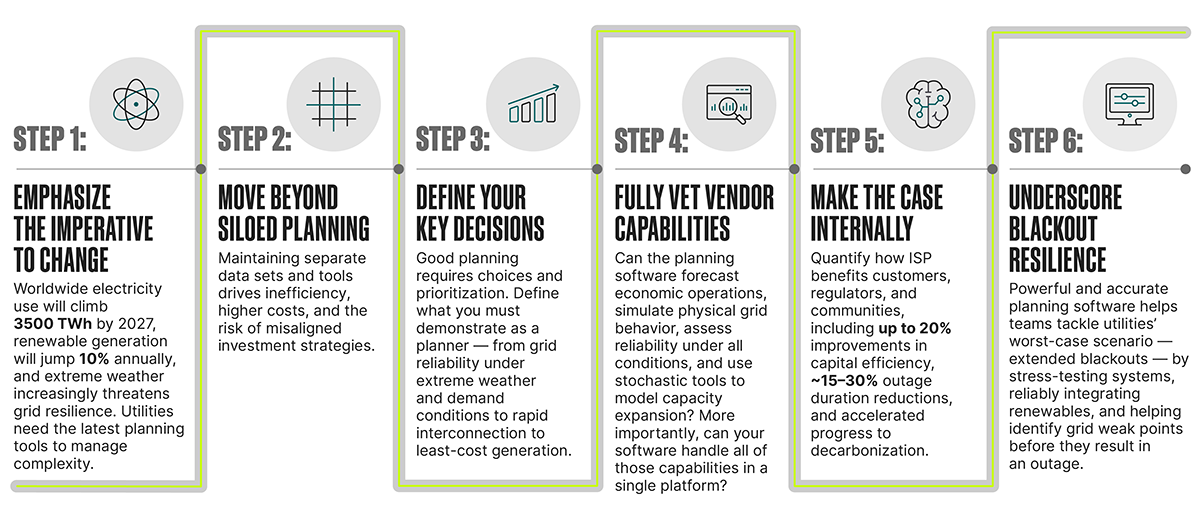
The infographic above outlines six steps utilities can use to navigate internal dynamics, evaluate planning software more critically, and build momentum for change. The steps form a practical roadmap for moving from fragmented planning to a more integrated approach.
From siloed tools to more confident decisions
The electricity grid is getting more complex, and today’s planning environment needs a platform that reflects that complexity without creating new silos. If planning remains siloed, outcomes will feel disconnected. If it becomes integrated, planners can make decisions with confidence.
Discover more
You might also be interested in
Contact us
Contact GE Vernova’s Consulting Services Business
Connect with industry experts to learn more about winning support for integrated grid planning software.