Search Consulting Services
Recommended resources
Webinar
Power your plant for the future
Power plants built 20 years ago weren't optimized to achieve the operational goals of today and physics and financial challenges of the near-future. So, how can we prepare?

Podcast
Cutting Carbon - Season 2
Learn more about hydrogen-based fuels, capturing and sequestering carbon, and tangible pathways to a more decarbonized future.

Decarbonization
Explore the future of energy
See how GE Gas Power is helping to build a world that works.

Webinar
Exploring carbon capture
While the energy industry continues to prepare for the future of decarbonization, in addition to preparing for a hydrogen society, could CCS be a viable option?
Prefer to listen?
Stream our audio version
This audio content was developed with the use of Generative AI.
The power system’s increasing complexity and evolving needs demand a modernized approach to long-term planning.
What is Integrated Systems Planning (ISP)?
Integrated Systems Planning represents a transformative approach to long-term grid planning. Providing a holistic understanding of load (including variable loads), generation (traditional, battery storage, and inverter-based), and system constraints. While considering all aspects of an energy system, helping to ensure reliability, and improving the system for cost-effectiveness and sustainability by coordinating them together rather than planning for each separately. Most system operators and utilities have historically relied on siloed planning analysis and methods for system planning. This has resulted in organizations evaluating different and potentially competing system models. With the rapidly increasing complexity of energy systems and evolving regulatory requirements being introduced to the grid, more frequent and detailed analysis is required to comprehensively view the grid’s functionality.
A change in electricity demand
What makes today’s planning challenges fundamentally different is the return of sustained load growth. For a decade and a half, the U.S. Energy Information Administration’s (EIA) forecast of electricity consumption was predictable, and predictably flat. Indeed, between 2005 and 2020 load growth averaged about 0.1%, pushed slightly upward by population and economic growth while also held down by improved efficiency.1 The rest of the world has also seen relatively modest growth in electricity demand. According to the International Energy Agency (IEA), global electricity demand grew by an average of 2.6% between 2015 and 2023.2
Today, we have entered an era of load growth that marks a generational shift in how energy is generated, transmitted, and consumed. The demand, as it used to be, in terms of predictability and density, has transformed into patterns that are difficult to predict and extremely high density, thanks to greater demand from electric transportation, manufacturing, and, of course, the boom in electricity demand from data centers and AI.
The U.S. Department of Energy forecasts that data centers could consume up to 580 TWh annually in 2028, equivalent to about 123 GW and representing up to 12% of total US electricity use.3 Globally, electricity demand is expected to rise by 3.3% in 2025 and 3.7% in 2026, with China and India growing significantly faster.3 Reliable power supplies are now an economic and societal imperative, and utilities are responding with major investments in grid infrastructure and assets. But not all investments deliver equivalent value in terms of reliability, resilience, and cost management.
These shifts in demand are not happening in isolation. They coincide with fundamental changes in how the grid operates, the uncertainties planners must account for, and even the grid's underlying physics. Together, they create a new planning environment that requires a more integrated approach.
Three simultaneous grid transformations
At the center of today’s planning challenges, the grid is undergoing three interrelated transformations: operations, uncertainty, and physics. The ongoing transformations in the energy sector are driven by the shift from Synchronous Machines (SMs) such as gas, nuclear, hydro, and coal to Inverter-Based Resources (IBRs) like wind, solar, batteries, and HVDC systems. This transition makes it challenging for planners to assess various reliability aspects simultaneously.
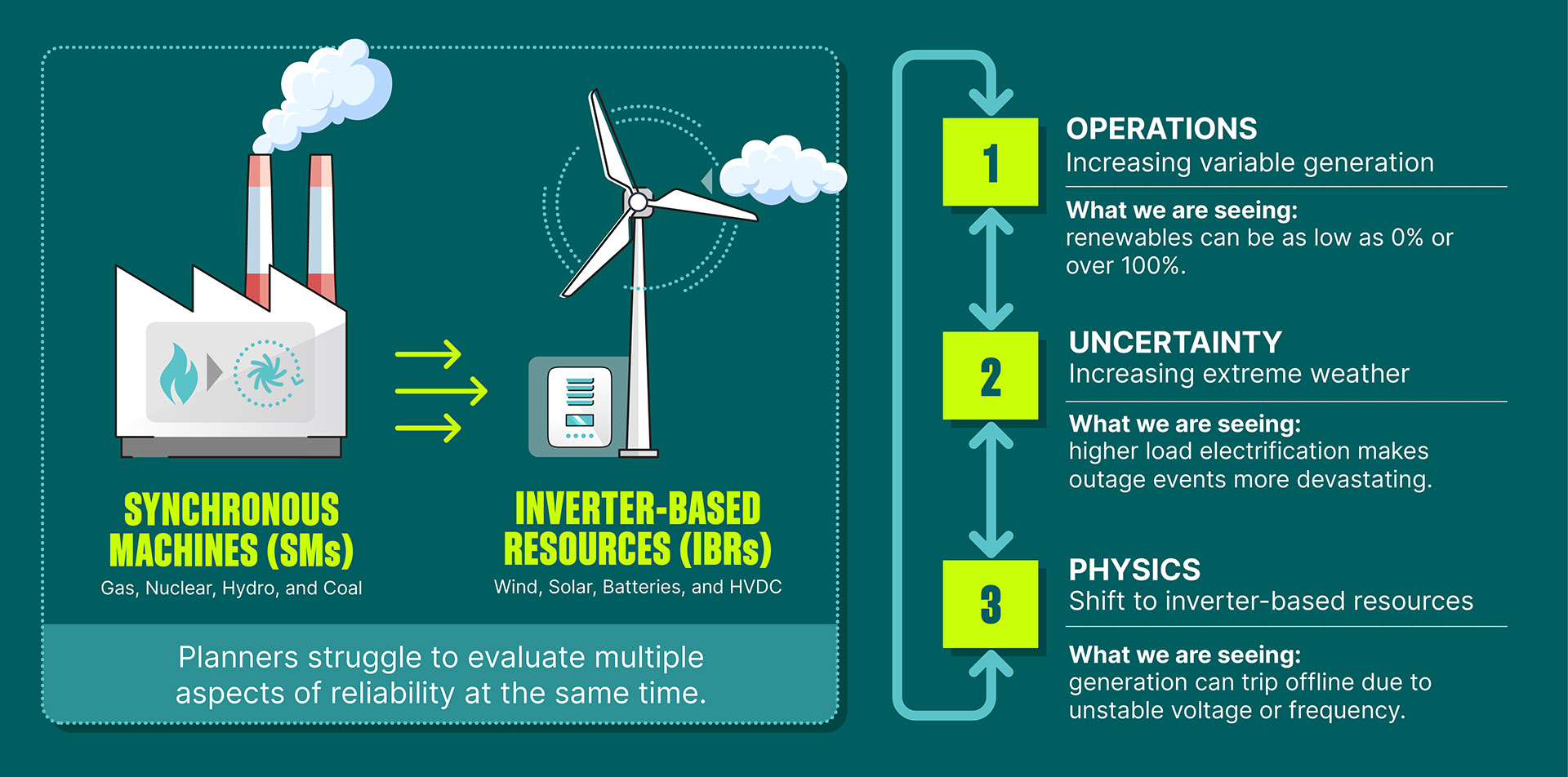
The shift from conventional SMs to renewable energy sources is redefining grid operations. Traditional power plants, such as those fueled by coal, natural gas, or nuclear energy, provide a fairly steady fuel source that helps ensure grid stability. However, renewable energy sources like wind and solar have variable energy delivery, depending on weather conditions. These characteristics make balancing supply and demand more complex, requiring advanced forecasting, operations flexibility, and integration of energy storage solutions.
The second transformation is the increased uncertainty on the grid due to more frequent extreme weather events. Heatwaves, storms, and cold snaps can greatly impact energy demand and supply. The weather may cause more uncertainty than the variability of renewable resources alone. At the same time, the electrification of transportation and industrial sectors is increasing demand. All these factors increase the uncertainty of energy generation and utilization. Accurate modeling and scenario planning are crucial to help ensure reliability.
The third transformation is the physics of the system; not only are we shifting in fuel sources and uncertainty, but the shift from synchronous machines to inverter-based resources changes the physics of the grid. Synchronous machines naturally provide inertia, stabilizing frequency, and voltage through the rotation of the equipment. In contrast, IBRs like solar and wind rely on inverters to convert direct current to alternating current.4 This results in the physics of the frequency and the voltage being fundamentally different from SMs. Without careful coordination, the grid may face more risks of generators tripping offline due to voltage and frequency instability. Awareness of these challenges allows you to address them head-on with innovative solutions to maintain stability and reliability in a system with increasing penetration of IBRs.
With these three transformations happening in unison, grid planning can no longer occur in silos. Addressing challenges like variability, uncertainty, and the changing physics of the grid requires a comprehensive approach. ISP provides a unified framework for integrating comparative analysis to help address operational, economic, and technical factors.
The Integrated Systems Planning imperative
Utility planners are facing the reality that traditional tools and processes were built for a very different power system. Transmission, distribution, and generation planning have historically operated in vertical silos—economics here, physics there, adequacy over there—each with its own models and assumptions. This approach worked when electricity flowed one way from large plants to consumers and load growth was modest. But it struggles to keep up with high load growth, more renewables and distributed energy resources (DERs), and climate-driven uncertainties.
ISP acknowledges these pressures and offers a unified framework that coordinates planning across domains, enabling faster, more accurate, and more collaborative analysis. This is essential for maintaining system adequacy and guiding investments that deliver more reliability, sustainability, and affordability.
The value of ISP:
- Comprehensive analysis for making faster planning decisions that drive investment signals, operational efficiency, and stakeholder collaboration.
- Enhancing the efficiency of investments that drive prioritization while accounting for rapidly changing demand and interconnection requests.
- Improving system reliability by fully anticipating how renewables and DERs affect the whole power system.
- Accelerating planning cycles to better meet the needs of customers who require electricity as fast as possible.
- Improving regulatory outcomes by providing transparency around the need for capital investments.
Powering ISP with PlanOS
ISP requires more than a desire for traditionally siloed planning operations to work together. It needs real tools for seamless, efficient, and valuable collaboration. GE Vernova’s PlanOS provides a platform where Capacity Expansion, Resource Adequacy, Production Cost, and Power Flow analysis work together in real time instead of in isolated silos.
A unified data model forms the foundation of the PlanOS platform, ensuring all planners work from the same assumptions. Updates flow across the system, eliminating the time-consuming and error-prone process of manually reconciling different spreadsheets and models.
PlanOS enables scenario-based planning, allowing utilities to explore multiple potential futures and stress-test investments under different load growth, policy, and technology conditions. Collaboration features like version control and distributed access let diverse teams work together seamlessly without losing the specialized tools they need.
A framework for smarter investment and a more resilient grid
Electric grids face unprecedented pressures, including soaring demand, a shifting generation mix, intensifying climate impacts, and aging infrastructure. PlanOS from GE Vernova's Consulting Services enables Integrated Systems Planning for utilities through a framework that directs investments to best support grid reliability, resilience, and cost-effectiveness.
Read the next blog in our educational series to learn how PlanOS allows you to seamlessly transition between modular applications for economic planning, reliability assessments, and power flow.
- U.S. Energy Information Administration. “After More Than a Decade of Little Change, U.S. Electricity Consumption Is Rising Again.” Today in Energy, May 13, 2025 https://www.eia.gov/todayinenergy/detail.php?id=65264&utm.com.
- International Energy Agency. “Global Electricity Demand to Keep Growing Robustly through 2026 despite Economic Headwinds.” IEA, July 30, 2025. https://www.iea.org/news/global-electricity-demand-to-keep-growing-robustly-through-2026-despite-economic-headwinds?utm_.com.
- Shehabi, Arman, Sarah Josephine Smith, Alex Hubbard, Alexander Newkirk, Nuoa Lei, Md AbuBakar Siddik, Billie Holecek, Jonathan G. Koomey, Eric R. Masanet, and Dale A. Sartor. 2024 United States Data Center Energy Usage Report. Lawrence Berkeley National Laboratory Report LBNL-2001637, December 19, 2024. https://escholarship.org/uc/item/32d6m0d1.
- Federal Energy Regulatory Commission (FERC). “Explainer: Inverter-Based Resources Notice of Proposed Rulemaking.” FERC, November 17, 2022. https://www.ferc.gov/explainer-inverter-based-resources-notice-proposed-rulemaking/.
Discover more
You might also be interested in
Contact us