
D485 - Legacy
Modbus to DeviceNet Converter
Sales of this product has been discontinued. Please contact us to discuss alternatives.
D485 - Legacy
Modbus to DeviceNet Converter
Sales of this product has been discontinued. Please contact us to discuss alternatives.
D400-DA - Legacy
Manufacturing for this product has been discontinued. Please contact us to discuss alternatives
The D400-DA is a substation based Fault Detection, Isolation, and Restoration system, designed for improving the reliability of distribution utility networks. With the ability to monitor and control reclosers and switches, the D400-DA can restore unfaulted sections of network thereby improving utility reliability indices and customer satisfaction.
D400-DA - Legacy
Manufacturing for this product has been discontinued. Please contact us to discuss alternatives
The D400-DA is a substation based Fault Detection, Isolation, and Restoration system, designed for improving the reliability of distribution utility networks. With the ability to monitor and control reclosers and switches, the D400-DA can restore unfaulted sections of network thereby improving utility reliability indices and customer satisfaction.
Key Features
- Automatic control and operator assisted reconfiguration modes of operation
- Integrates control into SCADA or DMS systems, or operates as a completely stand alone solution
- Email notification to operations and field crew notifying of:
- Fault location
- Reconfiguration actions taken
- KW of customers still without power
- Supports advanced D400-DA Gateway functionality for integrating substation and distribution field equipment
- Equipment Monitored & Controlled
- Breakers and protection relays
- Reclosers and recloser controllers
- Switches and switch controllers
- Fault circuit Indicators
- Communications Protocols
- Protocols to distribution controllers
- Modbus RTU
- Modbus TCP/IP
- DNP 3.0 RTU
- DNP 3.0 TCP/IP
- IEC60870-5-104
- Advanced Gateway Capability
- Data collection, concentration, visibility and media conversion
- Advanced automation utilizing IEC611331 configuration toolsets
- Logging and archiving of device Fault Records & Event Records
- Provides secure access to substation intelligent controllers

Substation Based FDIR/FLISR - Fault Detection, Isolation & Restoration
Reliability Challenges
When faults occur on the distribution network, utility protection and control schemes normally shut down power on the feeder thus disrupting service to many customers. The size of area affected by the outage will directly translate into the number of consumers inconvenienced and some degree of economic loss.
Many distribution utilities are measured as to how well they are serving their customers and may be subjected to regulatory penalties if the regulators feel their performance is not as good as it should be. There are several different measurement indices that are used to gauge utility reliability effectiveness including:
- CML - Measurements indicating number of Customer Minutes Lost per average 100 customers
- CI - Measurements indicating total number Customer Interruptions per average 100 customers
- SAIDI - The System Average Interruption Frequency Index measuring the average number of minutes of interruptions that a customer would experience
- SAIFI - The System Average Interruption Frequency Index measuring the average number of interruptions that a customer would experience
- CAIDI - The Customer Average Interruption Duration Index measures the average outage duration that any given customer would experience
What FDIR Can Provide
Fault Detection, Isolation and Restoration (FDIR) schemes, also known as Fault Location Isolation and Supply Restoration
(FLISR) or Circuit Reconfiguration Schemes, will greatly enhance distribution grid reliability by quickly restoring power to as many customers as possible. By quickly isolating faults and rerouting power from alternate sources to customers on
healthy parts of the network, utilities can greatly reduce the number of customers affected by outages thus reducing their measurement indices and any penalties that may be associated with them.
Methods of Performing FDIR
Centralized Schemes
Utilizes a system wide Distribution Management Systems (DMS) that analyzes the entire network to identify the best way to reconfigure the feeders to restore power after a fault.
Decentralized or Substation Based Schemes
Analyze smaller sections of the network and does not require information about the larger distribution network to reconfigure local sections of the grid that are experiencing outages due to faults.
High Degree of Reliability
Through implementing a D400-DA substation based FDIR scheme, communications needed for monitoring or reconfiguring the network only need to extend from the field recloser and switch controllers to the substation where the D400-DA is located. While communications can be sent back to a Control Center for SCADA management, the complete reconfiguration of the network can be done without a backhaul communications infrastructure. When large scale events occur that can cause multiple utility wide problems, the D400-DA substation based FDIR solution will continue to operate and reconfigure the network even if backhaul communications are lost.
Looped and Multi-Ended Circuits
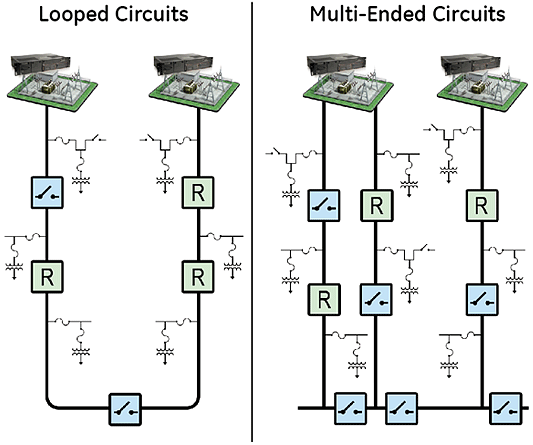
The D400-DA substation based FDIR solution can automate both Looped and Multi-Ended feeder network configurations. The D400-DA can typically restore power to unfaulted sections less than 1 minute after a fault occurs, fast enough to prevent the outage affecting SAIDI and SAIFI indices.
Scalable, Cost-Effective Solution
This D400-DA solution provides a scalable solution for automating from as few as two and as many as twenty circuits or feeders with a single D400-DA. With this scalability, utilities have a cost effective solution that can be incrementally rolled out feeder by feeder or just installed on circuits that are causing the most reliability problems. One D400-DA can automate these twenty circuits whether or not they are emanating from one substation or from multiple substations, as long as the D400-DA can communicate to the controllers in the field.
Feeder Sectors
Each D400-DA can monitor and automate up to twenty feeder sectors. Each sector is defined as a feeder that begins at a breaker and ends at a normally open tie point. The D400-DA that is monitoring a particular sector will be responsible for isolating that sector in the event a fault has occurred on it. This same D400-DA will also be responsible for controlling the tie switches to other sectors in the event that more load will be added to it to restore adjoining dead sectors.
Devices Controlled
Each D400-DA can communicate with and control up to 100 devices found within the sectors it is monitoring. Devices interfaced with it may include protection relays, recloser controllers, switch controllers and fault circuit indicators.
Modes of Operation
The D400-DA has two main modes of operation for isolating and reconfiguring distribution networks: Automatic Reconfiguration and Operator Assisted Reconfiguration.
Automatic Reconfiguration
– In Automatic Reconfiguration mode, the D400-DA will identify outages on its monitored sectors and take action to restore power to the maximum number of customers as possible. It performs the actions without any interaction required from system operators.
Operator Assisted Reconfiguration
– In Operator Assisted Reconfiguration mode, the D400-DA will require confirmation that system operators agree with the recommended action before these actions are carried out. This mode of operation is often used by utilities for an initial trial period of time to have their operators get comfortable with the D400-DA recommendation before going into full Automatic Reconfiguration mode.
Reconfiguration Triggers
While the D400-DA is monitoring its feeders, there are several sequences that will initiate a reconfiguration action:
- Protection Lockout: The operation of a protection function on a protection relay or recloser controller
- Loss of Voltage: The voltage on a sector has dropped below the programmed voltage threshold for an extended period of time defined by the utility
- Loss of Voltage After Fault: An intermediate loss of voltage after a downstream overcurrent detection
Network Topology Modeling and Sector Definition
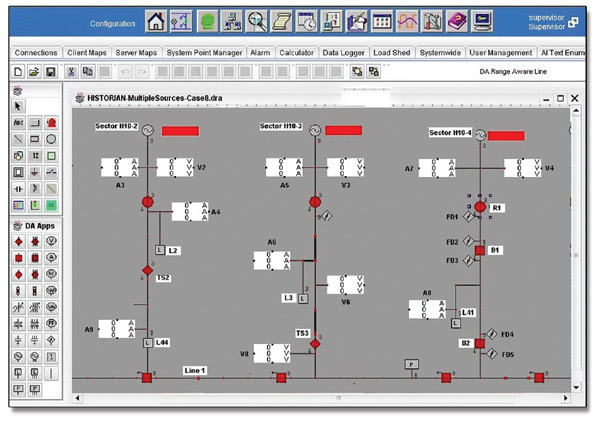
The D400-DA system configuration software is an easy-to-use online tool that allows for system modeling and FDIR sector configuration. When being used in Operator Assisted Mode, this tool can be the operator interface for acknowledging or rejecting reconfiguration scenarios proposed by the D400-DA FDIR system.
Isolation
When a reconfiguration action has been triggered, the first course of action the D400-DA will take is to isolate any faulted sections on the line. Isolation actions will attempt to minimize the number of customers falling within an isolated section. When the D400-DA is in Operator Assisted Mode, it will give a recommendation to the operators on the best course of action to take to isolate the fault. If the operator does not agree with the recommended action, the D400-DA will calculate the next optimal scenario and propose that to the operators.
Isolation on Sectors with Distributed Generation
When a fault occurs on a sector of the line, the D400-DA will open all of the available switches to completely isolate the fault. On radial feeders or laterals, if additional switches are located downstream of the fault, the D400-DA will also open those switches to prevent any other sources such as distributed generation that may back-feed the fault.
Restoration
Once the D400-DA has ensured any faults are isolated, it will attempt reconfigure the network to restore power to as many customers as possible. When operating in Operator Assisted Mode, the D400-DA will first ask for confirmation from the operator before taking any action. If the operator does not agree with the recommended action, the D400-DA will calculate the next optimal scenario and propose that to the operator.
Historical Load Modeling
To ensure that the source being used to re-energize a sector of the feeder can support the additional load, the D400-DA calculates the short term power requirements based on a 15 minute sliding peak demand window with 1 minute resolution. The D400-DA also identifies the long term load requirements using a 30 days sliding window with a 1 day resolution and a 15 minute averaging period.
Dead Line Verification
Before reconfiguring the network, the D400-DA will verify that the voltage on the dead sector has dropped below configurable thresholds to ensure that the line is still not energized due to any residual distributed generation sources.
Alternate Protection Groups
Before reenergizing a line, the D400-DA will alter the setting groups on any recloser or switch controllers on the line so that the protection functions will be coordinated for the new loads and direction of power flow.
E-mail Notification
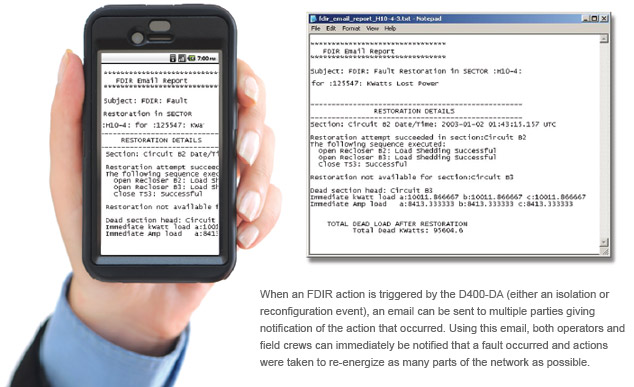

Advanced Gateway
The D400-DA collects data from substation protection, control, monitoring, RTU, and intelligent devices, pre-processes the data and moves it up to EMS and DMS SCADA systems providing centralized substation management.
Advanced Automation
The D400-DA provides the computing platform necessary to automate substation procedures, such that intricate processes are carried out safely and efficiently by creating custom automation programs using IEC 61131 compliant tools, and perform basic math functions on data points using the built-in Calculator tool.
Fault Recording/Data Logging
Using pass-through connections, users can extract valuable non-operational data such as digital fault recording (DFR) records and event files. The user can also access the historical log files and upload the archived data for trending and analysis.
Secure Remote Access
The D400-DA allows maintenance and relay engineers to securely access substation devices, locally or remotely, through advanced visualizations and communication tools, increasing productivity.
Hardware
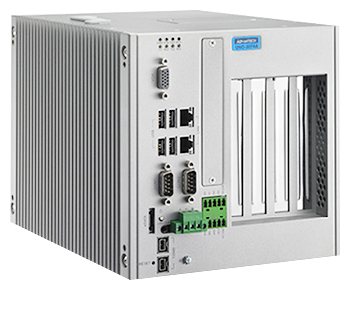
The D400-DA is built on a flexible, high performance, expandable disk-less and fan-less platform that is powered by a 1.0Ghz processor.
Two Ethernet networks are supported with separate multiport switches. An IRIG-B format time protocol input/distribution module is also supported. Isolated serial port media is selected for each pair of ports.

Redundant Power Supplies
The D400-DA has dual redundant, hot swappable power supplies, ensuring continuous uptime. Each power supply can be connected to a different source. As an example Power supply 1 can be connected to Mains, while power supply 2 is connected to the battery system. Power Supply Health Monitoring raises a SCADA point alarm when either power supply fails. This allows an alarm to be transmitted to the EMS /OMS or DMS system, where a field personnel can be dispatched to replace the failed supply, all without service disruption.
Time Sync Support
The D400-DA has extensive support for various time sync methodologies and will accept time sync signals from SNTP/NTP Servers, IRIG-B (un-modulated/modulated), and SCADA protocols. The D400-DA can also distribute this time sync information through its built-in IRIG-B distribution interface, SCADA protocols, and/or through the RS232 ports directly.
Recommended Products & services
Substation Systems
Electric utilities and independent power producers are under increasing pressure to...
View More

Integrated Substation Control System
Next generation substation control and automation Network operators/owners are seeing...
View More
DS Agile Substation Gateway
GE Vernova’s DS Agile Substation Gateway substation gateways perform the communication...
View More
Multilin D.20 RIO – Legacy
Distributed I/O Controller
Manufacturing for D.20 RIO has been discontinued. As an alternative, please refer to the G100 or G500.
Multilin D.20 RIO – Legacy
Distributed I/O Controller
Manufacturing for D.20 RIO has been discontinued. As an alternative, please refer to the G100 or G500.
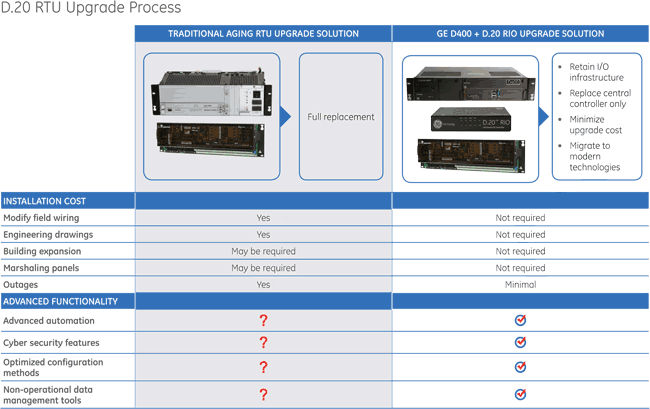
Cost Effective Upgrade Solution
Utilities have large investments in hard wired automation systems. As a piece of equipment ages it fails more frequently, takes longer to repair, and eventually reaches the end of its life. Re-design and forklift replacements require utilities to re-engineer substation designs, replace field wiring, and re-train staff to manage and maintain the system, which is a costly endeavor.
The D.20 RIO option with support for D.20 communications provides a cost effective alternative to upgrades of legacy D20 RTUs. Simply replace the failed or end of life D20 unit with a D400 Gateway and D.20 RIO module, plug the D.20 interface cable into the D.20 RIO, connect the D.20 RIO to the D400 or an Ethernet port in the substation LAN and you are ready to add modern functionality to the D400 series of Substation Gateways including:
- Cyber security features for integration into NERC CIP environments
- Secure real time browser access
- Browser-based HMI interface
- Secure remote engineering access
- IEC 61850 capabilities
- Automatic record retrieval (fault records, SOE, settings files, any other file available in the IED)
I/O Where You Need It, Minimizing Wiring Cost
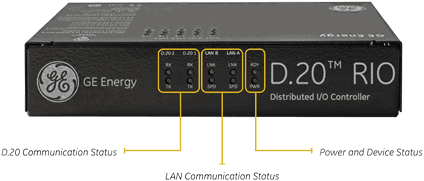
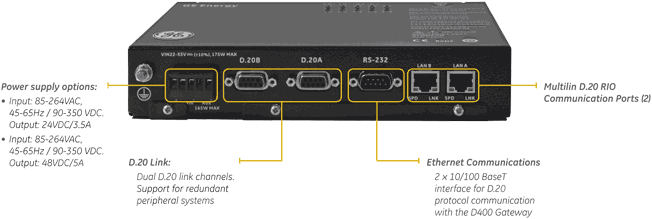
The D.20 RIO Distributed I/O Controller is a small form factor stand-alone device that supports two D.20 link channels for communication with the D20 series of input / output modules.
- Interface with standard D20 I/O (status, analog input, control and combination input) peripheral modules
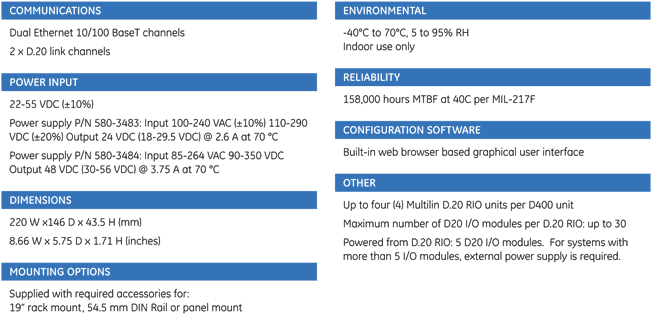
- Support for up to 30 I/O modules in a single D.20 RIO, or distributed over up to four D.20 RIO devices within the substation
- Small form factor with multiple mounting options for installation flexibility: 19" Rack, panel mount or DIN Rail
Use the D.20 RIO module to install input / output modules in the substation LAN. No substation LAN? No problem, connect the optional D.20 RIO device directly to the built-in D400 Ethernet switch.

User Interface
Front Panel
Back Panel
Technical Specifications
Recommended Products & services

Gateways and RTUs
GE Vernova offers an industry-leading suite of multifunction servers, gateways, RTUs, and...
View More
Multilin D20MX Substation Controller Legacy
Simple to Advanced Substation Automation Control
Manufacturing for the D20MX portfolio has been discontinued. Please contact GE Vernova for availability.
Multilin D20MX Substation Controller Legacy
Simple to Advanced Substation Automation Control
Manufacturing for the D20MX portfolio has been discontinued. Please contact GE Vernova for availability.
Advanced Controller
The Multilin D20MX Substation Controller collects, filters, and sorts data from a wide range of intelligent devices (RTUs, relays, meters) in the substation. The D20MX preserves original data time stamps for accurate sequence of event (SOE) logs, allowing data from large diverse geographic regions and time zones to be analyzed in extreme detail. Data can be presented simultaneously to multiple SCADA hosts. The D20MX comes with a built-in suite of protocols and security applications to facilitate integration with various substation devices and SCADA hosts.
D20MX is the sixth generation of D20 CPUs designed to provide a smooth migration path for D20 users to extend the life of aging D20 systems. It introduces a new and modern network security feature suite that enables effective compliance with NERC-CIP requirements, using open and trusted standards and protocols that allow integration with modern cyber security systems and tools.
Advanced Substation Controller Connectivity
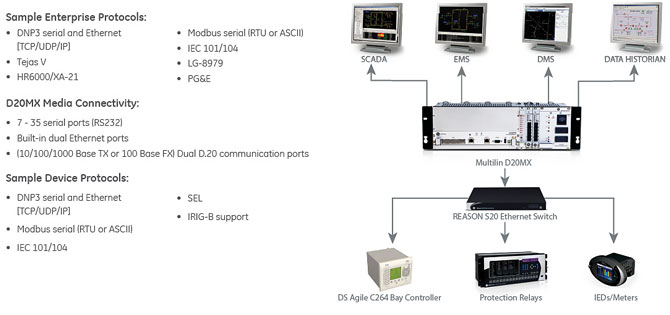
D20MX Upgrade Process
The Multilin D20MX provides a cost-effective alternative to upgrades of legacy D20/D200 RTUs. This means that the investments made in GE Vernova’s automation systems keep paying dividends beyond their originally projected end of life. Simply replace the Multilin D20/D200 processor module with a Multilin D20MX and migrate the device configuration to extend the life of the existing D20/D200 Controller. Add cyber security features for integration into NERC-CIP environments. As technology changes with market demands, GE Vernova continues to invest in a partnership with their customers through advanced modular design principals
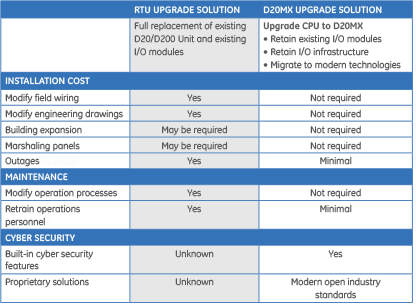
Integration into NERC-CIP Environments
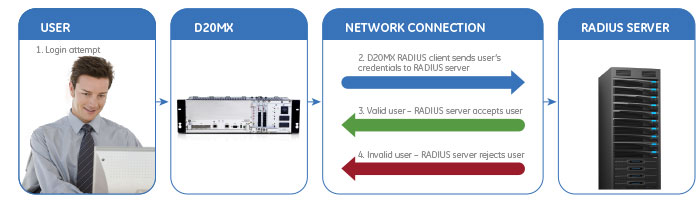
The Multilin D20MX supports a comprehensive set of security functions to allow a seamless integration with existing IT department policies. Built-in cyber security features, such as Remote Authentication Dial-In User Service (RADIUS), Role Based Access Control (RBAC), and user activity logging, provide a complete security toolkit required to enable simpler and more efficient compliance with NERC-CIP requirements, using open and trusted standards and protocols, that allow integration with modern cyber security systems and tools.
Centralized Authentication and Authorization
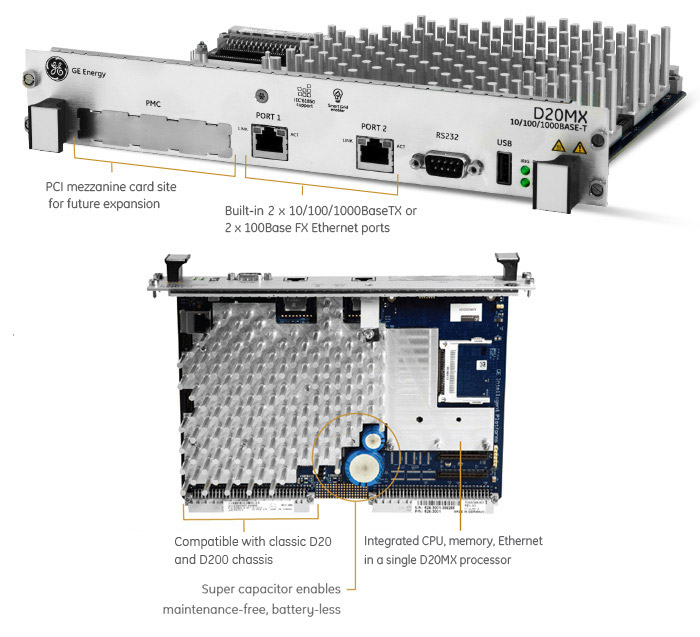
Hardware Overview
Backwards Compatibility with Earlier Vintages of Multilin D20 RTUs
The Multilin D20MX is an embedded single board computer powered by a 667 MHz PowerQUICC II Pro processor pin-for-pin compatible unit with existing D20 Processors and accessories, such as chassis, D20 remote I/O peripherals, modems.
Fully Equipped Out-of-the-Box
Previous generations of D20/D200 RTUs required add-on system components and software to support Ethernet communications and optional memory expansion. The new D20MX is equipped by default with integrated memory, 10/100/1000BASE-TX or 100BASE-FX IEEE 802.3 compliant communications and a core load firmware with a comprehensive set of key substation automation applications.
D20 I/O options
A complete family of substation hardened I/O modules makes the D20MX controller scalable to both large and small substations. A distributed architecture with both ring and star topologies allows for easy expandability and remote placement of I/O modules. The following I/O modules are available in a variety of models with I/O ranges up to 300VDC.
| D20S - 64 channel status input module | Buy Now |
| D20A - 32 channel DC Analog input module | Buy Now |
| D20K - 32 channel control output module | Buy Now |
| D20KI - 8 external interposer relay pairs module | Buy Now |
| D20C - 16 status input, 8 control output, optional 16 DC analog inputs or 8 analog inputs and 8 analog outputs | Buy Now |
I/O with DNP Communication
The DNP I/O modules are data collection and control devices that combine the DNP 3.0 communications protocol with our existing industry proven and robust line of I/O modules. The DNP I/O modules implement the industry standard DNP 3.0 (Level 2) slave protocol over a single RS485 interface to provide expandable I/O functionality for the D400, D25 and iBox product lines, as well as third-party products.
The following DNP I/O modules are available:
Recommended Products & services
Gateways and RTUs
GE Vernova offers an industry-leading suite of multifunction servers, gateways, RTUs, and...
View More
CHC Instantaneous Overcurrent - Legacy
Manufacturing for CHC has been discontinued. As an alternative, please refer to P153, P14N or
CHC Instantaneous Overcurrent - Legacy
Manufacturing for CHC has been discontinued. As an alternative, please refer to P153, P14N or
Recommended Products & services
CFVB Voltage-balance Relay - Legacy
Manufacturing for CFVB has been discontinued.
CFVB Voltage-balance Relay - Legacy
Manufacturing for CFVB has been discontinued.
Recommended Products & services
CFD High Speed Differential Relay - Legacy
Manufacturing for CFD has been discontinued.
CFD High Speed Differential Relay - Legacy
Manufacturing for CFD has been discontinued.
Recommended Products & services
CEYG – Legacy
Reactance and Mho Phase Directional – Distance Relay
Manufacturing for CEYG has been discontinued . As an alternative, please refer to D60 or P443.
CEYG – Legacy
Reactance and Mho Phase Directional – Distance Relay
Manufacturing for CEYG has been discontinued . As an alternative, please refer to D60 or P443.
Recommended Products & services
CEY Reactance and Mho Phase Directional-distance - Legacy
Manufacturing for this product has been discontinued. As an alternative, please refer to the 3 Series relays.
CEY Reactance and Mho Phase Directional-distance - Legacy
Manufacturing for this product has been discontinued. As an alternative, please refer to the 3 Series relays.
Recommended Products & services
CEX Angle Impedance Relay - Legacy
Manufacturing for this product has been discontinued. As an alternative, please refer to the 3 Series relays.
CEX Angle Impedance Relay - Legacy
Manufacturing for this product has been discontinued. As an alternative, please refer to the 3 Series relays.