
CEH Loss of Excitation Relay - Legacy
Manufacturing for CEH has been discontinued.
CEH Loss of Excitation Relay - Legacy
Manufacturing for CEH has been discontinued.
Recommended Products & services
CEB Offset Mho Directional-distance - Legacy
Manufacturing for this product has been discontinued. As an alternative, please refer to the 3 Series relays.
CEB Offset Mho Directional-distance - Legacy
Manufacturing for this product has been discontinued. As an alternative, please refer to the 3 Series relays.
Recommended Products & services
C90Plus - Legacy
Manufacturing for C90Plus Bay Controller has been discontinued. As an alternative, please refer to the C60 with Firmware 7.7 or newer and User Interface Option E: 7” Graphical Front Panel Display.
C90Plus - Legacy
Manufacturing for C90Plus Bay Controller has been discontinued. As an alternative, please refer to the C60 with Firmware 7.7 or newer and User Interface Option E: 7” Graphical Front Panel Display.
Key Features
- Dedicated automation controller with 4000 lines of logic
- Powerful math, control and Boolean operators
- Multiple stages for under/over and rate of frequency protection for load shedding
- Dedicated protection logic at 1 msec execution rate
- Dedicated HMI for breaker and disconnect control
- Multi-breaker synchrocheck with single/three-pole autoreclosing
- Dual-breaker failure protection
- Direct and teleprotection elements using the inter-relay communication card
- CT and VT monitoring
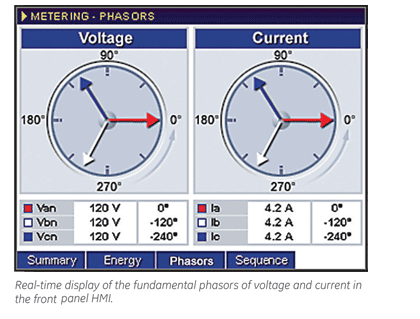
- Metering – current, voltage, frequency, power, energy and phasors
- Fault recorder – 256 samples/cycle, 30 sec of storage capacity
- Disturbance recorder – 1 sample/cycle, 5 min of storage capacity
- Event recorder – 8000 time tagged event, with 0.5 ms scan of digital inputs
- Comprehensive display of metering, phasors, maintenance and fault information in the front panel
Advanced Bay Control
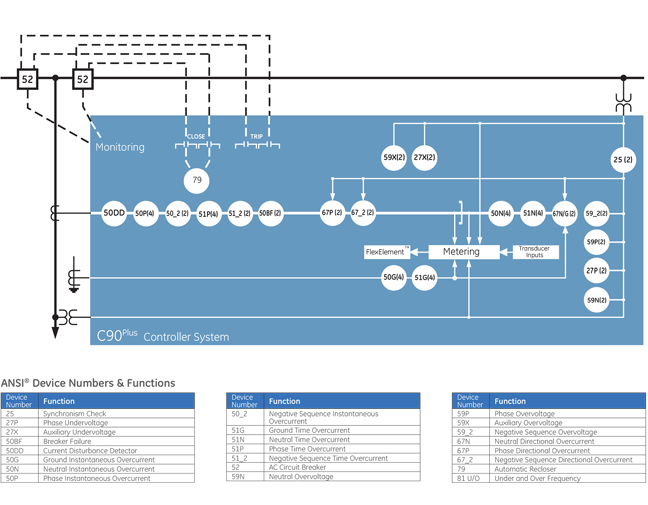
The C90Plus bay control or monitoring functionality is intended for high-end bay control applications typically used in transmission installations, where a larger quantity of I/O, advanced protection and control functionality and an advanced HMI is desired.
- Advanced bay control and interlocking
- Breaker monitoring and control
- Automatic Bus Transfer schemes
- Load shedding and load restoration schemes
Fast Load Shed Benefits
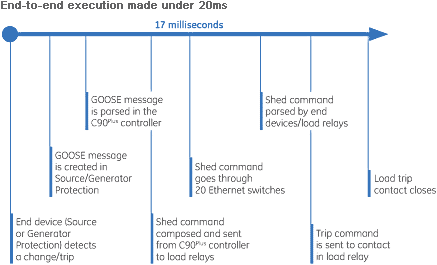
- Fast optimal load shedding executed within 20ms
- Intelligently sheds loads to maintain system/process integrity
- Highly customizable and scalable, integrating easily into most industrial plants with new or existing EMS/SCADA
- Optional stand-alone system with local HMI for viewing dedicated system status and reports
- Suitable for small or large industrial systems without re-design
Easy to use system where settings and priorities can be configured within seconds
Fast Load Shed
Conventional frequency and voltage load shedding schemes operate typically between 250ms to seconds. Contingency-based load shedding schemes are typically faster at 160 – 400 ms, depending on both system architecture and communications employed. Both these scheme types are too slow for industrial cogeneration applications such as oil and gas or manufacturing, where very fast load shedding is required for power system and critical process integrity.
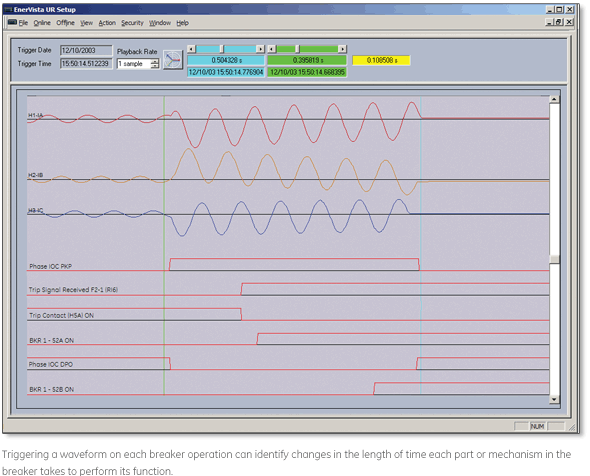
 Digital fault recorder summary with the latest information on the events, faults, transients and disturbances.
Recording capability
There are three recorders available within the C90Plus that eliminate the need for other stand-alone recording equipment. The transient recorder allows for a high sampling rate usually to capture power system faults and system transients. The disturbance recorder is used to capture longer records in order to understand issues such as voltage sags or swells. Lastly, the C90Plus is equipped with a powerful and accurate Sequence of Event (SOE) recorder. Information for all three recorders can be accessed either through the front panel HMI or through EnerVista™ Launchpad Software.
Deterministic automation
- Dedicated automation controller with 4000 lines of logic at a deterministic 50 msec execution rate
- Powerful math, control and Boolean operators to support the automation logic engine
- 10 stages of under/over frequency protection for load shedding
- 4 stages of rate of change of frequency for load shedding
- 6 stages of under-voltage elements for load shedding
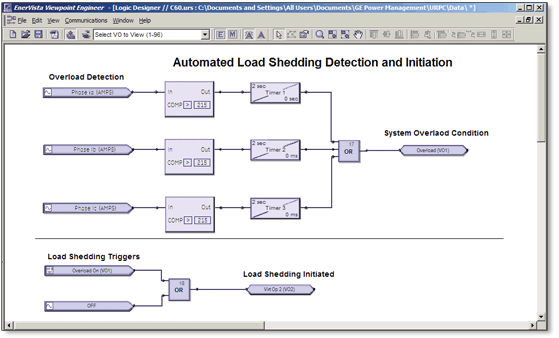 The C90Plus supports an advanced automation logic engine that supports Boolean operators, analog comparisons, and advanced mathematical operations.
Key Features
- HMI can show fault reports to local operators, enabling quick access to time sensitive information
- Customizable annunciator panel, capable of handling up to 288 alarms using a pallet of 16 colors
- Front panel display of results from the self-tests performed, allowing easy maintenance and viewing of critical indications
- Access product information, such as IP addresses and serial numbers, without the need to connect to the unit
- Increase network availability by reducing failover time to zero through IEC62439-3 “PRP” support
- IP addresses and serial numbers of each module are also accessible without the need to connect to the unit
- Full color customizable local HMI allowing easy and secure control
- HMI-equipped with pre-built screens or configurable to display any single diagram
- Reliable communication card with automatic failover and extremely fast redundant schemes
- Inter-relay communication card enables implementation of pilot schemes based on standard communication protocols
- Both “Direct” and “Teleprotection” I/O elements
Advanced communications
The C90Plus provides for secure remote data and engineering access, making it easy and flexible to use and integrate into new and existing infrastructures. Fiber optic Ethernet provides high-bandwidth communications allowing for low-latency controls and high-speed file transfers of relay fault and event record information. The availability of three independently configurable Ethernet options provide the means to create fault tolerant communication architectures in an easy, cost-effective manner. The C90Plus supports the most popular industry standard protocols enabling easy, direct integration into SCADA systems.
- IEC 61850
- DNP 3.0
- Ethernet Global Data (EGD)
- IEC 60870-5-104
- Modbus RTU, Modbus TCP/IP
- PRP as per IEC 62439-3
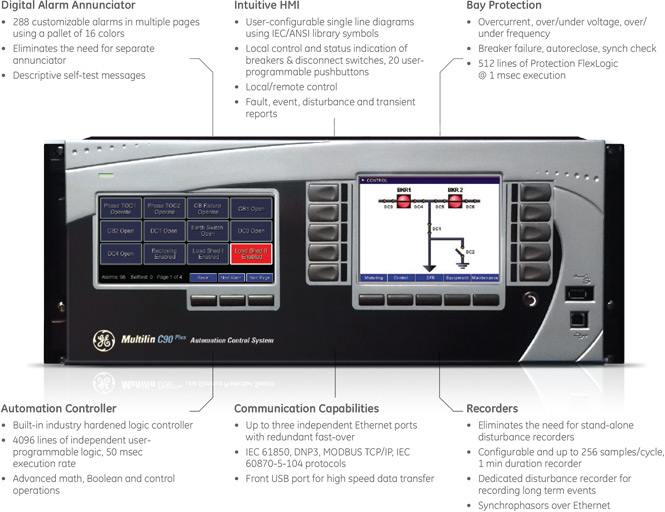
Key Features
HMI Display
- Display fault reports and self-test results, enabling quick access to time sensitive information
- Customizable annunciator panel, capable of handling up to 288 alarms using a pallet of 16 colors
- Access product information, such as IP addresses and serial numbers, without the need to connect to the unit
- HMI equipped with pre-built screens or could be configured to display any single diagram
Security
- Dual permission access, requiring live permission from both the user and from SCADA operators
- Remote and local setting and control passwords
- Configurable lockouts to unsuccessful password access attempts
- Successful password access logged in Events Record
- Logging of user commands in the security audit trail report creates a record and sequence of events log for troubleshooting and security auditing
Enervista software
The EnerVista™ suite is an industry-leading set of software programs that simplifies every aspect of using the C90Plus relay. The EnerVista™suite provides all the tools to monitor the status of the protected asset, maintain the relay, and integrate information measured by the C90Plus into DCS or SCADA monitoring systems. Convenient COMTRADE and Sequence of Events viewers are an integral part of the UR setup software included with every UR relay, to carry out postmortem event analysis and ensure proper protection system operation. Learn More
Security - enabling NERC CIP compliance
Access Control
Multilin devices and relays are designed with simple but powerful security to enable reliability and compliance for virtually any project or implementation. With support for multi-level permissions and multi-factor supervisory controls, Multilin devices can help you manage the integrity of your system during commissioning, testing, implementation, and beyond. The UR and URPlus families provide separate authentication for settings and commands to the system. In addition, as discrete authentications for local and remote access they also provide supervisory control factor that can lock or unlock a device for configuration changes and other modifications.
Intrusion Detection
Multilin’s family of protection and control products can also help enable your security perimeter and intrusion detection programs. By providing essential alarming and logging of critical events, Multilin devices can help you detect potential breaches within your system and allow you to respond quickly and effectively. Specifically, unsuccessful access attempts are logged, alarmed, and lead to potential attackers being locked out. This ensures the reliability of your system during questionable activity, and a control factor that can lock or unlock a device for configuration changes and other modifications.
Auditing and Reporting
With the security audit trail reporting feature and support for event logging of key activities such as configuration changes, Multilin devices can help ensure device and protection system integrity, and perform forensic auditing of activities and changes for compliance.

Fast Load Shed
The C90Plus Automation Control System with fast load shed is a powerful automation control system that eliminates the need for several separate devices. Performing intelligent high-end and fast optimal load shedding, the C90Plus is highly customizable and scalable.

Communications & HMI
- Enhanced HMI and annunciator panels on the front of the C90Plus make it one of the most powerful human machine interfaces on local units
- Three new Inter-Relay Communication (IRC) cards enable the URPlus devices to support pilot-schemes based on standard communication protocols, and both “Direct” and “Teleprotection” inputs and output elements are available. The IRC cards can work on either schemes that demand direct URPlus-to-URPlus connection or schemes that have specialized communication devices between the line terminals (multiplexers, microwave, etc).
- PRP as per IEC 62439-3

Protection
New small signal oscillation detection protection element. With increasingly large interconnected power systems, one of the technical challenges is the inter-area low frequency oscillations. Inter-area oscillations not only limit the amount of power transfer, but also threaten system security and equilibrium, as they may lead to system instability and cascading outages. Therefore, it is essential to identify the characteristics of the inter-area oscillations, including oscillation frequency and damping ratio, so that proper actions can be taken based on the results. This is required to improve system damping and maintain stability in the power system. The C90Plus can detect these inter-area oscillations and provide an alarm or even trip signal to prevent a large-scale system disturbance.

Security Enhancements - Enabling NERC CIP compliance:
Support for alphanumeric passwords as per the CIP-007-02 cyber security standard.
Recommended Products & services

Line Protection
GE Vernova's transmission protection solutions deliver the speed and security necessary...
View More
BUS1000/2000 Bus Bar Protection - Legacy
Manufacturing for BUS1000/2000 has been discontinued.
BUS1000/2000 Bus Bar Protection - Legacy
Manufacturing for BUS1000/2000 has been discontinued.
Recommended Products & services

Bus Protection
GE Vernova provides enhanced reliability through advanced protection for a wide range of...
View More
BDD Percentage Differential with Harmonic Restraint - Legacy
Manufacturing for this product has been discontinued. For more information, contact us.
The Type BDD relays are for the protection of transformers rated 2000 kVA and above and for transformers with windings rated 15 kV or above. However, the importance of the transformer to the system, not its size alone, should be the basis for the decision on this quality of protection.
BDD Percentage Differential with Harmonic Restraint - Legacy
Manufacturing for this product has been discontinued. For more information, contact us.
The Type BDD relays are for the protection of transformers rated 2000 kVA and above and for transformers with windings rated 15 kV or above. However, the importance of the transformer to the system, not its size alone, should be the basis for the decision on this quality of protection.
Recommended Products & services
B95Plus – Legacy
Manufacturing for this product has been discontinued.
B95Plus – Legacy
Manufacturing for this product has been discontinued.
Field Wiring
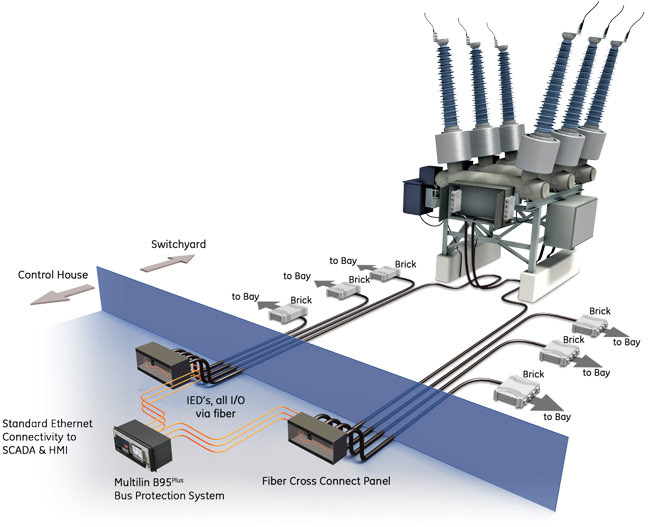
We Solve the Field Wiring Challenge with the B95Plus Bus Protection System
The Multilin B95Plus Bus Protection System changes the focus of bus protection to that of application by replacing most of the field wiring with distributed I/O and fiber optic cables. The bus protection system consists of a distributed process interface (data acquisition and tripping) architecture using HardFiber Bricks as bay units, with centralized processing performed by the B95Plus protection relay. All copper field wiring is between primary equipment in the switchyard and Bricks, which ideally should be located at the primary equipment in the switchyard. Fiber optic cables connect Bricks to the B95Plus. For all applications, the installation is then identical: the physical interface consists of Bricks connected to a fiber optic cable. A single B95Plus is mounted in a relay cabinet, with the process cards in the unit patched to the fiber optic cables coming from the Bricks.
HardFiber Brick System
The HardFiber Brick System can easily be incrementally scaled to include new equipment as stations evolve. Duplicated Bricks in the switchyard provide a drastic improvement in reliability and security over today’s technology.
Hardware
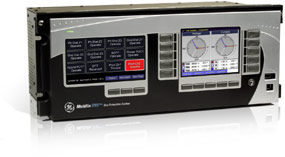
Multilin B95Plus Bus Protection Relay
The B95Plus bus protection relay unit is the heart of the system. This unit performs all processing functionality, including protection functions, metering, monitoring, FlexLogic and SCADA communications.
- Simplifies use through a Graphical User Interface (GUI) that includes configurable single line diagrams for bus sources, local control and status indication of breakers and disconnects, 20 programmable pushbuttons, and a configurable digital alarm annunciator
- Connects up to 8 Bricks for each process card while, supporting up to 12 bus sources per card
- Supports 2 process cards per unit, for a total of 16 Bricks and 24 bus sources
- Provides identical connections and installation for all bus configurations
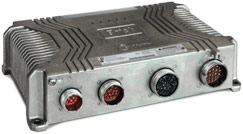
HardFiber Brick as Bay Unit
- Measurement and control for primary apparatus, including AC measurements (4 currents and 4 voltages, or 8 currents) and contact I/O (18 digital inputs and 7 digital outputs including a latching relay)
- Simple device with no field configuration or configuration settings
- Environmentally hardened for outdoor mounting in switchyards
- Connectorized cables for simple, tools-free field installation and removal
- IEC 61850 message formats for communications, including sampled value messaging for currents and voltages
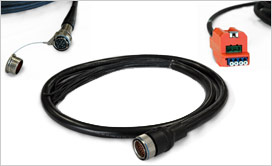
Cables
The HardFiber Brick uses connectorized cables to interface with primary equipment and with system measurements, and to interface to the B95Plus itself. The cables at the Brick end uses an IP67 certified industry standard connector designed for rugged environments. These connectors screw onto the Brick for a simple, tools-free connection. Three of the cables are copper cables used to acquire AC measurements, acquire equipment status, and provide equipment control. The fourth cable provides the fiber interface to the B95Plus central unit as well as DC power to the Brick. These cables therefore can become standard parts, manufactured in advance of installation by any cable manufacturer. These cables are also directly available from GE Vernova.
Protection
The B95Plus bus protection relay system provides robust and reliable protection for all bus protection applications. Highlights of the protection functions related to bus protection include:
- Multi-zone differential protection with both restrained (dual-slope percent or biased) and unrestrained (unbiased or instantaneous) functions incorporated.
- Differential protection is fast (typical response time: 1 power system cycle) and secure. Security is achieved by using a fast and reliable CT saturation detection algorithm and a phase comparison operating principle. Security is further enhanced by support for redundant process interface units (Bricks). Supports both three-phase tripping and individual phase tripping.
- Dynamic bus replica functionality and multi-zone protection (up to 6 zones) is supported allowing application of the B95Plus to multi-section reconfigurable buses. A zone expansion/contraction to an open breaker feature is included. Isolator position monitoring for up to 48 isolators.
- Check-zone functionality configured by programming one of the differential zones to enclose the entire bus.
- Additional bus protection functions including end fault protection, breaker fail and overcurrent protection for each bus source, CT trouble monitoring for each bus zone.
Multilin B95Plus Functional Block Diagram
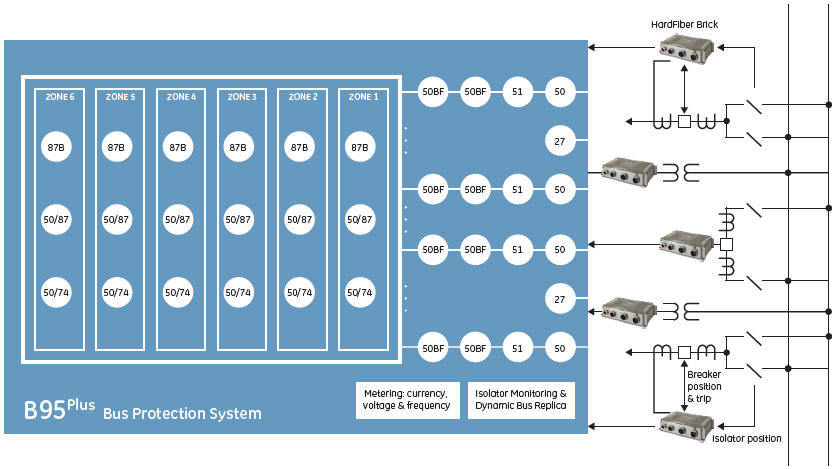
ANSI Divice Numbers & Functions
| Device Number | Function |
|---|---|
| 87B | Percent bus differential |
| 27 | Undervoltage |
| 50 | Instantaneous overcurrent |
| 50/74 | CT Trouble |
| Device Number | Function |
|---|---|
| 50/87 | Unrestrained Bus Differential |
| 51EF | End fault protection |
| 51 | Time overcurrent |
| 50BF | Breaker failure |
Applications
- Reconfigurable multi-section bus bar with up to 24 feeders
- Retrofit and greenfield installations for power generation, transmission and distribution systems
- Reconfigurable bus bars for single bus, breaker-and-a-half and double bus with and without bus couplers
- Air-insulated and GIS stations
Standardize on the B95Plus for Any Bus Configuration
The B95Plus can be applied on a multitude of bus configurations due to the distributed architecture, and includes support for up to 6 zones of bus differential protection and support for up to 24 bus sources. The physical connection and wiring architecture for the B95Plus system will be identical for any bus configuration: Bricks installed to acquire measurements and equipment status, with the B95Plus unit connected to Bricks via fiber optic cables. The relay panel design will be identical for all applications, for all bus configurations. The only difference from application to application is the number and location of Bricks, and the programming of the B95Plus unit.
Some typical bus configurations that can be protected by the B95Plus:
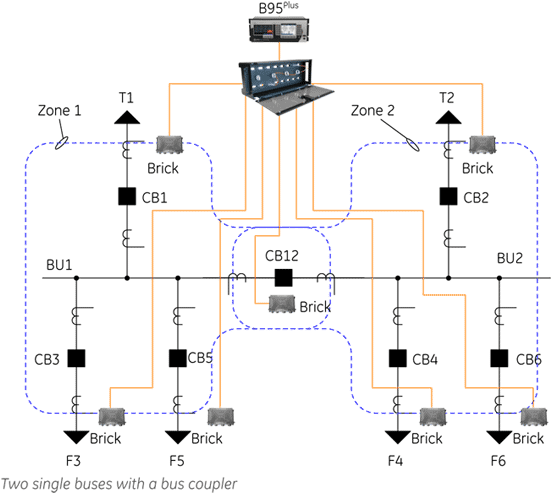 Two single buses with a bus coupler
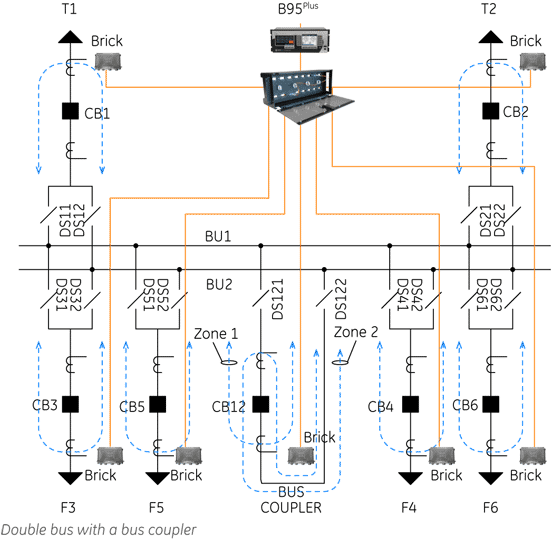 Double bus with a bus coupler
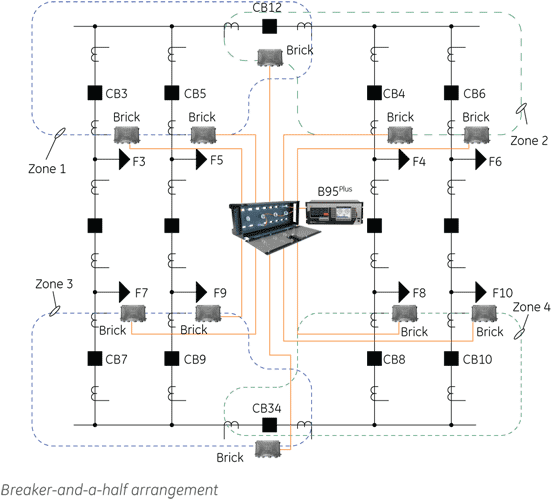 Breaker-and-a-half arrangement
Process Bus
Quickly Expand Protection through Process Bus
The B95Plus Bus Protection System is intended to operate as a standalone, distributed bus protection system. The bay units for this system are Bricks, part of the HardFiber IEC 61850 process bus solution. Once the Bricks for the B95Plus are installed process bus data is available for use for any other zone of protection. The Bricks, then, are a distributed I/O interface for all protection functions and zones, not just the B95Plus. With the B95Plus in place, installing line protection or feeder protection is a simple process: mount the relays in a panel, and patch to the fiber optic cable from the appropriate Bricks. The only requirement is the relays must implement the appropriate IEC 61850 datasets to interface successfully with the Bricks. All members of the Universal Relay family have the ability to interface with Bricks.
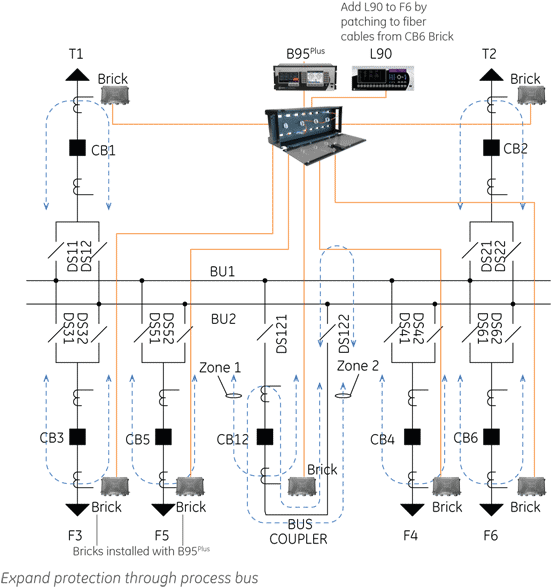 Expand protection through process bus
Specifications
| BUS DIFFERENTIAL PROTECTION | |
|---|---|
| Number of differential zones | Six 3-phase zones |
| Max number of currents: | Total dynamic number of bus source to zone connections closed at any one moment in time up to 120 |
| CT ratio compensation range | 32:1 |
| Operating time | < 1 power system cycle - typical bus fault |
| BUS REPLICA | |
|---|---|
| Features | Dynamic bus source current assignment to each zone, dynamic zone trip assignment to each bus source, dynamic blocking of zones on CT bypassed, 1 user programmable auxiliary zone trip inputs, 3 user programmable bus source trip inputs, dynamic zone expansion/reduction |
| BUS SOURCES | |
|---|---|
| Number of bus sources | 12 per process card included in the order code |
| Current inputs | 3-phase currents |
| CT rated primary | 1 to 65000 A |
| CT rated secondary | 1 A or 5 A |
| Nominal frequency | 50 or 60 Hz |
| CT Trouble Monitoring | 1 element per bus source |
| Breaker failure protection | 1 element per bus source |
| Instantaneous Phase Overcurrent | 1 element per bus source |
| Inverse Time Phase Overcurrent | 1 element per bus source |
| VOLTAGE SOURCES | |
|---|---|
| Number of voltage sources | 2 per process card included in the order code |
| Voltage inputs | 3-phase voltages, wye or delta |
| VT ratio | 1.00 V to 24000.00 /td> |
| VT rated secondary | 25.0 V to 240.0 V |
| Nominal frequency | 50 or 60 Hz |
| ISOLATORS | |
|---|---|
| Number of isolators | 48 per process card included in the order code |
| Isolator status inputs | Form “a” and form “b” contact inputs, each optionally dual redundant |
| Configurable failsafe modes | 2Open, closed, last valid state |
| Monitoring | Alarm on inconsistent inputs persisting longer than a user set time |
| TRANSIENT RECORDER | |
|---|---|
| Storage capacity | Five records with all channels recorded, at 128 samples per cycle, spanning 1 second with no retriggers |
| Number of records | 1, 2, 5, 10, 20, 30, 40, or 50 records |
| Sampling rate | 16, 32, 64 or 128 samples per power cycle |
| AC waveform channels | All enabled bus sources and voltages sources |
| Analog channels | Magnitudes and angles of all ac waveforms recorded plus all enabled zone differential and zone restraint phase current magnitudes and angles |
| Digital channels | 128 user configurable channels on the main card and 128 user configurable channels on each process card |
| Configurable digital data | Any FlexLogic™ operand |
| Storage modes | Automatic overwrite, protected |
| Triggering modes | Time window from rising edge of trigger, continuous recording up to 4 additional basic record lengths as long as retrigger is active |
| Pre-trigger window | 0 to 100% of the basic record length |
| Data storage | non-volatile memory |
| EVENT RECORDER | |
|---|---|
| Storage capacity | 8,192 events plus 8,192 events on each process card |
| Time tag: | to 1 µs |
| Triggers | all FlexLogic™ operand activations |
| PROCESS I/O | |
|---|---|
| Number of process bus ports | 8 per process card |
| Port type | 100Base-BX-D, in SFP package with LC 50/125µm multi-mode connector |
| Transceiver diagnostics | per SFF-8472 |
| Brick synch frame jitter | ±1µs |
| POWER SUPPLY | |
|---|---|
| Nominal DC voltage | 125 to 250 V |
| Minimum DC voltage | 80 V |
| 1Maximum DC voltage | 300 V |
| Nominal AC voltage | 100 to 240 V at 50/60 Hz |
| Minimum AC voltage | 80 V at 48 to 62 Hz |
| Maximum AC voltage | 275 V at 48 to 62 Hz |
| Voltage withstand | 2 × highest nominal voltage for 10 ms |
| Voltage loss ride-through | 200 ms duration at nominal input voltage |
| Power consumption | 150 VA maximum |
| PROCESS CARD OPTICAL | |
|---|---|
| Number of transceivers | 8 |
| Transceiver type: | Transmit 1550 nm, receive 1310 nm, 100Mb/s, bi-directional single-fiber 50/125µm multi-mode module (levels comply with IEEE 802.3 standard 100Base-BX-D) |
| Optical transmit power | –14 to –8 dBm |
| Maximum optical input power | –8dBm |
| Optical receiver sensitivity | –30dBm |
| Termination | LC fiber connector |
| Laser class | Class 1. This product is eye-safe under all operating conditions. |
| REMOTE RESOURCE SPECIFICATIONS | |
|---|---|
| Number of field units | 8 per process card |
| Number of field contact inputs | 1 for each brick contact input |
| Number of field contact outputs | 1 for each brick contact output |
| Number of field latching outputs | 1 for each brick latching output |
| Number of shared inputs | 16 per process card |
| Number of shared outputs | 16 per process card |
| APPROVALS AND CERTIFICATION | |
|---|---|
| Compliance | CE, UL, ISO |
| Compliance | Applicable Council | Directive According To |
|---|---|---|
| CE | Low voltage directive | EN 60255-27 (normative sections) |
| EMC directive | EN 60255-26 / EN 50263 EN 61000-6-5 (Area G) | |
| UL | cULus | UL 508 UL 1053 C22.2 No 14 |
| ISO | Quality management system | ISO 9001 |
Recommended Products & services
Bus Protection
GE Vernova provides enhanced reliability through advanced protection for a wide range of...
View More
Legacy MU Agile AMU
Analogue Merging Unit
Manufacturing for this product was discontinued as of December 31, 2014. As an alternative, please consider MU320E.
Digitise the output of conventional instrument transformers in the substation with this compact, accurate and withdrawable device. The AMU complements the MiCOM Px40 range of relays with an IEC 61850-9-2LE interface for building digital bays or full digital substations.
Legacy MU Agile AMU
Analogue Merging Unit
Manufacturing for this product was discontinued as of December 31, 2014. As an alternative, please consider MU320E.
Digitise the output of conventional instrument transformers in the substation with this compact, accurate and withdrawable device. The AMU complements the MiCOM Px40 range of relays with an IEC 61850-9-2LE interface for building digital bays or full digital substations.
Recommended Products & services
Merging Units
Merging units are a key element of the process bus concept, enabling the digitization of...
View More
ALPS Advanced Line Protection System - Legacy
Recommended Products & services
Line Protection
GE Vernova's transmission protection solutions deliver the speed and security necessary...
View More
Multilin A60 - Legacy
Manufacturing for this product has been discontinued. As an alternative, please refer to the 350 or 8 Series relays.
Multilin A60 - Legacy
Manufacturing for this product has been discontinued. As an alternative, please refer to the 350 or 8 Series relays.
- Independent device provides continuous, always on, operation to maximize equipment protection
- Continuous health monitoring of optical sensors, fiber cables, and control unit to ensure reliable operation
- Direct connection to breaker trip circuit using solid state output relays, for increased operating speed
- Reliable and deterministic multi-stage (light and pressure) detection with optional supervisory input reduces nuisance tripping
- Simplified installation and configuration with sensor auto-calibration and no requirement for additional setup software
- Scalable arc flash system, allowing for multiple unit connectivity for large installations
- No requirement to install additional CT's reducing time and costs associated with installation and commissioning
- Suitable for both new and retrofit applications
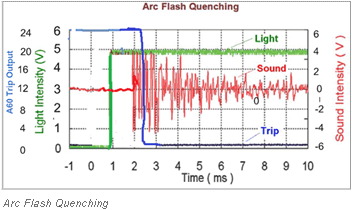
An arc flash event is the sudden release of electrical energy through the air. The resulting forces can produce temperatures up to 35,000°F, in less than one thousandths of a second, causing copper to turn into plasma expanding by 67,000 times. With these type of extreme events, fast, reliable arc flash detection is critical to avoid significant damage to equipment and reduce the repair and replacement costs, as well as downtime of the power system. The Multilin A60 Arc Flash System utilizes a unique sensing method that detects both light and pressurized sound signals that occur during an arc flash event, enabling more reliable and faster operating times to reduce the total arc energy generated. Utilizing a patented arc flash sensing method, the Multilin A60 is able to reliably detect an arc flash event in as fast as 1 msec.
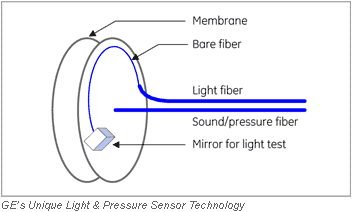
Light and pressure wave arc flash detection
Based on a known time relationship between the speed of light and sound (pressure wave), GE Vernova's patented sensor is able to detect and issue a trigger signal to clear the fault in under 2 milliseconds – significantly reducing incident energy from an arc flash event. Specifically, the sensor head detects these two key factors (light and pressure wave) using LEDs, bare fiber and a membrane.
During an arc flash event, the diaphragm vibrates due to the pressurized sound wave creating a signature which is recognized by the Multilin A60. It is this unique combination of light and pressure wave detection that ensures reliable and fast detection of an arc flash event.
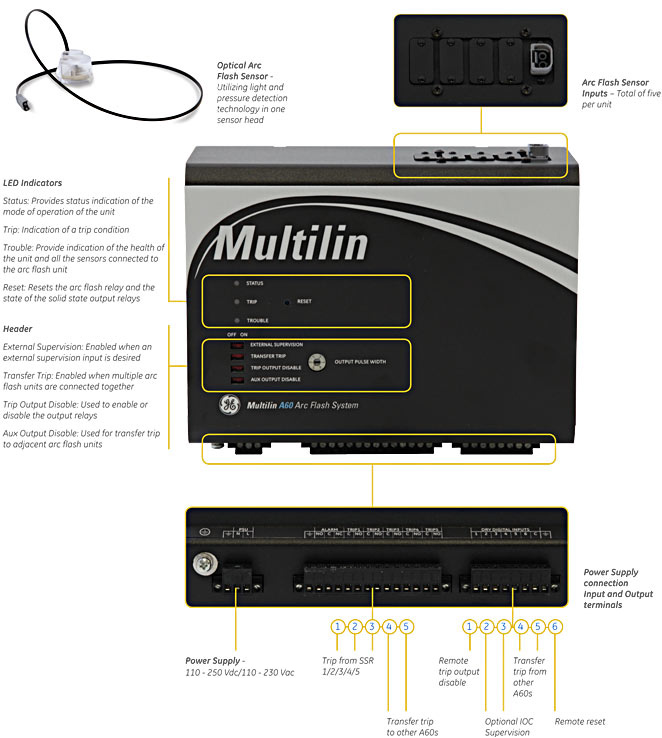
The Multilin A60 supports up to five sensors per unit providing optimal coverage in a typical two-high medium voltage switchgear section. To cover a larger area or for multi-section applications, Multilin A60's may be daisy chained together.
Well suited for both new and existing applications
As a stand-alone unit, the Multilin A60 relay is DIN rail mountable and should be mounted inside the control cabinet of the medium voltage switchgear or motor control center. Sensors should be installed where there is a high probability of an arc flash occurring.
As the Multilin A60 utilizes both light and pressure to detect an arc flash condition, installation and wiring of external CT's are not required. An external current supervision from a separate Instantaneous Over Current (IOC) device may be used and connected as a contact input for enhanced security and mitigation of nuisance tripping.
Calibrating & testing
The Multilin A60 provides an auto-calibration function for the sensors reducing total commissioning and testing time. Once installed and powered, the device will first run in calibration mode. This mode, sets the thresholds for both the light and pressurized sound based on surrounding or ambient conditions. As surrounding conditions may change, the Multilin A60 may be re-calibrated at anytime.
Control panel interface
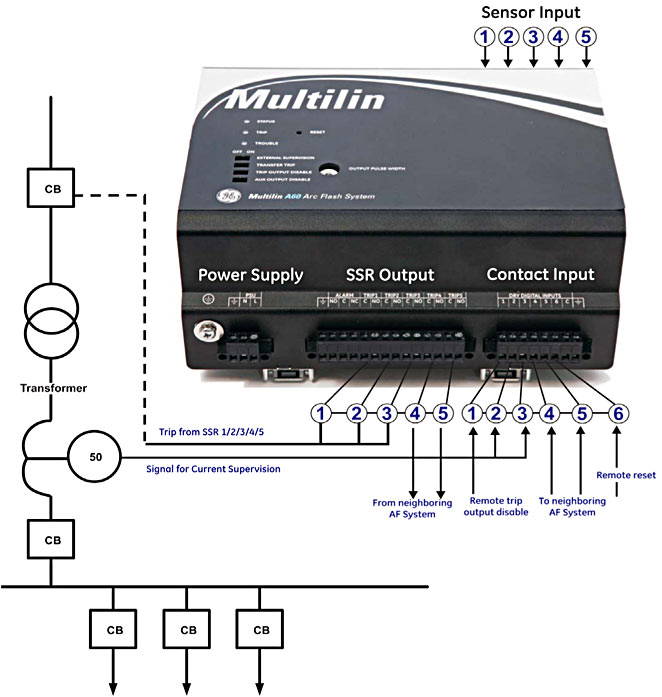
Typical wiring diagrams & application examples
This figure shows the typical wiring diagram of the Multilin A60 Arc Flash System. The typical wiring diagram shows the connection of the input and output relays and the connected sources. The wiring diagram also shows the connection of the supervisory circuit (option) to the A60 unit.
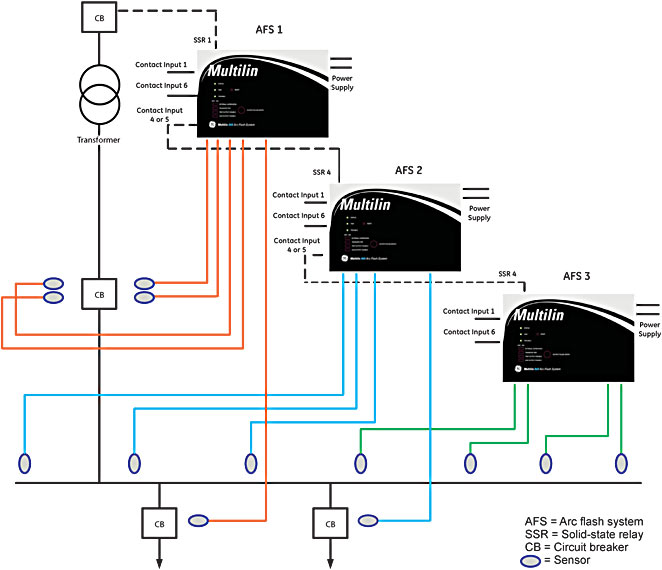
This application example below describes the ability of the Multilin A60 to be deployed in a cascading configuration across multiple MV switchgear sections and compartments, including through a substation bus bar vault. The Multilin A60 sensors should be installed at a certain distance from each other to ensure coverage of the entire bus bar.
By connecting devices together using the transfer trip input/output, individual Multilin A60 devices may receive a transfer trip signal from an upstream or downstream device, ensuring fast, reliable detection of an arc flash event in large MV switchgear applications.
Recommended Products & services

Feeder Protection
GE Vernova’s distribution feeder protection systems provide advanced protection with...
View More
Multilin 850R - Legacy
Recloser & Switch Controller
Manufacturing for the 850R has been discontinued. As an alternative, please refer to the R650.
Multilin 850R - Legacy
Recloser & Switch Controller
Manufacturing for the 850R has been discontinued. As an alternative, please refer to the R650.
Recloser Overview
The role of a recloser in a distribution network has developed in line with the increasing need for operators to minimize outage duration and the numbers of customers affected by faults, which in turn helps maximize performance according to reliability indices like CAIDI/SAIDI. As a result, it has two main functions. Its primary function is to clear the fault when it occurs as quickly as possible. Secondly, if the fault is permanent, the recloser takes on a sectionalising role driven by logic or commands. These control systems are dependent on the data delivered by the recloser on three levels: general monitoring from a historic perspective, fault data at the time of fault and pre/post fault data.
850R Primary Function
Multifunction Distribution Automation Controller with Recloser/Switch/Sectionalizer (Tie-Bus) control for overhead applications
- Improved distribution network reliability with a fast and reliable dynamic tripping and 4 consecutive shot 1-Phase or 3-Phase Autoreclosing
- Supports 6 Low Energy Analog (LEA) or 4 traditional voltage Input
- Autoreclosing integrated high speed driving electronics board with capacitor and battery charging capabilitie
- 5 shot switch control function included within the control
- 6 setting groups gives flexibility in building FDIR/ FLISR logic as well as loop schemes for 1/3 pole operations, improving system reliability
- Adaptive reclose with zone/sequence coordination
- Support for 41 recloser curves
- Flexibility to assign the current and voltage terminal configuration to match the primary recloser and user terminal configuration
- Integrated Distribute Energy Resources (DER) management including local islanding features to achieve IEEE 1547-2018
- Comprehensive power quality monitoring as per IEEE 519
- Real time asset monitoring for increased reliability and optimized asset life
- Remote device management and easy maintenance with secure WiFi connectivity
850R for Distribution Automation
From simple automation to advanced analytics, the 850R provides the flexibility and scalability required to meet unique application requirements for the distribution utilities.
Distributed FDIR
The decision making algorithm utilized in Distributed FDIR is spread among the field devices in the covered area using IEC 61850 GOOSE multicast. This approach eliminates the need for a centralized or decentralized system, and therefore reduces the total cost. Since this approach uses IEC 61850 GOOSE peer-to-peer communication messages among the field devices, it can be much faster and cost effective than other options.
Decentralized FDIR
Decentralized FDIR is a model-based scheme with the decision making algorithm residing at the substation level rather than the DMS level. The substation controllers, known as Distribution Automation Controllers (DACs), can also send the received data to the DMS level for supervisory monitoring and control in a more efficient manner. Automation applications, such as IVVC, can still be added at the substation level. The 850R supports redundant Ethernet and fiber port physical interface options and a wide range of industry standard protocols for communication, namely Modbus TCP/IP, DNP 3.0, IEC 60870-5-101, IEC 60870-5-103, IEC 60870-5-104, IEC 61850 ED2, IEC 62439 / PRP.
Protection & Control
The 850R provides secure and reliable protection & autoreclose functionality by offering a comprehensive range of standard and advanced protection and control elements. The controller provides directional and non-directional overcurrent protection along with the option of single-phase tripping and reclosing. Additionally, voltage and frequency protection elements may be used to disconnect Distributed Energy Resources (DER).
Multilin 850R feeder protection relay functional block diagram
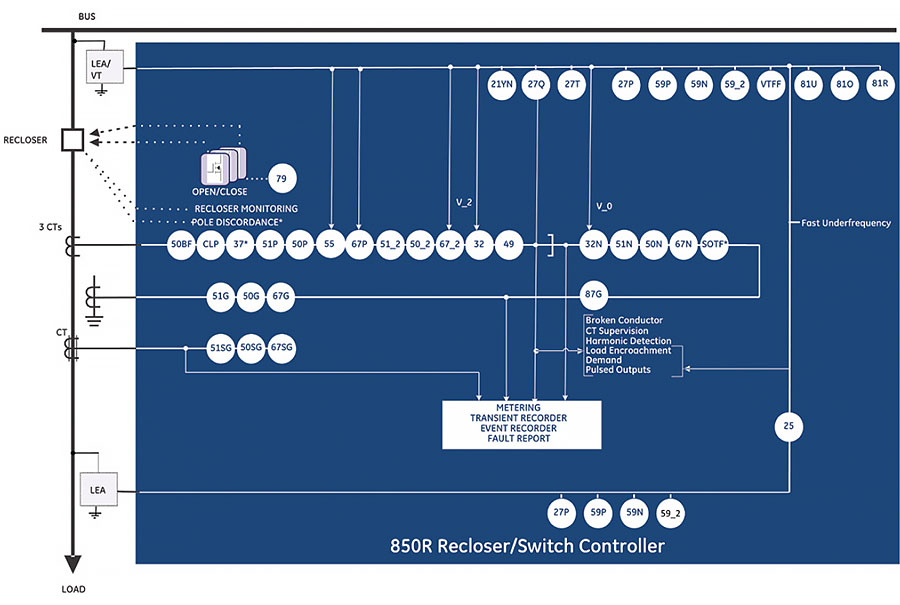
ANSI Device Numbers & Functions
| Device Number | Function |
|---|---|
| 21YN | YN Neutral Admittance |
| 25 | Synchrocheck |
| 27P | Phase Undervoltage |
| 27Q | UV Reactive Power |
| 27T | Timed Undervoltage Protection |
| 27X | Auxiliary Undervoltage |
| 32 | Directional Power |
| 32N | Wattmetric Ground Fault (Wattmetric zero sequence directional) |
| 37 | Undercurrent |
| 49 | Thermal Overload |
| 50BF | Breaker Failure |
| 50G | Ground Instantaneous Overcurrent |
| 50SG | Sensitive Ground Instantaneous Overcurrent |
| 50N | Neutral Instantaneous Overcurrent |
| 50P | Phase Instantaneous Overcurrent |
| 50_2 | Negative Sequence Instantaneous Overcurrent |
| 51G | Ground Time Overcurrent |
| Device Number | Function |
|---|---|
| 51SG | Sensitive Ground Time Overcurrent |
| 51N | Neutral Time Overcurrent |
| 51P | Phase Time Overcurrent |
| 51_2 | Negative Sequence Time Overcurrent |
| 59N | Neutral Overvoltage |
| 59P | Phase Overvoltage |
| 59X | Auxiliary Overvoltage |
| 59_2 | Negative Sequence Overvoltage |
| 67G | Ground Directional Element |
| 67SG | Sensitive Ground Directional Element |
| 67N | Neutral Directional Element |
| 67P | Phase Directional Element |
| 67_2 | Negative Sequence Directional Element |
| 79 | Automatic Recloser |
| 81O | Overfrequency |
| 81U | Underfrequency |
| Device Number | Function |
|---|---|
| 81R | Frequency Rate of Change |
| 87G | Restricted Ground Fault (RGF) |
| CLP | Cold Load Pickup |
| I1/12 | Broken Conductor |
| MCB | Manual Close Blocking |
| SOTF | Switch Onto Fault |
| TGFD | Transient Ground Fault Detection |
| VTFF | Voltage Transformer Fuse Failure |
| Auto Sectionalizer | |
| Battery Testing and Monitoring | |
| Capacitor and Coil Monitoring | |
| Fast Underfrequency | |
| Load Encroachment | |
| Overhead Switch Health Monitoring | |
| Power Loss | |
| PseudoVoltage | |
| Recloser Coil, Cap Voltage, and Health Monitoring | |
| Supply Switchover Function |
Distribution Automation
From simple automation to advanced analytics, the 850R provides the flexibility and scalability required to meet unique application requirements for the distribution utilities.
Distributed FDIR
The decision making algorithm utilized in Distributed FDIR is spread among the field devices in the covered area using IEC 61850 GOOSE multicast. This approach eliminates the need for a centralized or decentralized system, and therefore reduces the total cost. Since this approach uses IEC 61850 GOOSE peer-to-peer communication messages among the field devices, it can be much faster and cost effective than other options.
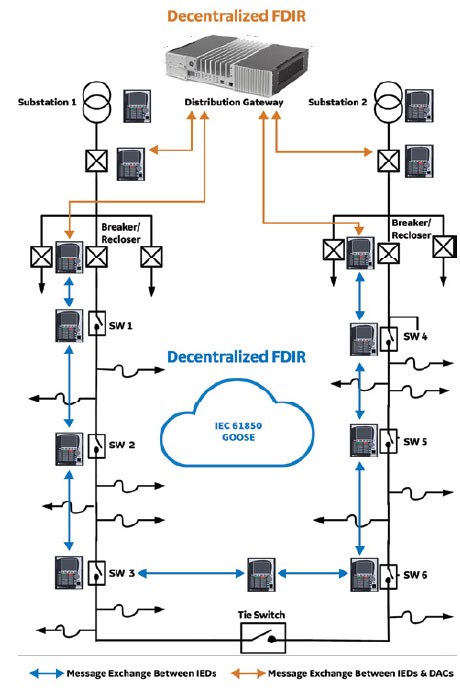
Decentralized FDIR
Decentralized FDIR is a model-based scheme with the decision making algorithm residing at the substation level rather than the DMS level. The substation controllers, known as Distribution Automation Controllers (DACs), can also send the received data to the DMS level for supervisory monitoring and control in a more efficient manner. Automation applications, such as IVVC, can still be added at the substation level.
Communications
The 850 provides advanced communications technologies for remote data and engineering access, making it easy and flexible to use and integrate into new and existing infrastructures. Direct support for fiber optic Ethernet provide s high-bandwidth communications, allowing for low-latency controls and high-speed file transfers of relay fault and event record information. The 850 also supports two independent IP addresses, providing high flexibility for the most challenging of communication networks.
Providing several Ethernet and serial port options, dual independent Ethernet Ports, and support for a wide range of industry standard protocols, the 850 enables easy, direct integration into DCS and SCADA systems. The 850 supports the following protocols:
- IEC 61850 Ed2, IEC 62439 / PRP
- DNP 3.0, IEC 60870-5-103, IEC 60870-5-104
- Modbus RTU, Modbus TCP/IP
The 850 has two interfaces as USB front port and Wi-Fi for ease of access to the relay. Wi-Fi Connectivity:
- Simplify set-up and configuration
- Simplify diagnostic retrieval
- Eliminate personnel in front of switchgear
- WPA-2 security
Cyber Security
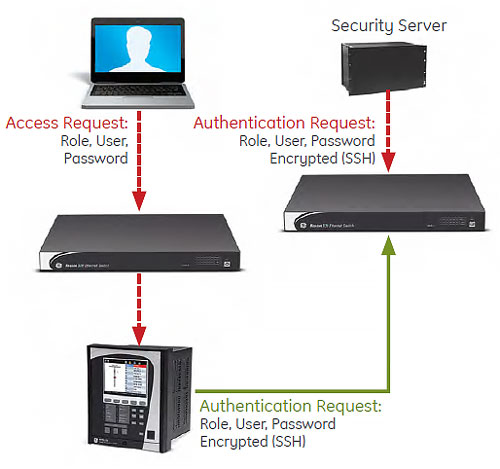
The 850 cyber security enables the device to deliver full cyber security features that help operators to comply with NERC CIP guidelines and regulations.
AAA Server Support (Radius/LDAP)
Enables integration with centrally managed authentication and accounting of all user activities and uses modern industry best practices and standards that meet and exceed NERC CIP requirements for authentication and password management.
Role Based Access Control (RBAC)
Efficiently administrate users and roles within UR devices. The new and advanced access functions allow users to configure up to five roles for up to eight configurable users with independent passwords. The standard “Remote Authentication Dial In User Service” (Radius) is used for authentication.
Event Recorder (Syslog for SEM)
Capture all cyber security related events within a SOE element (login, logout, invalid password attempts, remote/local access, user in session, settings change, FW update, etc), and then serve and classify data by security level using standard Syslog data format. This will enable integration with established SEM (Security Event Management) systems.
Advanced Monitoring and Diagnostics
Coil Circuit Supervision
The driving electronics board checks the coil connection continuity of the trip/close circuit, as well as the leakage current to ground. When magnitude of any phase current falls below the undercurrent trip pickup level for the time specified by the undercurrent trip delay. The alarm and trip pickup levels should be set lower than the lowest feeder loading during normal operations.
Capacitor Voltage Alarm
The Capacitor Voltage Alarm function defines the low voltage alarm for the internal/external capacitor charging power supply circuit. This rated voltage is used for charging the external capacitors that open and close the single-pole of the recloser. If the measured voltage of the capacitors is less than the configured percentage of the rated voltage, then the Cap Volt OP operand is generated. In addition, to prevent the charger from damage due to overloading or load short faults created by incorrect wiring, bad capacitors, or hardware failures, the 850R automatically turns off the capacitor charger to prevent damage.
Recloser Wear and Recloser/OHSW Health Monitoring
The 850R relay provides recloser/OHSW health information by monitoring and analyzing the operation count, arcing energy of breaking current, arcing time, opening time, and closing time when applicable. The recloser health status depends on many factors, such as permissible operation number, magnitude of breaking current, mechanical wear and contact wear.
Time of Day Timer
The Time of Day Timer function provides the user with the ability to program control actions based on real time. There are two identical Time of Day Timers.
Application
Monitoring of the total accumulated energy/accumulated demand/minimum and maximum power demand at the end of an event or a shift interval. A shift can be defined by the breaker status operand (opclosed) or operand derived from the Time of Day Timer element.
Voltage Disturbance
The Voltage disturbance function of Voltage Swell and Voltage Sag, as described in IEEE 1159-2009. When the voltage on any phase drops below this level a voltage sag condition occurs. Voltage sags are usually associated with system faults but can also be caused by switching heavy loads or starting large motors. Short duration voltage sag may cause process disruptions. Voltage swells are usually associated with system fault conditions, but they are much less common than voltage sags. An SLG fault on the system can cause a swell to occur, resulting in a temporary voltage rise on the healthy phases. Swells can also be caused by switching off a large load, load shedding, or switching on a large capacitor bank. Voltage swell may cause failure of the components depending upon the magnitude and frequency of occurrence.
Software and Configuration
The EnerVista™ suite is an industry-leading set of software programs that simplifies every aspect of using the Multilin 8 Series. EnerVista provides all the tools to monitor the status of the protected asset, maintain the device and integrate the information measured by the Multilin 8 Series, into SCADA or DCS process control systems. The ability to easily view sequence of events is an integral part of the setup software, as postmortem event analysis is critical to proper system management.
EnerVista Launchpad
EnerVista Launchpad is a powerful software package that provides users with all the setup and support tools needed for configuring and maintaining Multilin products. The setup tools within Launchpad allow for the configuration of devices in real-time, by communicating via serial, Ethernet or modem connections, or offline by creating device setting files to be sent to devices at a later time. Included in Launchpad is a document archiving and management system that ensures critical documentation is up-to-date and available when needed.
8 Series Setup Software
8 Series Setup Software is a single setup and configuration across the platform and can reduce device setup and configuration time.
Recommended Products & services
Controllers
GE Vernova offers an industry-leading suite of controllers that support a variety of...
View More