
A collaboration between: Stony Brook University, GE Vernova Advanced Research, and Sandia National Laboratories
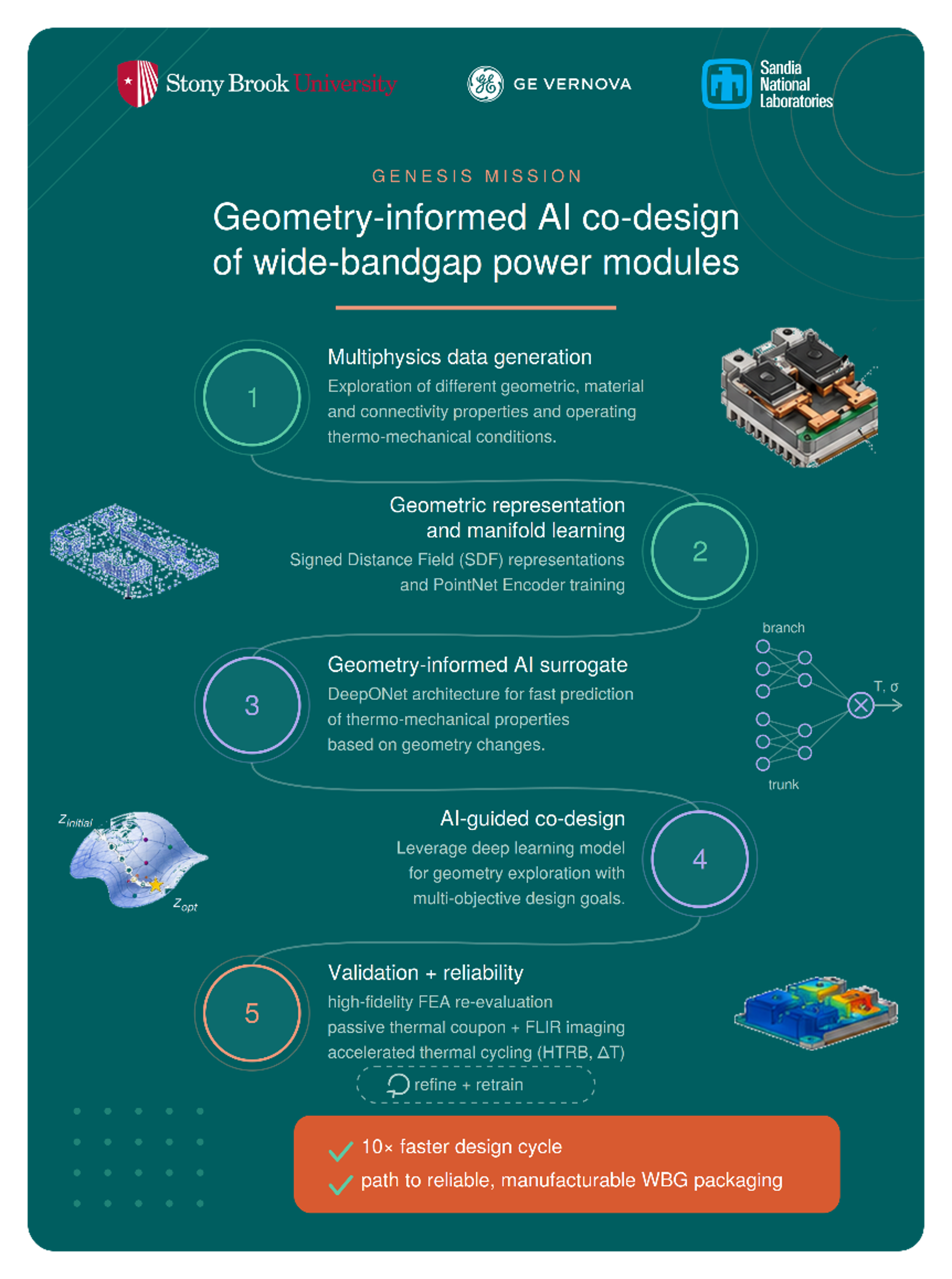
July 2026 – GE Vernova Advanced Research will collaborate with Stony Brook University and Sandia National Laboratories (SNL) to create an AI platform to accelerate the development and testing of advanced wide-bandgap power modules for high-efficiency energy systems. Referred to as the Geometry-Informed AI for Accelerated Multiphysics Co-Design of Wide-Bandgap Power Modules project, Advanced Research will lead the development of an AI and machine learning (ML) surrogate modeling workflow, specifically utilizing DeepONet architectures that incorporate power module packaging, design, and manufacturability constraints.
This nine-month project is among the first cohort of awards supported by the Genesis Mission, a national initiative harnessing AI to drive scientific innovation and accelerate breakthroughs in energy, discovery science, national security, and beyond. The Genesis RFA received tremendous response from the scientific community with more than 5,000 proposal submissions; just 278 were awarded. In addition to funding, Genesis Mission awardees gain access to the Genesis Mission Platform, including AI agent frameworks, advanced AI models and software provided by industry collaborators, and high-performance computing (HPC) resources across DOE’s National Laboratories and partner facilities.
“GE Vernova Advanced Research is blending decades of experience in wide-bandgap semiconductor technologies with the power of AI to push the boundaries of high-frequency, high-density power conversion. Our expertise on advancing AI and developing superintelligence tools for engineering will help us push the boundaries on current state-of-the-art power module manufacturing by combining geometries and material properties in ways that were previously impractical through conventional methods.” said Lead Engineer Panos Tsilifis, who also serves as the project lead for GE Vernova. “We’re excited to contribute to this Genesis Mission project and look forward to the impact it will have on reducing design cycle time, while ultimately contributing to enhanced grid solutions, renewable energy integration, and electrified infrastructure. We are privileged to be among the first research groups ever to enable AI exploration in this domain which is expected to result in significant improvements for power module component reliability and manufacturing costs.”
More Information
- Secretary of Energy Chris Wright Announces First Genesis Mission Projects Selected to Accelerate AI-Driven Scientific Discovery
- Energy Department Launches ‘Genesis Mission’ to Transform American Science and Innovation Through the AI Computing Revolution
GE Vernova Advanced Research Contact
- Panos Tsilifis (PI) – panagiotis.tsilifis@gevernova.com