
A collaboration between: GE Vernova Advanced Research, Massachusetts Institute of Technology (MIT), University of Maryland College Park
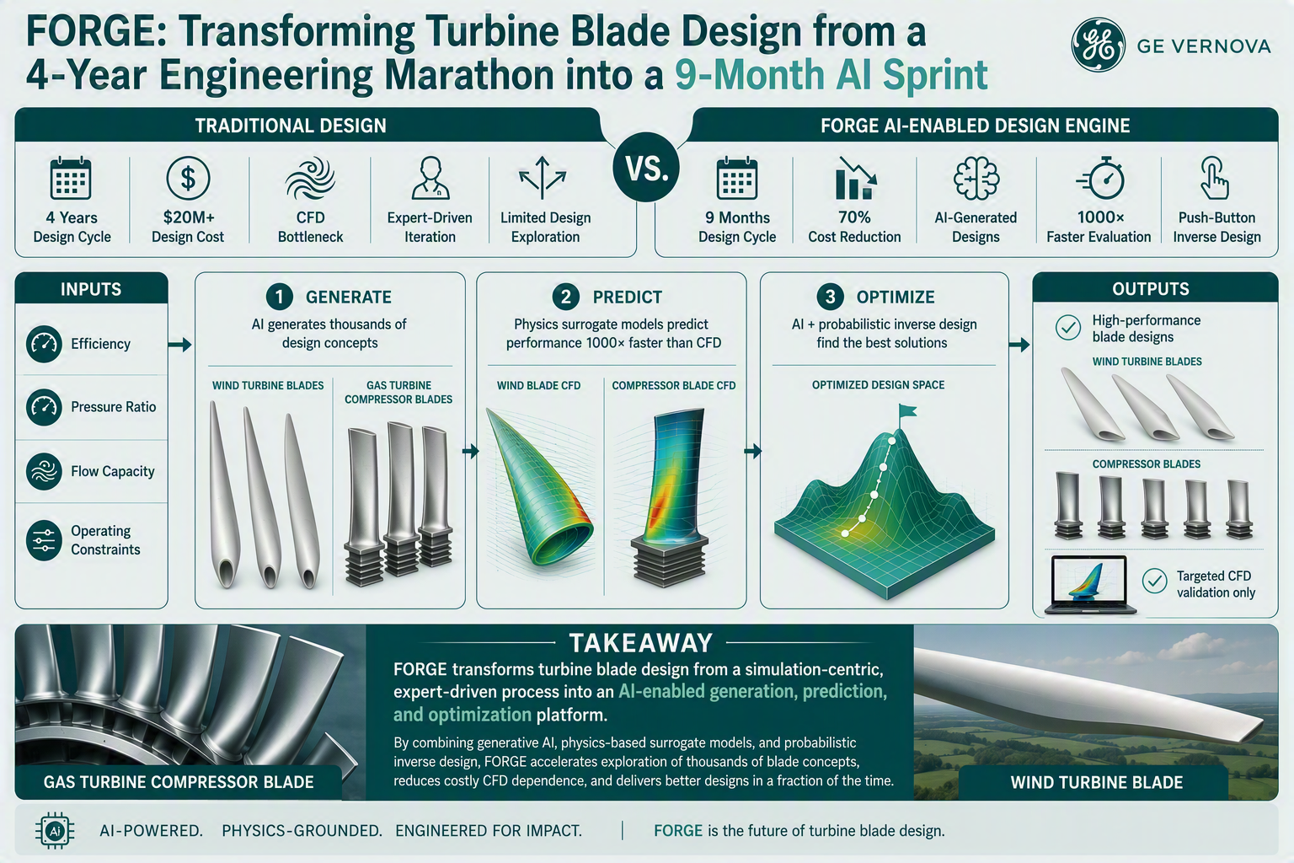
July 2026 – GE Vernova Advanced Research will lead development of an AI pipeline for rotating machinery blade design, evaluation, and refinement, transforming an otherwise rigid process. Referred to as the Framework for Optimized Rotating blade design using Generative Engineering (FORGE) project, this work will leverage advances in generative engineering to address three areas: creativity in design, AI-enabled surrogates for rapid design evaluations that require minutes instead of hours and ultimately, an inverse design paradigm that flips traditional design by directly mapping performance to design.
This nine-month project is among the first cohort of awards supported by the Genesis Mission, a national initiative harnessing AI to drive scientific innovation and accelerate breakthroughs in energy, discovery science, national security, and beyond. The Genesis RFA received tremendous response from the scientific community with more than 5,000 proposal submissions; just 278 were awarded. In addition to funding, Genesis Mission awardees gain access to the Genesis Mission Platform, including AI agent frameworks, advanced AI models and software provided by industry collaborators, and high-performance computing (HPC) resources across DOE’s National Laboratories and partner facilities.
“GE Vernova Advanced Research has a strong history of pioneering AI for science and engineering. FORGE builds on this legacy to transform blade design from a simulation-centric, expert-driven process into an AI-enabled engineering workflow that can generate, predict, and optimize designs directly from performance targets,” said Senior Engineer Balaji Jayaraman, who also serves as the project lead for GE Vernova. “By combining generative design, physics-based predictive models, and inverse design optimization, FORGE has the potential to dramatically accelerate development cycles while improving engineering productivity and enabling next-generation blade designs for wind, gas power, and hydro applications.”
More Information
- Secretary of Energy Chris Wright Announces First Genesis Mission Projects Selected to Accelerate AI-Driven Scientific Discovery
- Energy Department Launches ‘Genesis Mission’ to Transform American Science and Innovation Through the AI Computing Revolution
GE Vernova Advanced Research Contact
- Balaji Jayaraman (PI) – balaji.jayaraman@gevernova.com