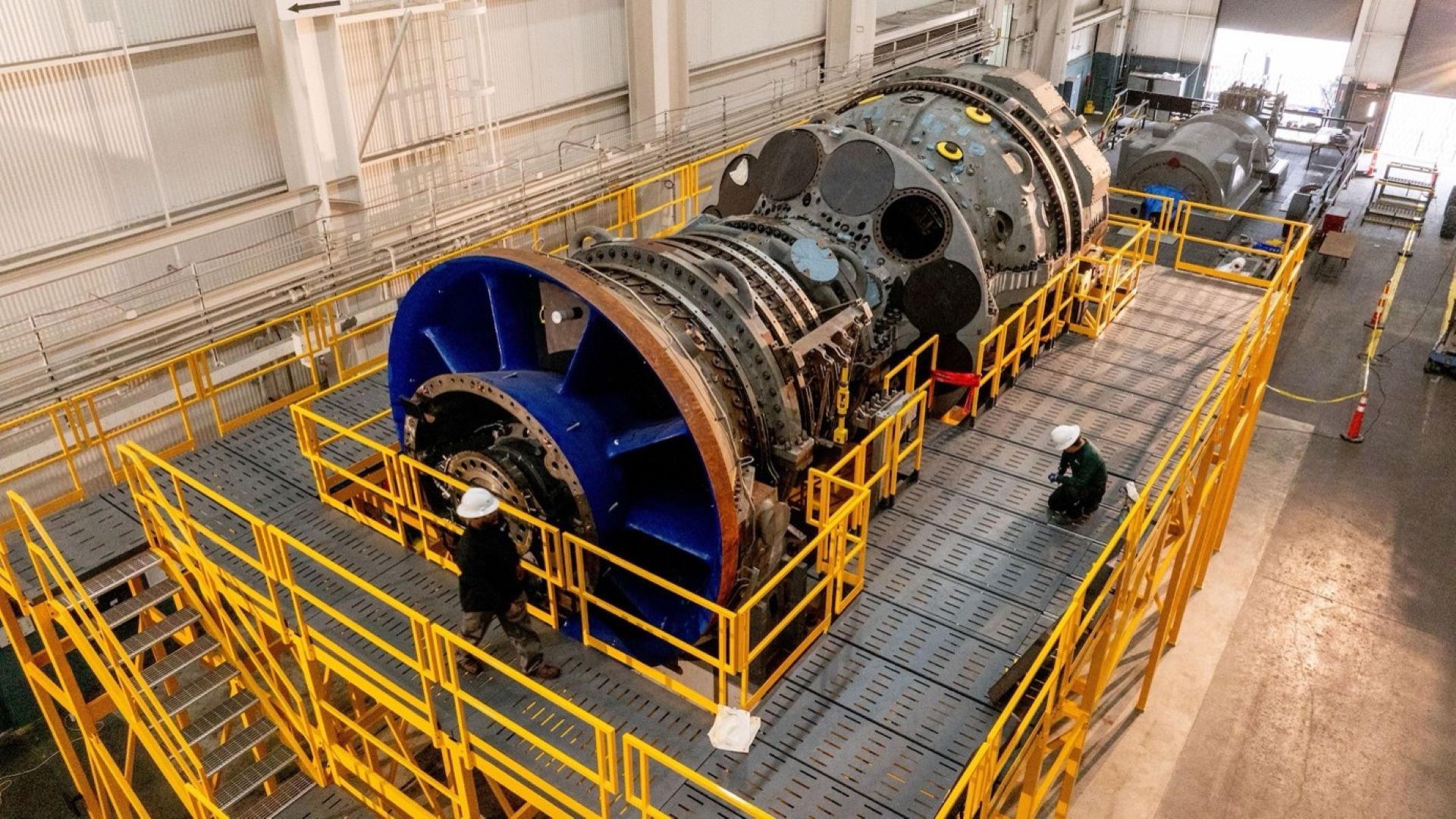
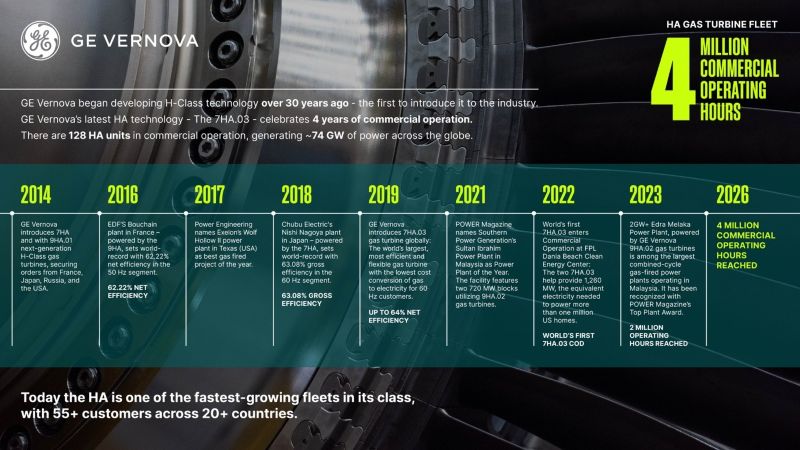
Fifteen years ago, the world’s power grids were starting to change fast. As coal plants retired and renewables expanded, power systems needed technology that could deliver both flexibility and scale. GE Vernova’s H-class gas turbine was built for that moment, and its record-breaking combined-cycle efficiency helped make it the fastest-growing fleet in its class.
But scaling a next-generation turbine fleet takes more than advanced technology. As the HA’s rapid uptake accelerated over the past decade — hitting 2 million commercial operating hours in 2023 and then 3 million just two years later — it created an equally urgent need for engineers with the training and expertise to service these machines in the field. That challenge is becoming more important as global electricity demand rises in the age of AI.
Today, as massive AI data centers account for nearly half of all new electricity demand growth in the U.S., the HA turbine has just surpassed 4 million operating hours — barely a year after hitting the 3 million mark. The current installed fleet of 128 HA units operates in 21 countries and can generate approximately 74 gigawatts (GW) of power plant capacity, the equivalent amount of electricity needed to power more than 55 million U.S. homes. Keeping that fleet running reliably requires more than hardware alone. It requires a pipeline of highly trained field engineers who can maintain, troubleshoot, and upgrade these machines as demand grows.
Building Skills, Expertise, and a Sense of Mission
GE Vernova’s Field Engineering Program (FEP) is one way the company is building that next generation of talent. The program brings in people from different backgrounds — from recent college graduates to former military personnel to mechanics with related experience — and gives them the training needed to maintain and upgrade heavy industrial power-generation equipment, including HA gas turbines. For many participants, including Cole Phillips, that training also gives the work a stronger sense of purpose.
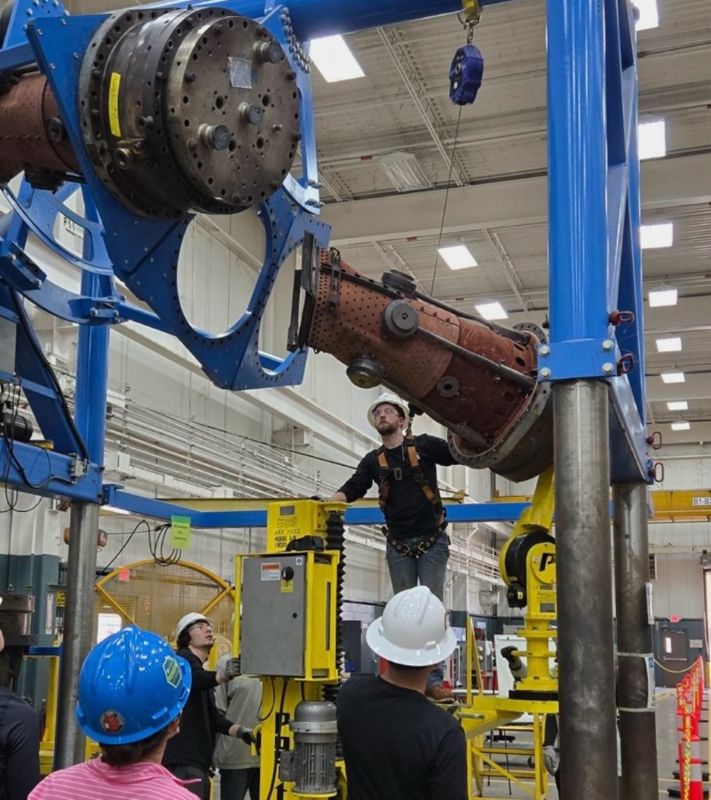
Phillips came to the FEP from the United States Marine Corps, where he worked on helicopter electrical systems before deciding he wanted a life beyond aviation. Although GE Vernova recruits regularly at military branches and colleges across the country, Phillips found his way in through a family connection: A cousin at the company told him hiring was ramping up in certain areas and that his electrical background made him a strong fit for field engineering. “But what really drew me in was just how much he liked his job,” Phillips says.
At the time, Phillips thought that turbines were three- to five-foot-long machines that powered aircraft. So when he joined FEP in 2025, he was initially struck by the size and power of the HA turbine itself. “Compared to the machines used in aviation, they’re just massive — which is interesting and cool on its own,” says Phillips. But then the technology’s role in power generation sank in. “That’s when I realized just how many people rely on the power GE Vernova equipment provides,” he says. “I realized my job would have a real purpose.”
This became even more apparent when fellow FEP participants straight out of college revealed how central AI technology had already become. “There was this generational difference in how much they’d used AI in college and still do,” he says. “Even though we’re about the same age, they had a more basic understanding of AI’s power needs and the important role this is going to play.”
Boots on the Ground
Every new turbine that comes online brings years of maintenance, upgrades, and performance work with it. Keeping those machines running depends on field service engineers who know how to solve problems in real time. As the HA fleet grows, their role becomes even more important — helping power plants stay online for homes, businesses, and increasingly the data centers driving new electricity demand.
“We have a big company and a big engineering group behind us, but they’re not the ones out there dealing with the challenges as they arise, during an outage or installation,” says Chief Field Engineer Jason Barody. “Service engineers are the face of GE Vernova, the ones with boots on the ground.”
Barody had been with GE Vernova for nearly 18 years when he saw the huge advance the HA brought to the 7F models that he’d trained on. But while the technology kept on advancing — from the HA.01 to the HA.02 and HA.03 in just five years — the relationships with customers have remained the same. “Our engineers are collaborating with the same customers, dealing with the same people during outages, and they know that having the right people doing the work is really what it’s about,” he says.
This month, Phillips will finish the FEP’s six months of hybrid training in Houston and then head to Switzerland to learn the related gas turbine technology produced at GE Vernova’s center of manufacturing excellence in Belfort, France. He is excited for his first time overseas, but he is also starting to see the bigger picture: As demand for dependable electricity grows, so does the need for people ready to keep critical power infrastructure running.
“You know the tools, you’re digesting all this complex information about parts and their operations, and there’s this moment when it all finally clicks — where you’re like, ‘OK, I know this,’” he says. “That’s really rewarding.”