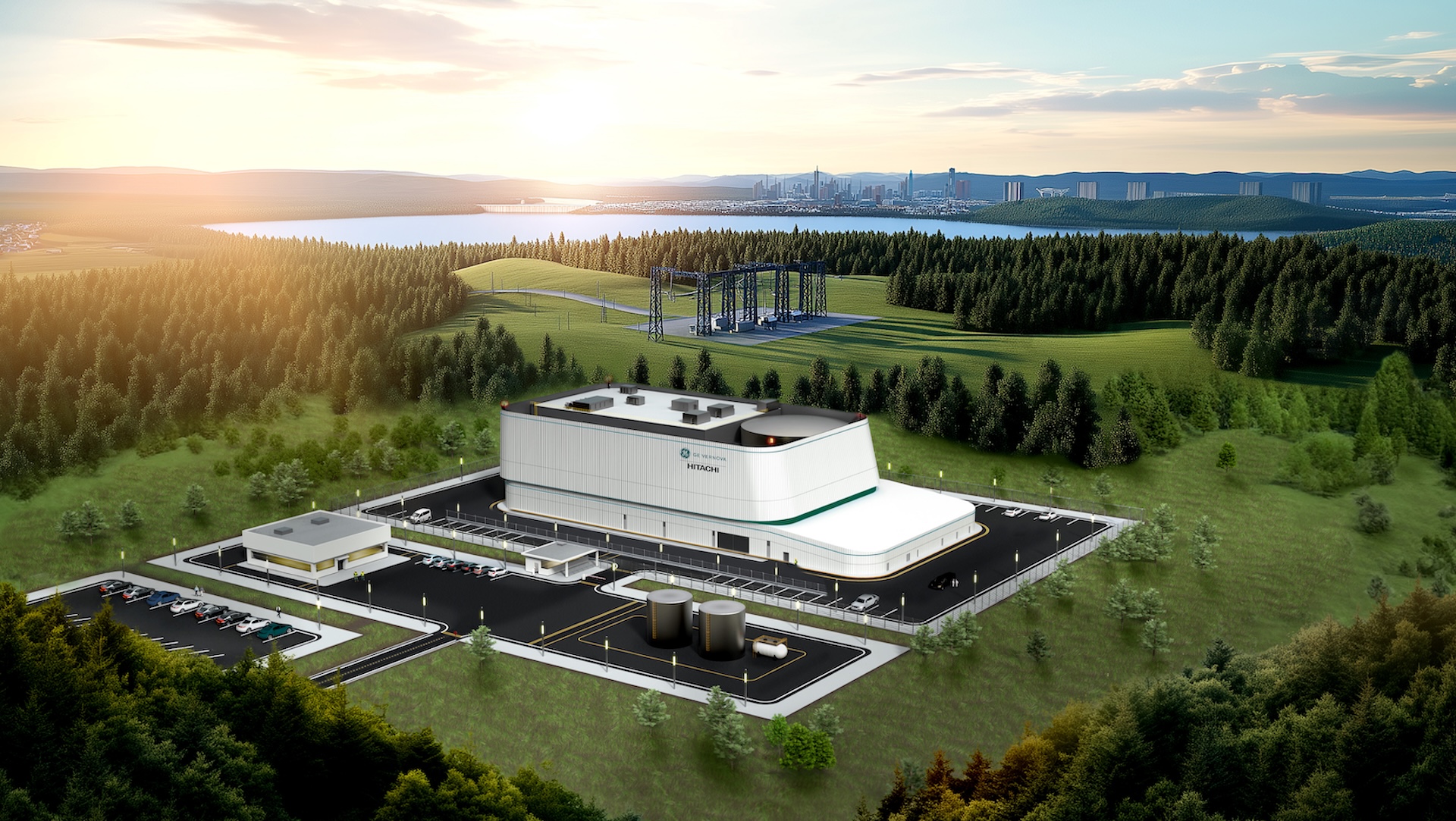
Nuclear energy offers reliable, lower-carbon power, but building a traditional large reactor can mean massive capital costs and construction schedules that are too slow for meeting the growing demand for reliable, low-carbon power. How to overcome these obstacles was a problem that a team of engineers, led by Christer Dahlgren and Brian Hunt, were ruminating on 10 years ago at the company that is today known as GE Vernova Hitachi Nuclear Energy. As the team explored designs, Dahlgren pitched an idea that could dramatically simplify the overall design for a small modular reactor (SMR). Today, Dahlgren is technical lead for the first deployment of the company’s BWRX-300, a 300-megawatt reactor that is expected to provide reliable, carbon-free* energy to some 300,000 homes when it goes online in 2030.
“It was in this building, sitting in my cube,” Dahlgren recalls, speaking from his office in Wilmington, North Carolina. “And we just said, ‘What if we do this?’ On a whiteboard, we drew a vessel and a valve. I erased the picture and we started writing a patent for it,” along with their fellow co-inventor, Wayne Marquino. “It was pretty cool right then.”
But going from a whiteboard drawing to a ready-to-build concept took persistence. It took a few years of rigorous analysis and modeling to convince everyone else, both inside and outside the company, that the new concept was safe and worthy of investment.
From Innovation to Execution
Dahlgren, a chief consulting engineer for GE Vernova Hitachi Nuclear Energy, was up for the task. He had grown up in Sweden, where nuclear energy produces about 30% of the country’s electricity, and he wrote his engineering master’s thesis on a nuclear power plant in Stockholm that flooded in 1969.
“The old reactor was still there, so I was able to climb on top of the reactor vessel, measure connections, and talk to veteran engineers who could find drawings and talk about the plant,” he says.
Dahlgren was attracted to nuclear engineering in part because he was fascinated by the calculations needed to understand the simultaneous flow of liquid water and steam within reactor systems. He also liked working with a multidisciplinary team of experts in materials science, hydraulic systems, chemistry, physics, electrical engineering, operations, and human-machine interfaces. That early exposure shaped his belief that nuclear safety must be approached as a unified, systemic puzzle.
“Every subject is touched,” he says. “It’s a challenge to get all these people around a big design goal, but that’s also the fun part.”
Safety by Design
Dahlgren’s team designed its SMR to rely on passive systems that can control reactivity and remove heat without AC power or a constant cooling source. To build in redundancy, each safety feature has two methods of activation. In an emergency, the system is designed to maintain a safe state for up to seven days without power or operator actions.
Small modular reactors bring a lot of benefits to power companies and households. In addition to being designed to be faster and more cost-effective to deploy than large reactors, SMRs fit more easily into an existing power grid and don’t require large backup power sources if they need to be taken offline.
“Nuclear energy can produce a lot of power with almost no land use, while hydroelectric dams, wind, and other forms of lower-carbon energy can take up a huge amount of space,” Dahlgren says.
Building a Nuclear Legacy
Today, the original concept that started on a whiteboard in Dahlgren’s cube has been developed into a full-fledged plant design and construction project, now taking physical shape at the Darlington New Nuclear Project in Ontario, Canada, about 40 miles east of Toronto. A thicket of cranes and a reactor shaft descending more than 100 feet underground represent a major milestone in bringing SMR technology from design and licensing into real-world construction. It’s the first of four planned units at the site, targeted to take around four years each to build, with lower upfront costs than a large reactor and additional savings through repeat deployment.
Dahlgren recently received the 2026 Honorary Prize from the Swedish Nuclear Society for his contributions to nuclear technology. He was in familiar company. Physicist Mattias Lantz, one of Dahlgren’s best friends growing up, was honored in 2025. In fact, Dahlgren learned about the recognition while the two were together on vacation in Scotland.
Before construction began on the BWRX-300 in Ontario, Dahlgren took a rock from the site as a souvenir. He keeps it as a tangible link back to that initial drawing in his cubicle — a reminder of how far an idea can travel when an organization rallies behind it.
“When we started this project, we had maybe a few dozen people who worked on new nuclear plants,” he says. “Now, we have several hundred. Building a legacy of starting something from a whiteboard to a huge organization working with one goal — that’s what I hope to accomplish. The journey has been amazing so far. It’s really exciting to see where we’re heading in the next five to 10 years.”
* “Carbon-free,” as used in this article, refers to the absence of carbon dioxide emissions during nuclear power generation and does not include indirect life-cycle emissions.