
Search Gas Power
Recommended resources
Upgrades
Your outcomes—delivered
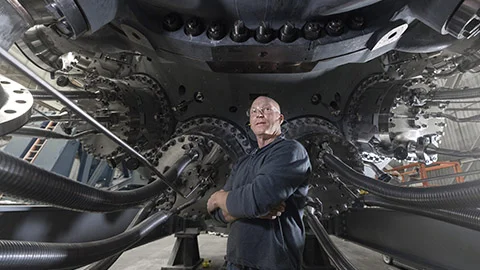
These days, we're all trying to do more with less, but GE Vernova can help. Our upgrades and modernizations can help you get more from your existing assets. Discover the possibilities with our interactive upgrades selector.

Controls
Control Lifecare Services
Whether you need 24/7 technical support, live remote diagnostics, onsite field engineering, or parts management, we have you covered with GE Vernova's Controls Lifecare Services (CLS).
Podcast
Cutting Carbon - Season 9
Join Dr. Jeff Goldmeer, Brian Gutknecht, and special guests for the final season of our 3-part series as they discuss the roles digital and electrification will play in the energy transition.

Decarbonization in action
Explore the future of energy
See how GE Vernova's Gas Power business is helping to build a world that works.
In an emergency, speed alone is not enough. Success requires a strategy that unites rapid deployment, proven reliability, and the flexibility to adapt to site-specific conditions. Discover how to protect your operations when it matters most.
When power supply is disrupted, the first question is rarely about equipment. It is about what happens next.
For a desalination plant, a prolonged outage can quickly become a water supply risk. For a smelter, it can threaten process stability and equipment integrity. For utilities and industrial operators alike, the issue is not simply whether backup power is available. It is whether power can be restored quickly, trusted once online, and adapted to the realities of the site.
That is what makes emergency power different from conventional generation planning. In an emergency, speed and reliability cannot function in isolation; they must be balanced with the flexibility to adapt to changing conditions. The requirement is all three together: the ability to respond before disruption spreads, perform with confidence, and fit the operating conditions on the ground.
Urgency has a timeline
In emergency power, speed is not only about how fast a unit starts after installation. It is also about how fast a solution can move from urgent need to delivered power.
Mobile power with an install time of approximately 14 days can significantly change the response window for operators facing sudden supply disruption. It narrows the gap between the moment a problem becomes operationally serious, and the moment power is available on site, helping prevent a localized event from becoming a broader continuity issue.
Once installed, response time matters just as much. A solution that can ramp to full load in five minutes offers a very different level of confidence than one that requires a longer restart sequence.
Together, 14-day install time and five-minute cold start define a more responsive model for emergency power generation.
By reducing site complexity, civil work, and infrastructure-related delays, mobile units deliver power faster, ensuring the site adapts to the solution rather than the other way around.
For critical operations, this is not just a scheduling advantage. It is part of protecting continuity when every hour counts.
The difference between available and dependable
Emergency power may be deployed quickly, but it still has to perform to the standards of critical infrastructure.
Proven availability is critical because high-consequence operations demand more than rapid startup. They require consistent, dependable performance over time. With availability exceeding 98%, the system delivers more than a technical benchmark. It provides proven reliability when every moment matters.
Its engineering heritage matters too. Aeroderivative technology traces its lineage to aviation, where performance expectations are uncompromising and reliability is essential, making aeroderivative gas turbines a trusted choice for demanding environments where uninterrupted power is essential.
GE Vernova's aeroderivative gas turbine fleet is backed by more than 140 million hours of operating experience, demonstrating a mature, proven technology with an extensive operating history across applications and geographies.
There is also a commercial dimension to reliability. A fired-hours maintenance model helps align maintenance exposure more closely with actual use. For emergency applications, where units may remain on standby for extended periods and start-stop frequently, that can help reduce financial uncertainty.
When the plan has to bend
Emergency conditions rarely stay fixed. Fuel availability can shift, load needs can change, and site limitations often shape what can be installed and how quickly it can be brought online.
With output of approximately 35 MW per unit, operators can size capacity around actual need rather than forcing operations to conform to a fixed generation block. Additional units can be added where larger load requirements exist, creating a modular path to capacity for utilities and industrial sites alike.
Configuration flexibility can also reduce execution risk. Mobile and modular solutions help limit civil infrastructure requirements, accelerate installation, and avoid the burden of large permanent-site commitments when the immediate priority is restoring supply quickly.
Access to lifecycle support, technical advisory services, maintenance planning, repairs, exchanges, and performance testing helps sustain readiness over time. Flexibility is not only about deployment. It is also about how effectively a solution can be supported as needs evolve.
What emergency power is actually asking for
In conventional planning, one attribute may be weighed against another. In emergency power, that tradeoff becomes much harder to justify.
Fast startup, proven reliability, and deployment flexibility are essential. Because a shortfall in any one area leaves your operations exposed, you cannot rely on them in isolation. Emergency readiness demands all three, working together.
When supply is disrupted, the real question is not simply whether emergency power is available. It is whether the solution can respond quickly, perform reliably, and adapt to the operating conditions your site faces.
Speak to a GE Vernova specialist to discuss your emergency power needs.
Contact us