
Search Gas Power
Recommended resources
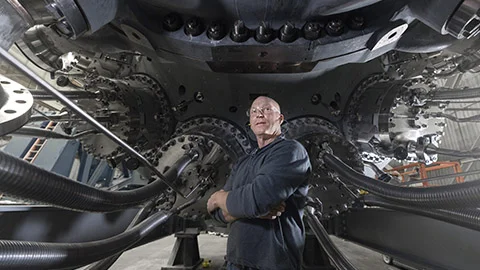
Upgrades
Your outcomes—delivered
These days, we're all trying to do more with less, but GE Vernova can help. Our upgrades and modernizations can help you get more from your existing assets. Discover the possibilities with our interactive upgrades selector.

Controls
Control Lifecare Services
Whether you need 24/7 technical support, live remote diagnostics, onsite field engineering, or parts management, we have you covered with GE Vernova's Controls Lifecare Services (CLS).

Podcast
Cutting Carbon - Season 9
Join Dr. Jeff Goldmeer, Brian Gutknecht, and special guests for the final season of our 3-part series as they discuss the roles digital and electrification will play in the energy transition.

Decarbonization in action
Explore the future of energy
See how GE Vernova's Gas Power business is helping to build a world that works.
As renewable energy scales across Asia Pacific and beyond, grid firming is emerging as a critical enabler of reliability, resilience, and decarbonization*.
Across Asia Pacific, renewable energy deployment is accelerating at record pace. Whether it’s large-scale wind farms in Vietnam or home rooftop solar in Australia, renewables are paving the path as energy resources for the future.
But this progress also exposes a critical challenge: the gap between renewable ambition and grid readiness.
In a recent GE Vernova webinar, energy leaders from policy, marketplace design, and technology explored why grid firming has become a defining issue for the next phase of the energy transition, and what it will take to build a firm, flexible, future-ready power system.
Renewable growth is outpacing grid readiness
The energy transition is no longer a question of “if.” It is now a question of “how fast.” Yet high penetrations of variable renewable energy can introduce new system stresses:
- Frequency and voltage stability challenges
- Grid congestion and curtailment
- Increasing exposure to the “duck curve” effect
As Vietnam’s experience shows, even systems with strong renewable potential must rapidly adapt operational practices, grid infrastructure, and marketplace frameworks to maintain reliability.
What is grid firming, and why it matters
Grid firming refers to the technologies, services, and mechanisms that can ensure electricity systems remain reliable and resilient as variable renewables scale.
These include:
- Flexible generation capable of fast starts and rapid ramping
- Energy storage and pumped hydro
- Grid infrastructure and interconnections
- Digital solutions for forecasting, dispatching, and control
- Demand-side management and demand response
Critically, firming is not about replacing renewables—it is about enabling them to operate at scale without compromising reliability or affordability.
Three perspectives, one clear message
Power systems must be able to respond quickly to changing supply and demand conditions. Flexibility—across generation, grids, and demand, is now a core design principle, not an add-on.
2. Complementary resources are essential
No single technology can deliver a reliable, low-carbon grid. Energy, shaping, and firming resources must work together in a complementary way to manage variability and extreme events.
3. Collaboration enables progress
The energy transition is a journey that requires collaboration across policymakers, utilities, investors, and technology providers. The industry, regulation, and finance sectors must evolve alongside technology to unlock investment and innovation.
Grid firming and decarbonization: Not a trade-off
A common concern is whether firming solutions slow decarbonization. The webinar made it clear that the opposite is true. Pragmatic firming solutions reduce system risk, lower curtailment, and enable higher renewable penetration today—while supporting a long-term pathway toward lower carbon intensity. Decarbonization is not a switch. It is a disciplined, measurable journey.
Looking ahead: Building future-ready grids
As energy systems evolve, the question is no longer whether to invest in grid firming, but how quickly and holistically it can be integrated into planning, policy, and the marketplace.
The systems that succeed will be:
- Flexible enough to adapt
- Complementary by design
- Collaborative across stakeholders
And although our webinar has an Asia-Pacific focus, the insights can be adapted and implemented across countries and across borders. The panelists brought a diverse range of expertise to the table, ranging from policy development, government affairs, and supply chain disruption to the energy landscape, power systems, smart grids, and operational strategy.
And differences in perspectives didn’t show division but instead highlighted the many innovative options and rapidly emerging trends available today that will shape the power systems of tomorrow. When you're in a world of changing technology, steadfast commitment is required in every step of the journey from renewable ambition to system reality.
*Decarbonization as used in this document is intended to mean the reduction of carbon emissions on a kilogram per megawatt hour basis.
Contact us