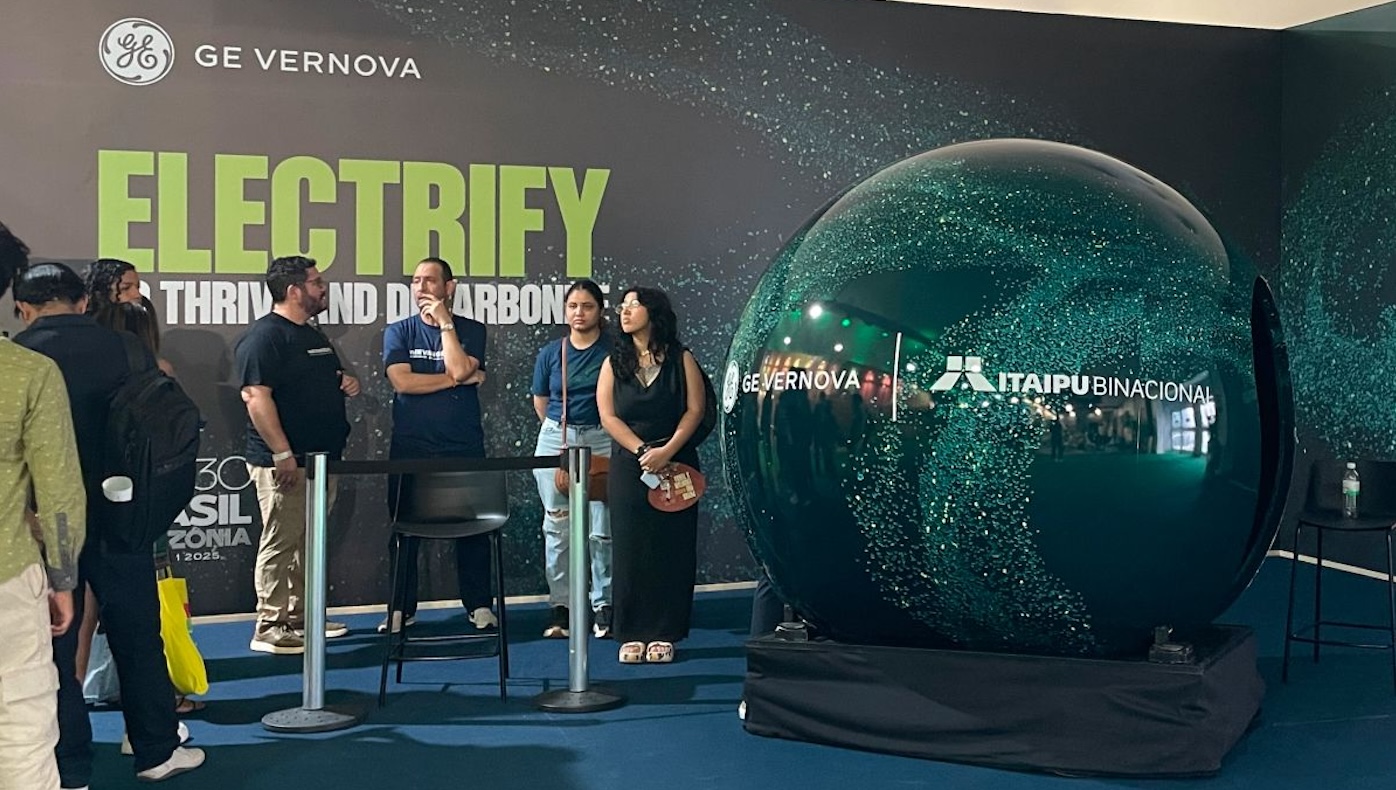
Last month, world leaders met in Belém, Brazil, at the UN’s COP30 summit to share their plans to implement solutions to address climate change. The next week, 5,300 miles away in Johannesburg, South Africa, at the annual summit of the B20 (or Business 20), a forum of the G20 for the global business community, leaders focused on a similar theme: “Inclusive Growth and Shared Prosperity Through Global Cooperation.” It’s a subject close to the heart of GE Vernova’s leadership, of which there were several members at both conferences. They joined forum discussions on meeting the world’s accelerating energy demands, shared optimism about new technology, and celebrated the future leaders of energy.
Concept to Reality
At COP30, the company used its Concept Becomes Reality series to show how five projects it’s leading around the world are bringing the theme of “electrifying to thrive and decarbonize” to life. The Western world’s first fleet of small modular reactors (SMR) is now under construction at the Darlington New Nuclear Site, near Toronto, where four planned GE Vernova Hitachi BWRX-300 units will potentially generate up to 1.2 gigawatts of power, producing the equivalent electricity to power up to 1.2 million homes. GE Vernova’s Advanced Research Centers in Niskayuna, New York, and Bengaluru, India, are developing direct air capture technology, which this year will move from lab-scale development to the world’s first cross-technology CO2 removal hub in Alberta, Canada. In Teesside, England, the company is collaborating on the world’s first large-scale gas power plant designed with built-in carbon capture, utilization, and storage. In Vietnam, the GE Vernova Foundation has invested $750,000 to launch a skills development program that will put thousands of students on a pathway to well-paid jobs in the renewable energy sector.
But most visible at the COP30 conference was the 15-year technological upgrade of Itaipu Binacional dam, on the Brazil-Paraguay border, one of the largest hydro facilities in the world. At the GE Vernova booth in the green zone, the company showcased the Itaipu 4D VR experience, where attendees learned how a drop of water from the rainforest enters the gigantic dam at Itaipu and eventually becomes the energy illuminating a children’s soccer game at night. It provided a vivid example of how energy uplifts communities while transforming the larger world.
Youth Movement
A recent report from the International Energy Agency (IEA) anticipates a need for 30 million new workers in the energy sector in the next five years, to meet the growing power demands from electrification, AI, and urban growth. At COP30, GE Vernova Chief Corporate Officer and Chief Sustainability Officer Roger Martella joined a roundtable discussion with Student Energy, where he heard from future leaders while also describing the company’s work with Future Leaders of Energy to build tomorrow’s workforce, as well as a $50 million alliance with MIT to develop the talent needed for the energy transition, among other efforts. “For them, this is more than a career choice,” Martella said. “It’s a mission.”

Expanding and Modernizing Energy Infrastructure
In the run-up to the B20 Summit, Martella co-chaired the B20 South Africa Energy Mix and Just Transition (EM&JT) Task Force, which delivered actionable proposals to support lower-carbon, resilient, inclusive energy systems. The task force stemmed from a belief, he explained, “that energy security, economic competitiveness, and environmental responsibility must be pursued together, not in isolation.” Illustrating how electrification and decarbonization can scale together to help communities thrive, GE Vernova brought up to 31 gigawatts of new generating capacity online across the world last year, delivering power with a carbon intensity about 20% below the global grid average. The projects spanned across 26 countries and regions, 17 of them in developing or emerging economies.
A white paper published by the task force offered recommendations to address the world’s most pressing energy challenges, including expanding and modernizing energy infrastructure. Building on this recommendation, Bernard Dagher, chief strategy and growth officer for the Middle East and Africa at GE Vernova’s Grid Solutions business, spoke at the “Scaling Resilient Grids” panel, a B20 side event convening a global audience of business leaders, policymakers, and financiers to explain how modernizing infrastructure could expand energy access. The grid is arguably one of the most complex man-made machines on the planet today, created to serve a centralized, one-way flow of electrons to cater to predictable demand and supply. “The grid of the future must cater to a different reality,” Dagher said, “one marked by decentralized power generation, two-way electron flows, and unpredictable demand, coupled with variable supply through renewables. This requires investment in new systems and collaboration, as well as orchestration among policymakers, utilities, equipment manufacturers, and others.”

Click on the photo to watch a video by Bernard Dagher, GE Vernova’s chief strategy and growth officer for the Middle East and Africa, Grid Solutions, discussing his appearance on a B20 panel devoted to the challenges of modernizing the global power grid.
New Initiatives in Asia and Africa
GE Vernova also announced new projects on the sidelines of the B20 Summit, highlighting how infrastructure modernization and expansion can enhance energy security. In Taiwan, the company secured its first onshore wind repower upgrade contract outside the U.S. Repower upgrade kits for 25 wind turbines will enable units approaching the end of their designed operational life to return to service with improved reliability and performance, maximizing existing infrastructure. On the African continent, the company supported the West African Power Pool to deploy grid software and solutions to enable cross-border electricity trading, contributing to a stronger energy future for 15 countries.
A Tech Revolution
One of the most striking vistas that B20 opened on the future of energy was in the marriage of big tech and big climate goals — in particular, the promise of AI to accelerate the energy transition. Sandra Helayel, managing director of international government affairs at GE Vernova, led a panel called “AI-Energy Nexus: Balancing Intelligence and Power in a Decarbonizing World,” where she pointed to customer enthusiasm for technology that delivers sustainability at scale. “SMRs, carbon capture — these will be critical technologies in the coming decade,” she said, “and we have a new customer archetype partnering with us in a very different way from the past. These large blocks of power with different innovative technologies will move faster at scale because of those customers.”
Helayel added, “As today’s power systems evolve to meet new AI demand, AI is being deployed across both data centers and grids to help regions leapfrog into smarter, cleaner systems. But these data centers require something different from typical industrial or commercial loads: absolute reliability with 24/7 availability, increasingly stringent carbon requirements driven by corporate commitments, and willingness to pay premium prices for guaranteed power quality.”

Click on the photo to see Sandra Helayel, GE Vernova’s director of international government affairs and sustainability, reporting from B20 on how the company is helping to expand and modernize global energy infrastructure.
Visual Intelligence
In regions where severe weather imperils power lines, transformers, and substations, new solutions are needed to manage these risks. GE Vernova’s GridOS orchestration software uses LiDAR or satellite scans overlaid with geographical maps to pinpoint vegetation risks and guide crews to trouble spots. In August, this technology got a dramatic boost with the company’s acquisition of Alteia, an AI computer vision and machine learning software that lets utilities effectively “see” the grid as it is built and shows how it should be operating — reducing the probability of catastrophic events and enhancing resiliency.
The faster GE Vernova can help bring all these new technologies online, the better the outlook for the future of energy. “Our gas turbines already serve numerous data center facilities, providing the backbone reliability that cannot be compromised,” Helayel said. “While that gas comes online and gas capacity grows, we continue to invest in innovative technologies that will lower carbon intensity even further, and our electrification business continues to innovate.”
“We are not waiting for the future of energy to arrive,” Helayel concluded. “We, in this room, are building it. From advanced gas turbines and small modular reactors to onshore and offshore wind to the digital systems that bind them together.”
