
Search Gas Power
Recommended resources
Upgrades
Your outcomes—delivered
These days, we're all trying to do more with less, but GE Vernova can help. Our upgrades and modernizations can help you get more from your existing assets. Discover the possibilities with our interactive upgrades selector.

Controls
Control Lifecare Services
Whether you need 24/7 technical support, live remote diagnostics, onsite field engineering, or parts management, we have you covered with GE Vernova's Controls Lifecare Services (CLS).

Podcast
Cutting Carbon - Season 9
Join Dr. Jeff Goldmeer, Brian Gutknecht, and special guests for the final season of our 3-part series as they discuss the roles digital and electrification will play in the energy transition.

Decarbonization in action
Explore the future of energy
See how GE Vernova's Gas Power business is helping to build a world that works.
The explosive growth of AI and high-performance computing is redefining what data centers need from power infrastructure. Demand is scaling faster than ever, and the grid is struggling to keep up.
Right now, just having power isn’t enough. Data centers need fast power. But waiting years for grid access isn’t always a viable option, and reliability can’t be put at risk for critical operations.
Today’s data center operators are moving toward flexible, modular, and scalable power solutions that can be deployed quickly and adapt as demand evolves.
GE Vernova’s gas turbine technology is at the center of this shift. Our aeroderivative (aero) gas turbines are engineered for fast installation, operational flexibility, and lower emissions to enable a range of configurations that meet data centers where they are, whether that’s fully off-grid, grid-supported, or somewhere in between. And our heavy-duty gas turbines provide efficient, stable load with pathways to decarbonize as AI campuses grow.
Onsite power generation: speed and independence
Onsite power generation puts control directly in the hands of the data center operator.
By deploying aeroderivative gas turbines at the point of use, developers can bypass grid constraints and bring power online quickly, often in a matter of weeks rather than years. This approach is particularly valuable in regions where grid capacity is limited or interconnection queues are backlogged.
Aero units are built for rapid deployment and modular scalability, allowing operators to add capacity as demand grows.
Beyond speed, onsite generation with our aero and heavy-duty gas turbines also delivers resilience. With power produced directly at the facility, data centers can operate independently of grid disruptions to help ensure uptime for critical workloads.
Key advantages:
- Rapid deployment
- Independence from grid constraints
- Scalable, modular growth
Grid connected with backup generation: reliability reinforced
For facilities with existing grid access, a grid connected with backup generation approach adds an additional layer of reliability.
In this configuration, aeroderivative gas turbines complement the grid by providing backup power when needed. Unlike traditional diesel backup systems, these turbines offer cleaner operation and can be brought online quickly to maintain continuity.
This approach strengthens resilience while supporting sustainability goals, reducing reliance on higher-emission backup solutions.
It also gives operators greater confidence in uptime, knowing that critical systems are protected even during grid disturbances.
Key advantages:
- Enhanced reliability and redundancy
- Lower emissions compared to diesel backup
- Fast response to grid interruptions
Grid connected with hybrid backup: flexibility meets efficiency
Grid connected with hybrid backup takes flexibility a step further by combining multiple energy sources.
In this configuration, aeroderivative gas turbines work alongside technologies like battery storage and other energy resources to create a more dynamic backup system. This allows operators to make the most of how and when power is used to balance cost, performance, and emissions.
For example, batteries can handle short-duration fluctuations, while gas turbines provide sustained, dispatchable power when needed.
The result is a system that not only improves resilience but also enhances operational efficiency and supports decarbonization strategies.
Key advantages:
- Optimized energy use across multiple sources
- Improved efficiency and cost management
- Reduced emissions through hybrid operation
Renewable thermal hybrid microgrid: integrated, future-ready power
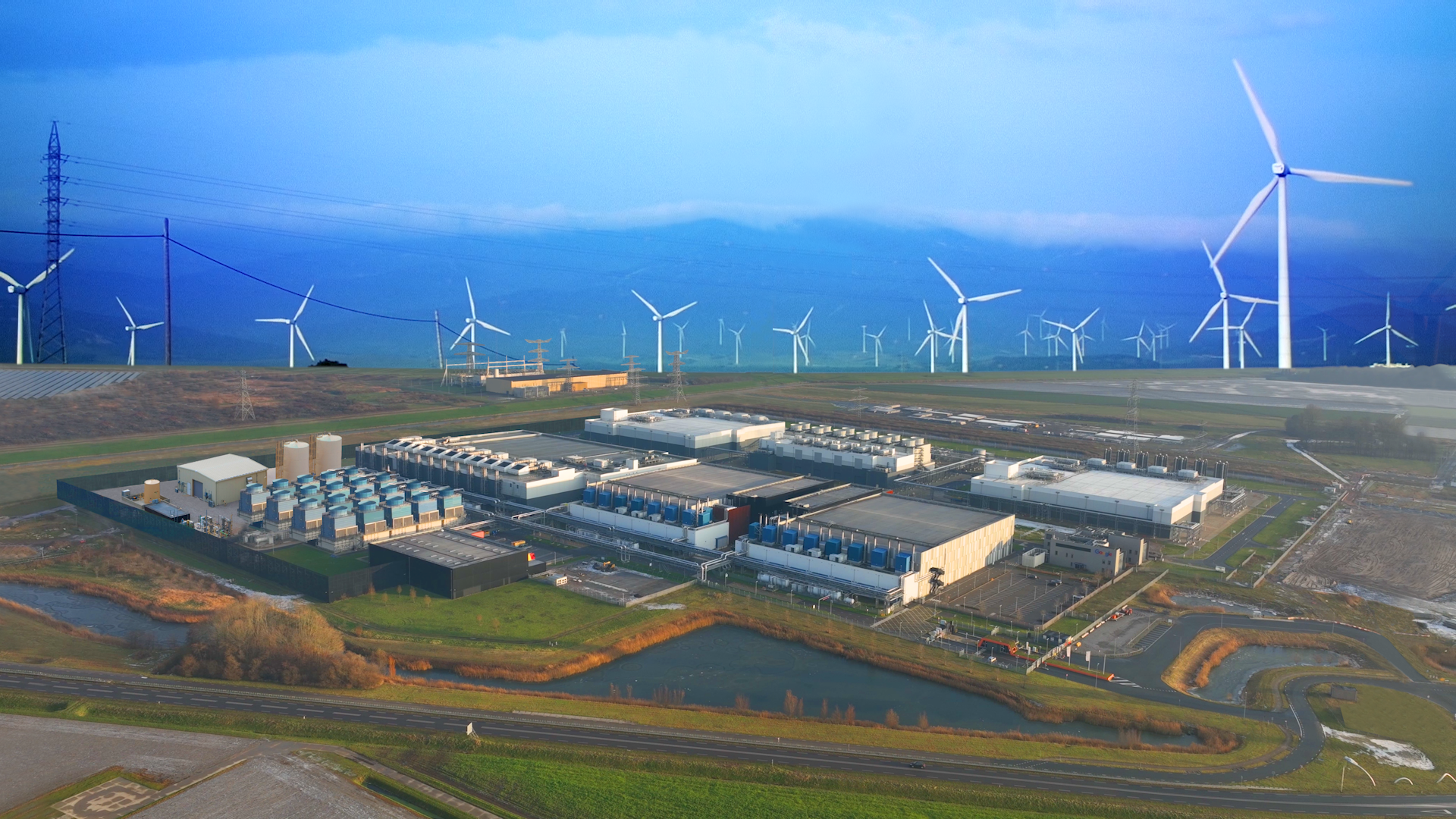
The most advanced configuration, the renewable thermal hybrid microgrid integrates gas turbines with renewable energy sources and advanced controls into a fully coordinated system.
This approach enables data centers to incorporate renewables like wind or solar while maintaining the firm, dispatchable power needed for continuous operations.
Gas turbines play a critical role here by providing stability and reliability when renewable generation fluctuates. At the same time, intelligent control systems can optimize the entire energy mix in real time.
This configuration is particularly well-suited for hyperscale campuses and operators looking to align aggressive sustainability goals with uncompromising performance requirements.
Key advantages:
- Seamless integration of renewables
- Reliable, dispatchable power
- Real-time optimization of cost and emissions
Final thoughts: Built for what’s next
Across all four configurations, there’s a common foundation: fast, flexible, and reliable power.
GE Vernova’s portfolio of gas turbines can enable rapid deployment, modular scalability, and fuel flexibility, including pathways to lower-carbon operation by using carbon capture or burning low-carbon fuels like hydrogen. These capabilities allow data centers to respond to today’s demands while preparing for tomorrow’s energy landscape.
As AI continues to scale, power will increasingly define what’s possible.
And with the right configuration, power can transform from a constraint to a competitive advantage.

Lisa Berry
Data Center Product Strategy Leader, Gas Power
GE Vernova
Lisa Berry is GE Vernova’s Data Center Product Strategy Leader, Gas Power, driving strategic product initiatives for supplying power to Data Centers using Gas Power solutions. She began her career at GE Power, spending 12 years in engineering on thermodynamic modeling of combined cycle plants and novel adjacent technologies. After roles at Honeywell and Hermeus Corporation, she returned to GE Vernova to focus on the energy industry. Lisa holds a BSME from Purdue, an MSME from Georgia Tech, and 17 US patents.

Kassy Hart
Data Centers and Hydrogen Commercialization Leader, Gas Power
GE Vernova
Kassy Hart is the Data Centers & H2 Commercialization Leader at GE Vernova Gas Power, where she drives growth in aeroderivative power generation across emerging markets. Her role spans global customer engagement, power plant configuration, commercial strategy, and market & policy insights. She began her career at GE Energy through the Edison Engineering Development Program and spent a decade in heavy-duty Gas Power Engineering, focusing on industrializing innovative technologies before supporting GE Vernova HQ energy transition strategy. She holds BSME/MSME from the University of Kentucky, completed the Global Energy Leadership Program at Rice Business School, and holds 17 U.S. patents.
Contact us