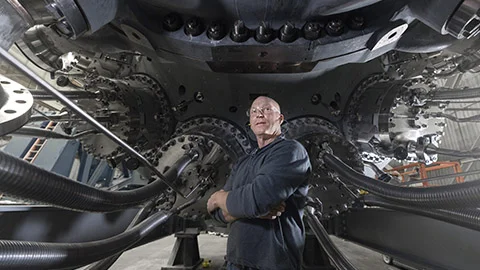



Jawa Satu: The world's largest single-shaft power plant
Learn about GE Vernova's ongoing critical role in supporting Indonesia's energy transition.

Search Gas Power
Upgrades
Your outcomes—delivered
These days, we're all trying to do more with less, but GE Vernova can help. Our upgrades and modernizations can help you get more from your existing assets. Discover the possibilities with our interactive upgrades selector.
Controls
Control Lifecare Services
Whether you need 24/7 technical support, live remote diagnostics, onsite field engineering, or parts management, we have you covered with GE Vernova's Controls Lifecare Services (CLS).
Podcast
Cutting Carbon - Season 9
Join Dr. Jeff Goldmeer, Brian Gutknecht, and special guests for the final season of our 3-part series as they discuss the roles digital and electrification will play in the energy transition.
Decarbonization in action
Explore the future of energy
See how GE Vernova's Gas Power business is helping to build a world that works.
Overview
Indonesia’s rapid economic growth and rising electricity need in recent years, particularly across Jawa, lead to the formation of the government’s 35 GW electrification program, spearheaded by PLN (Perusahaan Listrik Negara). This bold national strategy aims to expand generation capacity, diversify the energy mix, and tap into domestic natural gas as a cleaner, more sustainable energy source. The Jawa Satu project was engineered to help address this moment—filling a critical capacity gap by helping to provide more reliable, flexible, and low-carbon power to help accelerate the country’s energy transition.
Strategically located, the plant plays a vital role in the Jawa, Madura, and Bali (JAMALI) grid—currently the largest and most dynamic power system in Indonesia. With faster ramp-up capabilities than traditional coal or diesel units, Jawa Satu helps enable the integration of more renewables like wind and solar, while its substantial 1,760 MW capacity aims to support regional growth needs and emissions reduction.
Jawa Satu is a pioneering example of what’s possible in Southeast Asia—an innovative, integrated LNG-to-power solution that brings together state-of-the-art power generation and a more secure LNG supply via a Floating Storage and Regasification Unit (FSRU). The project includes two single-shaft generating blocks, each powered by a GE Vernova 9HA.02 gas turbine, STF-D650 steam turbine, W88 generator, and Once Through (OT) HRSG. Each block generates up to 880 MW, making this the largest single-shaft configuration currently in operation anywhere in the world.
At the heart of the project lies GE Vernova’s 9HA.02 gas turbine technology—chosen for its class-leading efficiency (up to 64% in combined cycle operation), rapid start and ramp-up capabilities, and flexible fuel portfolio. The units are also future-ready, capable of blending up to 50% hydrogen today with a publicly stated roadmap to 100%.
The integrated FSRU aims to provide stable LNG supply with on-demand regasification, offshore storage, and ship-to-ship transfer—boosting operational resilience while minimizing environmental impact.
Despite the challenges of the global COVID-19 pandemic, the project consortium—led by GE Vernova alongside Samsung C&T Corporation and PT Meindo Elang Indah—upheld strict and adaptable safety protocols, achieving 97% completion with a flawless safety record and delivery close to schedule.
Outcomes
We have here on site the world's largest single-shaft combined-cycle gas turbine that provides flexibility, adaptability, and reliability. The potential that we have with the hydrogen blend and the carbon capture further strengthen our position within this energy transition.
Dwi Murray
CEO, PT Jawa Satu Power
With its ability to offer power on demand, Jawa Satu helps strengthen grid resilience, supports peak loads, and enables more renewable energy deployment—lowering the overall cost of generation across the Jawa-Bali system. The plant aims to offer substantial CO₂ emission reductions annually compared to coal-fired alternatives and features a closed-loop cooling tower to help reduce marine impact and conserve water resources.
Engineered with the future in mind, GE Vernova’s HA turbines are not only hydrogen-capable but also support the broader decarbonization ecosystem—having contributed to a Carbon Capture and Storage (CCS) value chain study to explore scalable CO2 mitigation solutions.
Case Studies
Contact us