



- Home
- resources
- article
Part 2: Skipping breakthroughs: Why the BWRX-300 SMR banked on proven nuclear technology
Christer Dahlgren, Ph. D.
April 30, 2026
8-min read
Search Gas Power
Upgrades
Your outcomes—delivered
These days, we're all trying to do more with less, but GE Vernova can help. Our upgrades and modernizations can help you get more from your existing assets. Discover the possibilities with our interactive upgrades selector.
Controls
Control Lifecare Services
Whether you need 24/7 technical support, live remote diagnostics, onsite field engineering, or parts management, we have you covered with GE Vernova's Controls Lifecare Services (CLS).
Podcast
Cutting Carbon - Season 9
Join Dr. Jeff Goldmeer, Brian Gutknecht, and special guests for the final season of our 3-part series as they discuss the roles digital and electrification will play in the energy transition.
Decarbonization in action
Explore the future of energy
See how GE Vernova's Gas Power business is helping to build a world that works.
The BWRX-300 did not happen by accident. Every major configuration decision came back to a central question: How do we make it more reliable, simpler, and more cost-disciplined without compromising safety? Let’s walk through the four principles that guided us.
The BWRX‑300 relies on natural circulation to move water through the core. Instead of adding mechanical pumps, which can fail, we extended the reactor vessel and let physics do the work. We engineered a chimney-like structure: steam and water rise through the center of the vessel, while cooler, denser water on the outside drives flow back down through the core. That density difference, combined with the system’s height, creates a stable natural circulation loop. The chimney also has two major advantages for transient and off-normal operation: one, a large steam volume inside the RPV; and two, a large water volume in the down comer for pipe breaks.
What does this mean for grid operators? Many equipment failures that typically affect a plant’s reliability are simply no longer part of the system. We removed moving parts that require maintenance, consume power, or can trip offline. There’s also a significant house‑load benefit. Conventional reactors need large pumps running continuously, drawing electricity that could otherwise go to the grid. With natural circulation, the house-load is lower, resulting in better net output and less energy required to start up and operate the plant.
The key to a short deployment schedule is to use components and parts that have previously been used in this application. In the reactor vessel, all components have been used in a reactor before. One key component and a key learning for GE Vernova Hitachi (GVH) is the fuel; for BWRX-300, we opted to go with a commercially available fuel type, which completely eliminated the need for nuclear fuel product development. Other SMR configurations rely on fuels that are not commercially available and don’t have proven supply chains as of today.
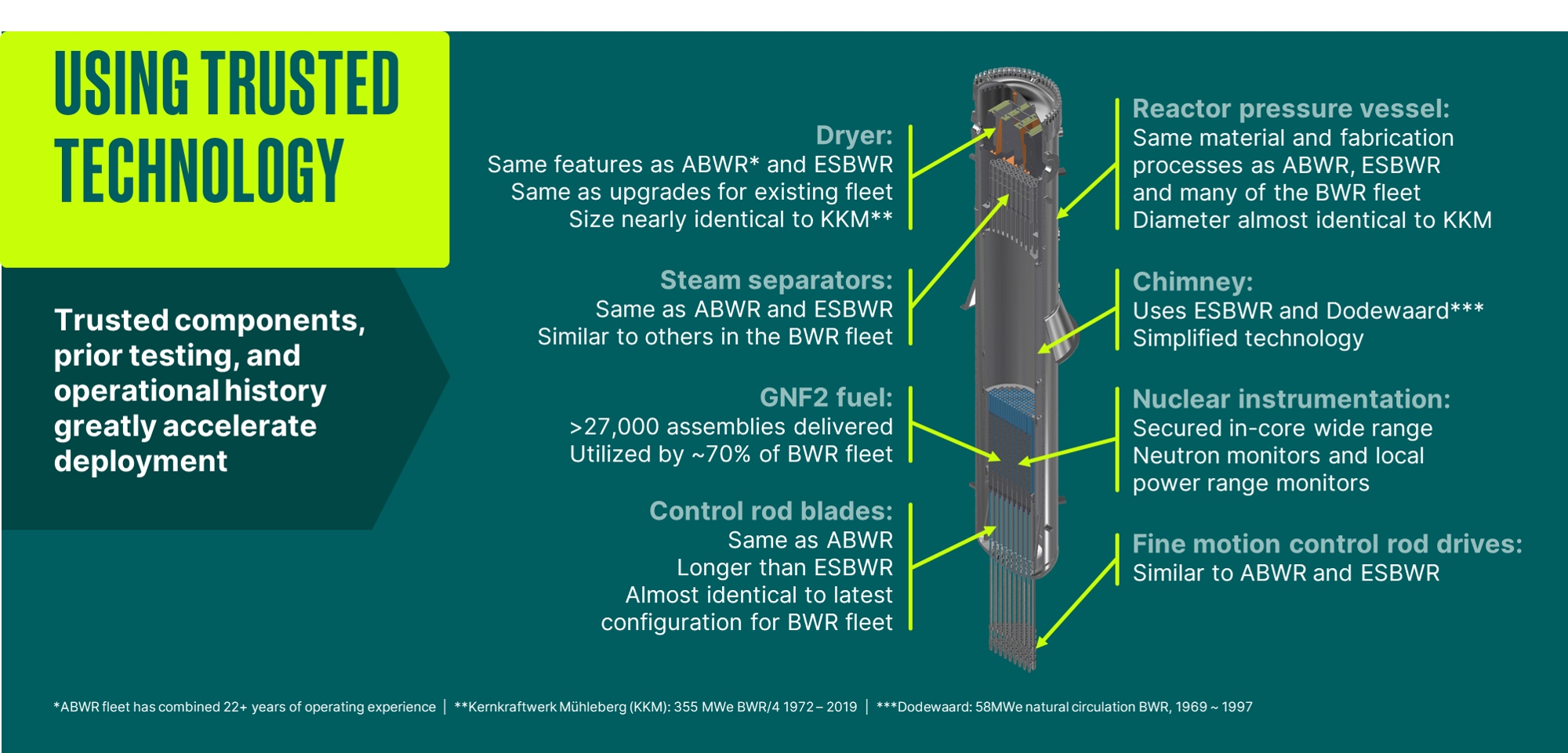
The BWRX-300 uses GNF2 fuel, which is commercially available today and backed by a proven global supply chain that has supplied ~1.7 million rods worldwide. It’s licensed in multiple countries, including Sweden and Canada, and its performance characteristics are well understood. We focused on what already works and what’s already proven, allowing the BWRX-300 to be deployed faster while staying cost‑effective.
The BWRX‑300’s passive safety systems can keep the plant in a safe state for seven days without electrical power or operator action following a station blackout event. Everything relies on natural circulation, gravity‑driven flows, and fail-safe repositioning of key valves. There are no active pumps maintaining water levels, and there is no need for operators to adjust valves manually or for control systems to actively modulate valve positions. The valves are engineered to trip in their safe position, typically open, and stay there for as long as needed. The systems will passively shut down the reactor, remove decay heat, and keep the plant isolated without depending on powered equipment or human intervention.
Now, passive safety is primarily about nuclear safety, not grid reliability. But there’s a connection, many plants in the current fleet use a nearby water source as their ultimate heat sink. Loss of on-site power and loss of cooling water are two high-risk factors in traditional reactors with active safety systems. The BWRX-300 doesn’t need on-site power for safety functions. It doesn’t need to return water to a lake or ocean for cooling. The BWRX-300 has heat exchangers submerged in pools in the seismically qualified reactor building that handle the heat removal passively.
We’ve removed two of the highest-risk factors through thoughtful engineering, helping to make the plant safer and more resilient to the kinds of extreme events that can destabilize a grid.
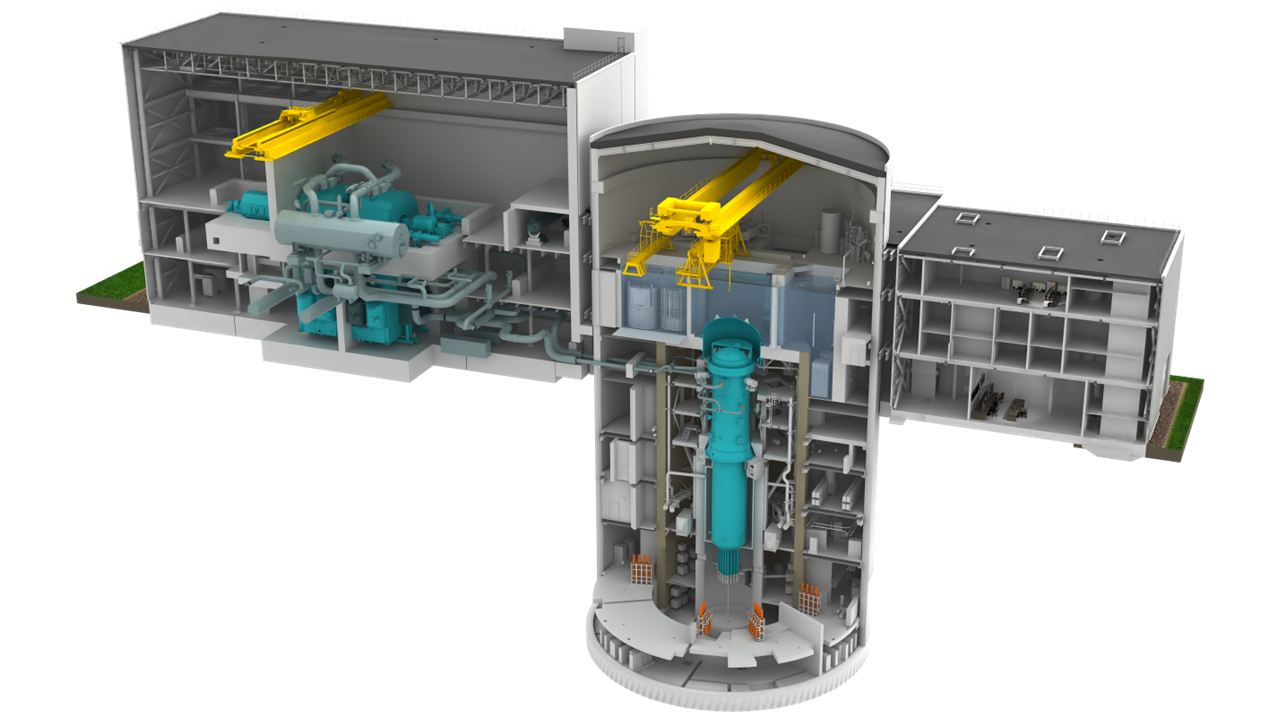
The question we kept coming back to while developing the BWRX‑300 was simple: Can smart simplification make a reactor both more affordable and more reliable? The answer is yes, but only if you are willing to rethink the fundamentals. When you shrink a reactor, you immediately face economy‑of‑scale challenges.
We could not just miniaturize a large plant; we had to reimagine it. As we reduced the size, we kept asking what we could remove without jeopardizing safety, reliability, and cost. Large nuclear power plants accumulate systems to solve problems created by their own scale. They outgrow their original building concepts and end up needing layers of auxiliary equipment. When developing a smaller nuclear boiling water reactor, many of those add‑ons were not necessary. The BWRX-300 fits cleanly into a compact, standardized configuration without all the extra infrastructure.
Fewer components mean fewer failure points, lower construction costs, and shorter building schedules. In nuclear construction, the real cost drivers are concrete and time. Every month on the schedule is another month of financing costs. Our ~48-60-month complete construction timeline, from groundbreaking to commissioning, is not about speed alone. It is about cutting the interest burden that hurts large nuclear projects. This is accomplished by having a simplified configuration with a clear implementation and construction plan.
Cost discipline doesn’t just make a single project viable. It makes it possible to build multiple units, strengthening the grid with reliable, repeatable capacity. One affordable plant can become five, then ten. That is how to scale while keeping reliability front and center.
In part one, we talked about how utilities and governments are moving forward with the BWRX-300, which reflects confidence that it can help deliver dispatchable power and that the engineering choices behind it are sound.
Our technology builds on more than 65 years of operating experience with boiling water reactors (BWRs). We are taking proven components, fuel, vessel specifications, turbines, and steam systems, and configuring them more efficiently in a smaller space. The internals are known, the fuel is known, and the vessel is known. What has changed is how we arrange the valves, where we place the heat exchangers, and how we enhance the overall configuration for passive safety and natural circulation. It is innovation grounded in decades of operational knowledge.
Someone asked me once, if you weren’t working at GE Vernova Hitachi and were developing an SMR from scratch, would you still choose a boiling water reactor? My answer is yes, without hesitation. A BWR can be more cost‑effective because it avoids the need to develop a large heat exchanger, such as a steam generator. A BWR uses a direct cycle, which means no massive steam generators are needed. Which helps to simplify the system, reduce the pressure boundary that must be maintained, and help to keep the plant cost‑efficient to operate.
When engineering the BWRX-300, we extensively studied reliability. We used design-for-reliability models to identify potential vulnerabilities and engineered them out, and we built in margins to handle real‑world operating conditions. During my time operating nuclear plants, I have seen what causes outages, which components are the most sensitive, and which systems create the greatest operational disruptions. With that knowledge, the BWRX-300 was engineered to reduce the components and systems that cause unplanned outages. We’re applying decades of lessons learned to our advanced reactor to help deliver reliable, dispatchable power.
If you want to decarbonize the grid, you need dispatchable baseload power that shows up every day, regardless of whether the conditions are favorable.
We didn’t chase breakthrough technologies or reinvent the wheel. We took proven BWR technology, commercial fuel, and decades of operating experience, and configured them in a way that’s simpler, more reliable, and economically viable at a smaller scale. Every major decision, from natural circulation to passive safety, was about removing complexity and failure points while keeping costs low.
The goal was to help deliver carbon-free, dispatchable electricity that’s economically competitive and has minimal time-to-deployment. Aiming to provide reliable performance when the grid needs it most. That’s what we engineered the BWRX-300 to do.
*Decarbonization, as used in this document, is intended to mean the reduction of carbon emissions on a kilogram per megawatt hour.
**Carbon-free, as used in this document, refers to the absence of carbon dioxide emissions during nuclear power generation and does not include indirect lifecycle emissions.

Chief Consulting Engineer, Power Plant Design and Design Authority, DNNP-1
GE Vernova Hitachi Nuclear Energy
Born in Sala, Sweden, Christer moved to the U.S. in 1995. He holds an M.S. in Mechanical Engineering from the Royal Institute of Technology in Stockholm and a Ph.D. in Nuclear Engineering from the University of Maryland. He began his career at the Palisades Nuclear Plant, serving in roles including safety analysis engineer, shift SRO, work control center manager, and shift manager. He joined GE Vernova Hitachi in 2008, supporting power uprates, new plant proposals, and advanced reactor design projects for both light‑water and sodium reactors. He is the co‑inventor and principal designer of the BWRX‑300 SMR. Currently, he serves as Chief Consulting Engineer for Power Plant Design at GE Vernova Hitachi, is Design Authority for DNNP‑1, and received the 2026 Swedish Nuclear Society Honorary Award.
Discover more
Contact us