
Search Gas Power
Recommended resources
Upgrades
Your outcomes—delivered
These days, we're all trying to do more with less, but GE Vernova can help. Our upgrades and modernizations can help you get more from your existing assets. Discover the possibilities with our interactive upgrades selector.

Controls
Control Lifecare Services
Whether you need 24/7 technical support, live remote diagnostics, onsite field engineering, or parts management, we have you covered with GE Vernova's Controls Lifecare Services (CLS).
Podcast
Cutting Carbon - Season 9
Join Dr. Jeff Goldmeer, Brian Gutknecht, and special guests for the final season of our 3-part series as they discuss the roles digital and electrification will play in the energy transition.

Decarbonization in action
Explore the future of energy
See how GE Vernova's Gas Power business is helping to build a world that works.
Prefer to listen?
Stream our audio version
Most outages restore existing performance. Your next outage, however, can be a strategic opportunity to upgrade your steam turbine and increase output. As gas turbine upgrades raise exhaust energy and steam flow beyond the limits of the existing steam turbine, an advanced steam path upgrade allows the unit to utilize that additional energy efficiently.
The 20-year milestone across the F-class fleet
Much of the F-class combined-cycle fleet has now been operating for 20+ years, with many units approaching 25 years of service. These plants, installed during the early 2000s build cycle, are now entering major inspection intervals, during which these inspections are typically treated as repair outages.
In most cases, worn components are replaced-in-kind, and the turbine is returned to service at its original performance level. This restores operation, but it does not increase output or prepare the plant for changing system demands.
Electricity demand is increasing worldwide, and existing combined-cycle plants are being asked to help deliver additional capacity while maintaining reliability. Creating a shift in how outages should be viewed.
Your next outage is a golden window to shift from a repair-focused to a performance-enhancement approach. Whether a gas turbine upgrade is planned in the near term or later in the decade, outage planning should account for how the full plant can process additional energy.
The steam throughput constraint
In a combined-cycle plant, performance improvement upgrades typically begin with the gas turbine. Higher firing temperatures and more air flow increases exhaust energy, which flows into the HRSG and is converted into steam.
That steam is then processed by the steam turbine, converted into mechanical power, and then converted into electricity by the generator. But to capture that additional output, each component in this sequence must be able to process the additional energy.
When the steam turbine cannot process the increased steam flow, the unit reaches a throughput constraint, commonly referred to as the “swallowing limit.” At this point, operators must manage excess energy rather than convert it into output. This is typically done through a combination of actions:
- Increasing attemperation
- Reducing steam turbine loading
- Limiting gas turbine operation or ambient capability
- Reducing duct firing where applicable
These actions help to maintain appropriate operation, but they result in opportunity loss of additional megawatts, since available exhaust energy is not fully converted into electrical output.
Breaking the repair cycle
Traditional maintenance strategies focus on repairing known issues such as foreign object damage, erosion, creep, or dished diaphragms. These repairs restore functionality but do not increase the turbine’s capacity to process additional steam. As a result, even after a major outage, the steam turbine may remain the limiting component in the power generation cycle.
An Advanced Steam Path (ASP) upgrade changes this approach. Instead of restoring the original configuration, the upgrade replaces aging components with modern configurations and resizes the steam path to process more steam. Helping the steam turbine convert the additional steam output from the gas turbine, rather than requiring the plant to manage or discard it.
Advanced Steam Path (ASP) upgrade
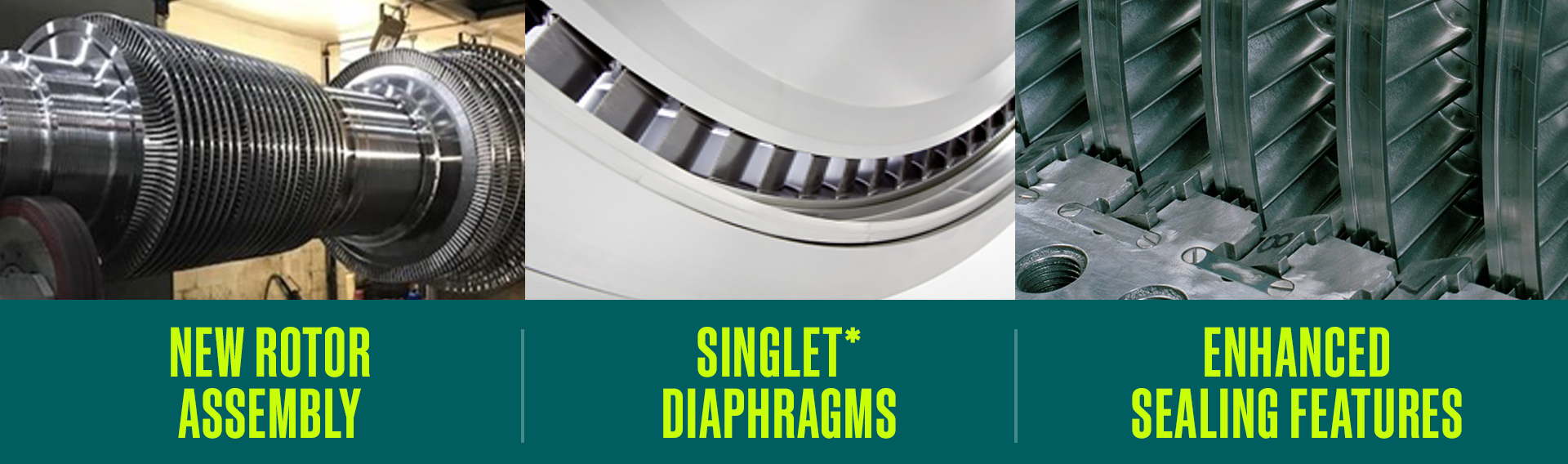
The ASP upgrade was engineered to increase throughput, improve reliability, and align the steam turbine with current and future operating conditions. The ASP upgrade focuses on resizing the steam path using more efficient blading and sealing allowing the turbine to handle more steam and produce more output with an improved heat rate.
GE Vernova has developed pre-engineered solutions for D11 steam turbines, with multiple installations in service and additional deployments planned. These upgrades are based on established technology with over 300K operating hours in the field since 2015.
- Availability and reliability: Helps address multiple TILs relating to diaphragm dishing and N2 packing head cracking (up to 20-day reduction in outage duration).
- Output: Up to 2.2% steam turbine output increases (10-15% in some cases, with flow increase).
- Efficiency: Up to 0.7% combined-cycle heat rate improvement
Customer success: Measurable megawatt gains
ASP upgrades help unlock additional power by converting more steam into electrical output, especially in cases where the steam turbine is no longer the limiting factor. To bring this to life, here are a couple of real-world examples where customers captured meaningful gains:
Customer success story #1
A customer upgraded from a 7F.04 AGP configuration to AGP Tech with DLN 2.6+, paired with a D11 steam turbine ASP upgrade. By upgrading and resizing the HP/IP sections to accommodate increased steam flow, the plant was able to generate an additional 19 MW.
- Gas turbine upgrade: AGP Tech with DLN 2.6+
- Steam turbine upgrade: D11 ASP (HP/IP section)
- Result: +19 MW from improved steam utilization
Customer success story #2
In this case, the customer moved from a 7F.04 AGP to a 7F.05 configuration, combined with a more extensive steam turbine upgrade. With both HP/IP and LP sections upgraded and resized, the plant was able to take full advantage of the additional steam and gained a boost in output of 33 MW.
- Gas turbine upgrade: 7F.04 AGP to 7F.05
- Steam turbine upgrade: D11 ASP + LP scope
- Result: +33 MW through increased steam flow and utilization
Is your steam turbine ready for the next 20 years?
Plants approaching the 20-year inspection cycle often focus on repairs that restore baseline performance. However, your next outage presents a strategic opportunity to enhance your plant’s capabilities. An Advanced Steam Path upgrade enables the turbine to process additional steam and convert it into output during that same outage window as your gas turbine upgrade. Steam turbine upgrades should be considered alongside gas turbine upgrades, even if they are executed in different outage cycles. The objective is to remove the steam throughput constraint and position the plant to capture additional output.

Jason Bowers
Steam Turbine and HRSG Upgrades Global Sales Leader
GE Vernova
Related services
Explore more stream services and upgrades
Contact us
Speak to an expert today to learn how ASP can help your plant
*Trademark of GE Vernova and/or its affiliates.