
Search Gas Power
Recommended resources
Upgrades
Your outcomes—delivered
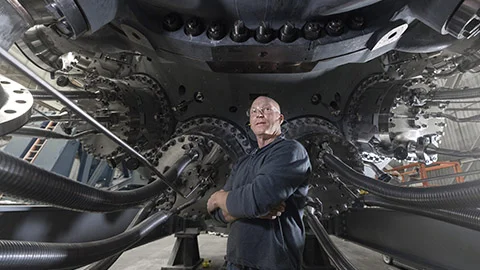
These days, we're all trying to do more with less, but GE Vernova can help. Our upgrades and modernizations can help you get more from your existing assets. Discover the possibilities with our interactive upgrades selector.

Controls
Control Lifecare Services
Whether you need 24/7 technical support, live remote diagnostics, onsite field engineering, or parts management, we have you covered with GE Vernova's Controls Lifecare Services (CLS).
Podcast
Cutting Carbon - Season 9
Join Dr. Jeff Goldmeer, Brian Gutknecht, and special guests for the final season of our 3-part series as they discuss the roles digital and electrification will play in the energy transition.

Decarbonization in action
Explore the future of energy
See how GE Vernova's Gas Power business is helping to build a world that works.
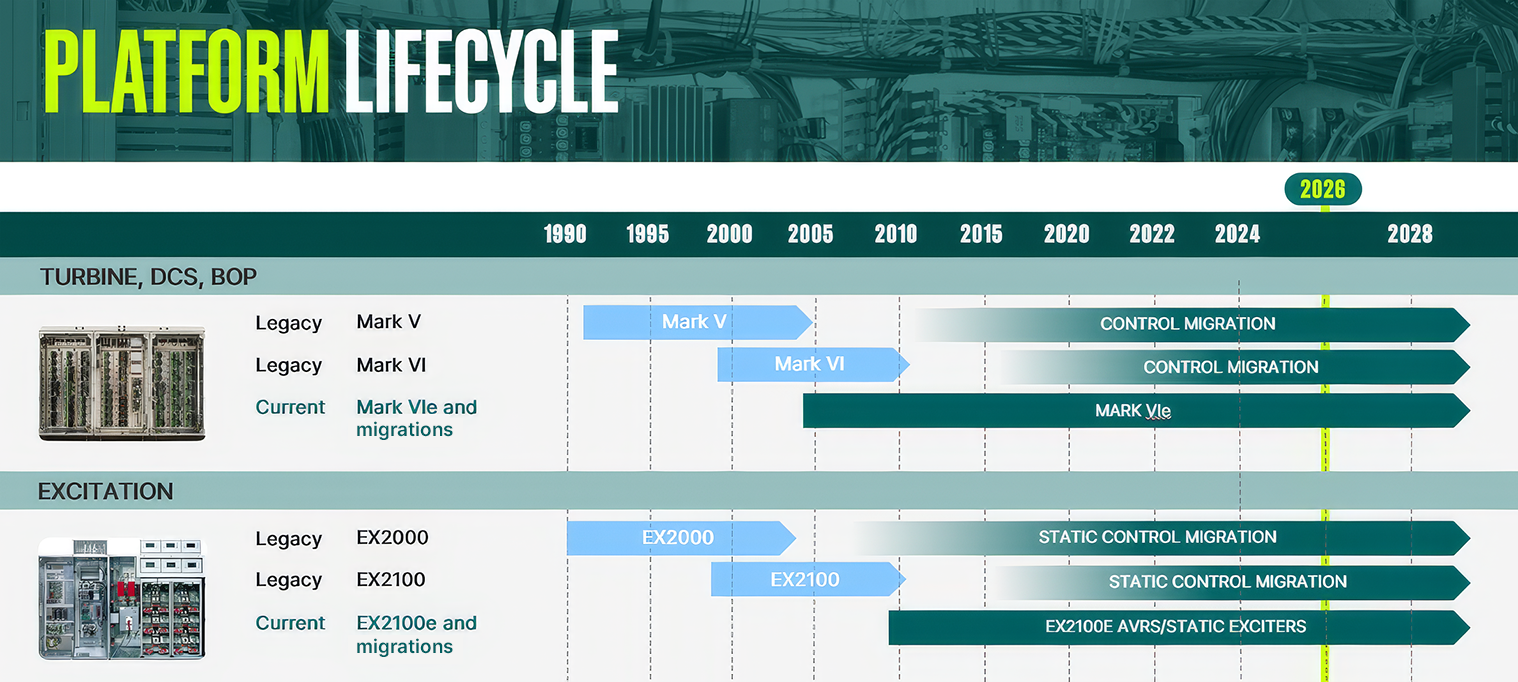
When control platforms had a prime life of around ten years, operators typically faced a choice between investing in an aging platform or absorbing the cost and disruption of a full replacement. The Mark VIe helps you avoid that platform scenario.
GE Vernova began shipping the Mark* VIe in 2004 and it’s used today on all of our latest heavy-duty and aeroderivative gas turbines. That is more than two decades of continuous production and active investment.
Today, more than 7,000 Mark VIe systems are installed on gas turbines, and around 800 to 900 of them in the aeroderivative fleet. Built for extended life, the Mark VIe is used in the installed base that generates approximately 25% of the world's electricity, demonstrating itself as a proven control system in the field.
Why previous Mark legacy control systems had shorter lives
The Mark V and Mark VI shared a fundamental architectural constraint. I/O modules sat inside a rack, and often multiple layers of circuit boards as the backplane, that could not be repaired. As each platform aged and a next-generation system arrived, the installed population of the previous one shrank. Supporting that rack became the first thing that determined end-of-life. Every generation of controls before the Mark VIe followed this pattern, including third-party PLCs and comparable platforms. The Mark VIe removed the rack and improved the lifecycle considerably.
What the architecture makes possible
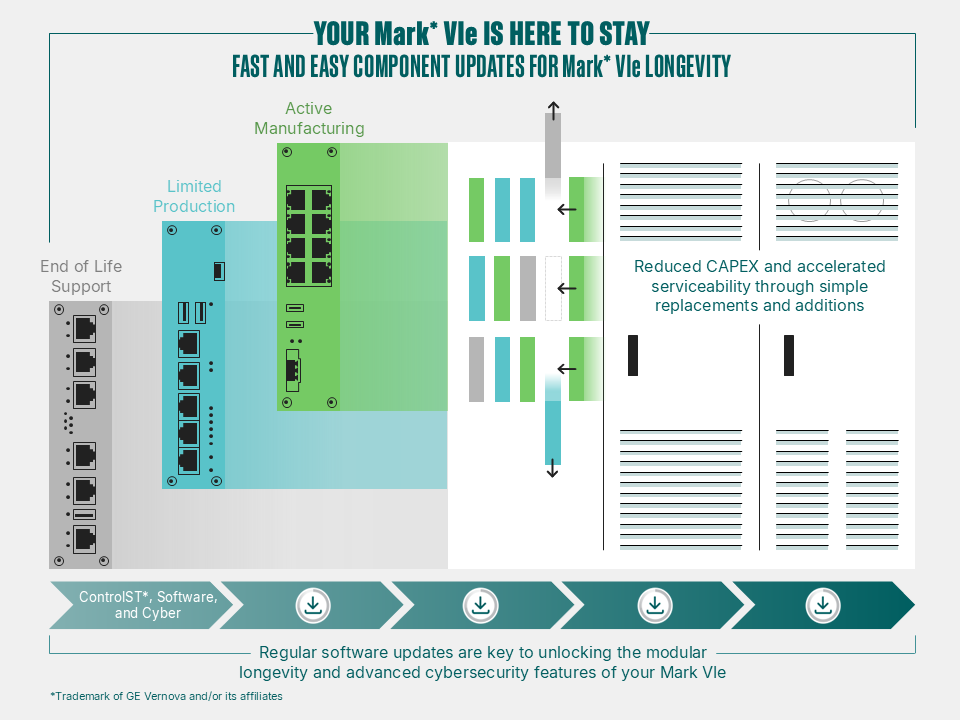
The Mark VIe is built around distinct, independently serviceable building blocks that include the software, the main CPU, a communications switch, and the I/O packs that handle field I/O. Each hardware building block requires 28-volt DC power and Ethernet communications. Notably absent are a rack, rack power supplies, and a distinct form factor.
That shared component hardware interface standard of lower voltage power and an Ethernet connection is one of the reasons for the platform's longevity. The envelope each component is in can evolve indefinitely, provided the next-generation revision maintains those two interface requirements. The latest CPU or revised I/O pack drops into an existing system without requiring the operator to change anything else.
When a component reaches obsolescence, the sustaining engineering team configures a replacement, whether to address parts availability or a field reliability issue, and releases a different version; the operator replaces that component only. A unit that has been running the same I/O pack for 15 years can be updated without a hardware platform migration. One of the platform's most significant operational advantages is that once you replace the component and upgrade the software, the system is back in service.
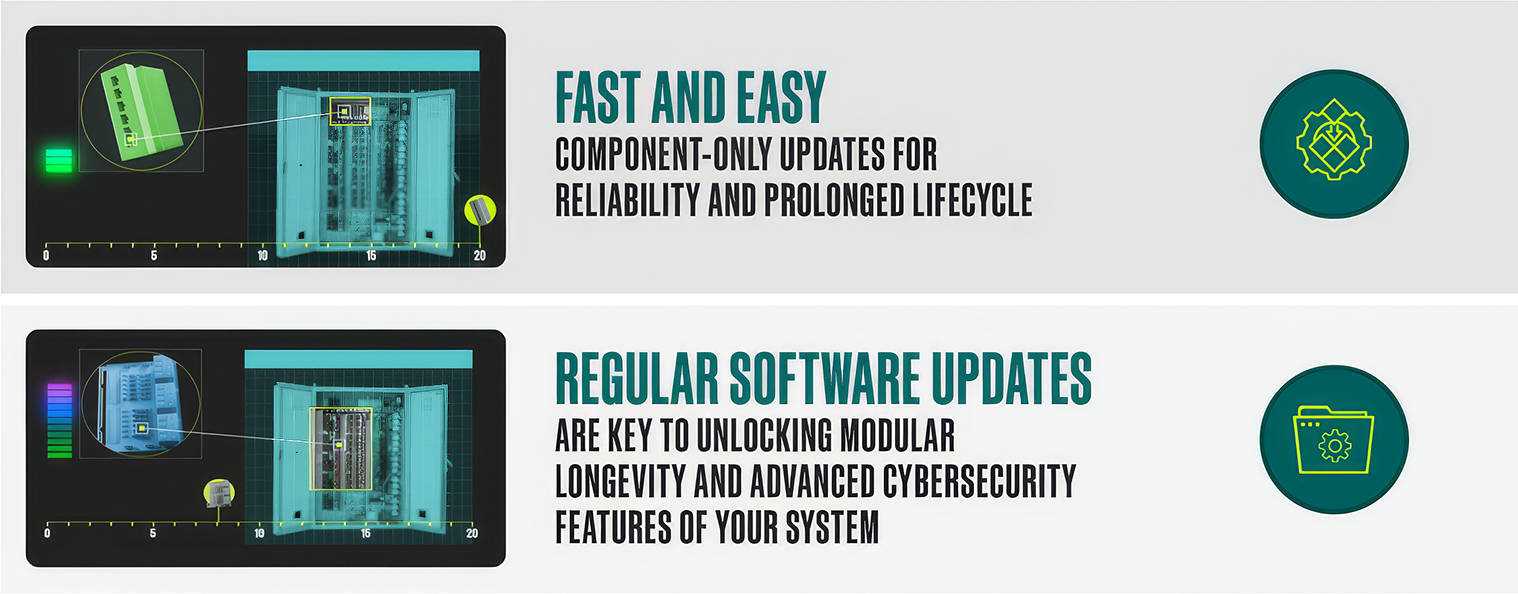
Common modular upgrades include CPU upgrades (to support features like Model-Based Control), HMI and I/O pack replacements, and new power supply and network hardware.
The hardware lifecycle model
GE Vernova formally manages Mark VIe hardware components through three defined phases, documented in the Mark VIe Control System Extended Lifecycle Policy.
- Active manufacturing: The component is actively produced and shipped as standard for updated and retrofit projects.
- Limited production: The component is no longer specified for the latest installations and a replacement is available. Operators in this phase are advised to secure spare parts, plan the transition, and stay current with ControlST* so the updated component can be inserted without friction.
- End-of-life support: The component can no longer be feasibly manufactured, and support continues on a best-effort basis. Before this transition, GE Vernova aims to issue a last-time buy offer, giving operators a defined window to act in.
This three-phase model gives operators something previous control system generations could not: a predictable, documented planning horizon, with specific action recommendations at each stage.
The software lifecycle model
Since 2004, the Mark VIe platform has gone through multiple generations of processor technology, multiple I/O pack data acquisition upgrades, and significant evolution in communication protocols, smart device integration, and cybersecurity architecture. The industry 20 years ago and the industry today are two different places. What has not changed is the fundamental software suite delivering those advances.
GE Vernova manages Mark VIe software in two states:
- Current release software is actively developed, receiving updated features, improvements, and security patching.
- End-of-development software no longer receives features or patching, and operators are advised to move to the current release to maintain cybersecurity best practices and support for the latest hardware.
Cybersecurity as a lifecycle requirement
Aeroderivative fleets are under growing pressure on cybersecurity. Faster start requirements, higher cycling rates, greater use of providing black start capable generation, and tightening OT security standards have placed demands on owners that historically operated under lighter requirements. A cybersecurity plan and supporting technology is no longer optional.
The Mark VIe addresses this through a defense-in-depth approach across all components. OTArmor* provides hardened network architecture, active monitoring, data loss protection, centralized backup/restore capability, and patch management. Coupled with a Controls Lifecare Services Multi-Year Agreement (CLS MYA), customers can benefit from representative hardware environment tested software updates and security patching on a continuous basis.
Cybersecurity is built into the platform from the start and maintained through lifecycle offerings supporting a site’s compliance program.
What Controls Lifecare Services (CLS) delivers
CLS helps operators execute against the hardware and software lifecycle models. Available as a multi-year agreement, CLS covers hardware components, ControlST* software updates, network switch firmware, security patching, and lifecycle assessments through a dashboard that tracks the specific hardware and software status of the installed system. It also supports long-term budget planning for incremental upgrades and parts inventory.
The business case in plain terms
This communication contains forward-looking statements. Actual results may differ materially from those projected due to risks and uncertainties. GE Vernova undertakes no obligation to update these statements.

Robert White
Sr. Sales Manager, Control Solutions and Services, GE Vernova
Rob has focused on the controls retrofit space for over 25 years, supporting applications within steam, industrial gas, aero gas, plant, hydro, and generator environments. Early in his career, he was shadowing a field engineer who stated, “I know less now than when I began, because I now realize how much more there is to know." This has stayed with him as he pursues continuous learning in his field. Based out of upstate New York, he enjoys boating on the freshwater lakes, hiking, spending time with his family, and playing soccer.
Explore content on Mark VIe and aeroderivative gas turbines
Contact us
Ready for an upgrade or assessment?
*Trademark of GE Vernova and/or its affiliates