A gas turbine is a combustion engine at the heart of a power plant that can convert natural gas or other liquid fuels to mechanical energy. This energy then drives a generator that produces the electrical energy that moves along power lines to homes and businesses.

Search Gas Power
Search our products, insights, and resources
Recommended resources
Upgrades
Your outcomes—delivered
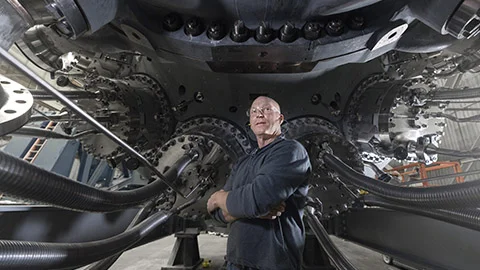
These days, we're all trying to do more with less, but GE Vernova can help. Our upgrades and modernizations can help you get more from your existing assets. Discover the possibilities with our interactive upgrades selector.

Controls
Control Lifecare Services
Whether you need 24/7 technical support, live remote diagnostics, onsite field engineering, or parts management, we have you covered with GE Vernova's Controls Lifecare Services (CLS).

Podcast
Cutting Carbon - Season 9
Join Dr. Jeff Goldmeer, Brian Gutknecht, and special guests for the final season of our 3-part series as they discuss the roles digital and electrification will play in the energy transition.

Decarbonization in action
Explore the future of energy
See how GE Vernova's Gas Power business is helping to build a world that works.
Gas turbine benefits
Fast, flexible, and sustainable
GE Vernova gas turbines are a great choice for a variety of industries and applications. Featuring unmatched fuel flexibility, ability to complement renewables, and fast installation/startup time, our aeroderivative and heavy-duty gas turbines offer proven, industry-leading performance.
Up to 100% hydrogen capability
As little as 2 weeks installation and commissioning
As fast as 5 minutes start time
More than 7,000 units worldwide
7000+ worldwide operating turbines
34 MW to 571 MW output range
How it works
How does a gas turbine work and produce electricity?
To generate electricity, the gas turbine heats a mixture of air and fuel at very high temperatures, causing the turbine blades to spin. The spinning turbine drives a generator that converts the energy into electricity.
The gas turbine can be used in combination with a steam turbine—in a combined-cycle power plant—to create power extremely efficiently.
Frequently asked questions
Learn more about gas turbines
What fuels can a gas turbine use?
Gas turbines are highly fuel-flexible machines capable of operating on a wide range of liquid and gaseous fuels. The specific fuel used depends on the turbine's configuration, the application, and what's available at the site.
Fuels broadly fall into several categories, including crude oils, refined petroleum products, natural gas and gas-derived fuels, and alternative or low-carbon options such as hydrogen and biofuels.
Crude oils
- Arabian Extra Light (AXL) crude oil
- Arabian Super Light (ASL) crude oil
- Heavy crude oil Light Crude Oil (LCO) Medium crude oil
Refined petroleum products
- Distillate Oil #2 (DO2)
- Heavy Fuel Oil (HFO)
- Kerosene (Jet A or Jet A-1)
- Naphtha
Natural gas and gas-derived fuels
- Ethane (C2)
- Lean methane
- Liquid Natural Gas (LNG)
- Liquefied Propane Gas (LPG)
- Natural Gas (NG)
- Sour gas (H2S)
- Steel mill gases
- Syngas
Alternative and lower-carbon fuels
- Biodiesel
- Condensate or Natural Gas Liquids (NGL)
- Dimethyl Ether (DME)
- High H2
- Hydrogen blends
- Methanol / ethanol (alcohol)
How efficient are gas turbines?
Gas turbine efficiency measures how effectively a turbine converts fuel into usable power. Higher efficiency means lower fuel costs, reduced emissions, and more output from the same energy input. Modern gas turbines typically achieve 33–44% efficiency in simple cycle operation, and over 60% in combined cycle configurations, where exhaust heat is captured to generate additional power.
GE Vernova's gas turbine efficiency numbers depend on:
- The specific turbine configuration
- Whether it is used in simple cycle or combined cycle applications
- 50/60 Hz electrical frequency
What is the difference between a gas turbine and a gas engine?
While both machines are considered internal combustion engines that convert a fuel into mechanical energy, they differ in how they operate and the applications where they are used.
A gas turbine mixes compressed air with either natural gas or liquid fuels (diesel or aviation fuel) then ignites it, producing high-speed exhaust gases that rotate turbine blades connected to a shaft that powers a generator or other machinery. They are used in large-scale power generation and aviation/marine propulsion systems.
A gas engine uses either spark or compression ignition on natural gas, biogas, propane, or liquid gasoline/diesel fuel to push pistons inside cylinders. They can be used in electricity generation, industrial cogeneration, and transportation (buses, trucks) applications.
What is the lifespan of a gas turbine?
As with most types of heavy machinery, a gas turbine’s operational lifespan depends on how well it is both constructed and maintained. Gas turbines have comparatively long lifespans because they tend to operate continuously and have fewer moving parts.
While this timeframe can’t be distilled down to a specific number, gas turbines can operate continuously if they are inspected every 4,000 hours to help ensure that worn bearings/rotors or damaged blade tips aren’t causing excessive vibration. Turbines should also be overhauled every 25,000 to 50,000 hours, depending on service.
Related gas turbine content
You might also be interested in


Contact us