Part 1: The role of the BWRX-300 SMR in keeping the lights on
Christer Dahlgren, Ph. D.
April 30, 2026
8-min read
Electricity demand must be met at every moment, regardless of weather conditions or time of day. Yet grid operators increasingly face periods when variable generation, such as wind and solar, is limited or misaligned with demand, while peak consumption can surge during cold weather, heatwaves, or other system stress events. In these moments, demand can approach or exceed the available supply of dispatchable baseload power needed to maintain system reliability.
As someone who’s spent decades operating and working on nuclear plants, as well as an owner and operator of a Swedish cottage “sommarstuga”, I’ve watched the grid challenges intensify, resulting in huge seasonal variations in electricity prices. The data shows us that if you want to decarbonize* while keeping the lights on 24/7, renewables alone won’t be enough.
Research from the Massachusetts Institute of Technology (MIT) confirms that a decarbonized grid needs at a minimum 20-40% dispatchable base power.1 Without that foundation, you’re left with fluctuating power prices and an unreliable grid. Which is why you also need to install dispatchable, carbon-free** baseload power. There are really only two essentially carbon-free baseload power options: hydro and nuclear. That’s where GE Vernova Hitachi Nuclear Energy’s BWRX-300 SMR is going to play an important role.
When we talk about reliability, we’re really talking about two interconnected factors: dispatchability and availability. Let’s break down what each of these means in practice.
Nuclear power plants can start regardless of weather conditions, within reason. They operate in extreme cold, extreme heat, and mostly everything in between. This is a fundamental advantage when it comes to grid stability. With GE Vernova Hitachi’s BWRX-300, we engineered it for a ~95% capacity factor, including planned refueling outages. Compare that to wind power’s ~30% capacity factor and solar power’s ~25% capacity factor.2
The reliability of the BWRX-300 doesn’t stop there. Many people were surprised when we first proposed that smaller units improve grid reliability. But, for example, if you have one 1,500-megawatt (MW) plant and it trips offline due to equipment failure, you’ve just lost 1,500 MW. Electricity prices spike, industries scramble, and the grid struggles to compensate while reserve power is brought online. Using SMRs, five 300 MW BWRX-300 units can produce the same total output. If one unit has an issue, you’ve lost only 300 MW, and the other four keep running. This results in a smaller grid disruption, helping to keep the grid stable and prices predictable. A multi-unit approach creates natural redundancy at the system level.
Now let’s talk about affordability and deployment timelines, because this is where smaller units can change the game. Few utilities can afford to build a traditional large nuclear power plant. That’s nation-to-nation deal territory, not typically utility territory. However, an SMR is a different conversation. Smaller utilities and countries can participate too. For instance, countries like Estonia, which would need extremely large infrastructure upgrades to support, a large nuclear plant on their grid, can now realistically consider small nuclear power plant units.
There is also a financial advantage that often gets overlooked. With multiple SMRs, you can bring the first one online while the others are still being built. You start generating power to the grid and revenue years before a traditional large nuclear plant project. It’s similar to a rental development; developers don’t wait until every unit is complete before renting out the first apartments. They want people to move in and create revenue as soon as possible. The same principle applies here, fundamentally changing the economic and risk profile of nuclear deployment.
It is one thing to have a strong idea on paper or in a PowerPoint. It is quite another to build a power plant, with a real project schedule, a functioning supply chain, and a team actively executing the work. Today, the first of four BWRX-300 units is under construction in Darlington, Ontario, Canada. The BWRX-300 SMR is no longer just a concept or a rendering in a PowerPoint slide deck; crews are on site right now building the first SMR in the Western world, with an operational target of 2030.
The construction of the first BWRX-300 is a major milestone, and its success is very important. The entire nuclear industry is watching closely. Success here, delivered on time and on budget, will be a significant win for grid reliability and the future of carbon-free power generation.
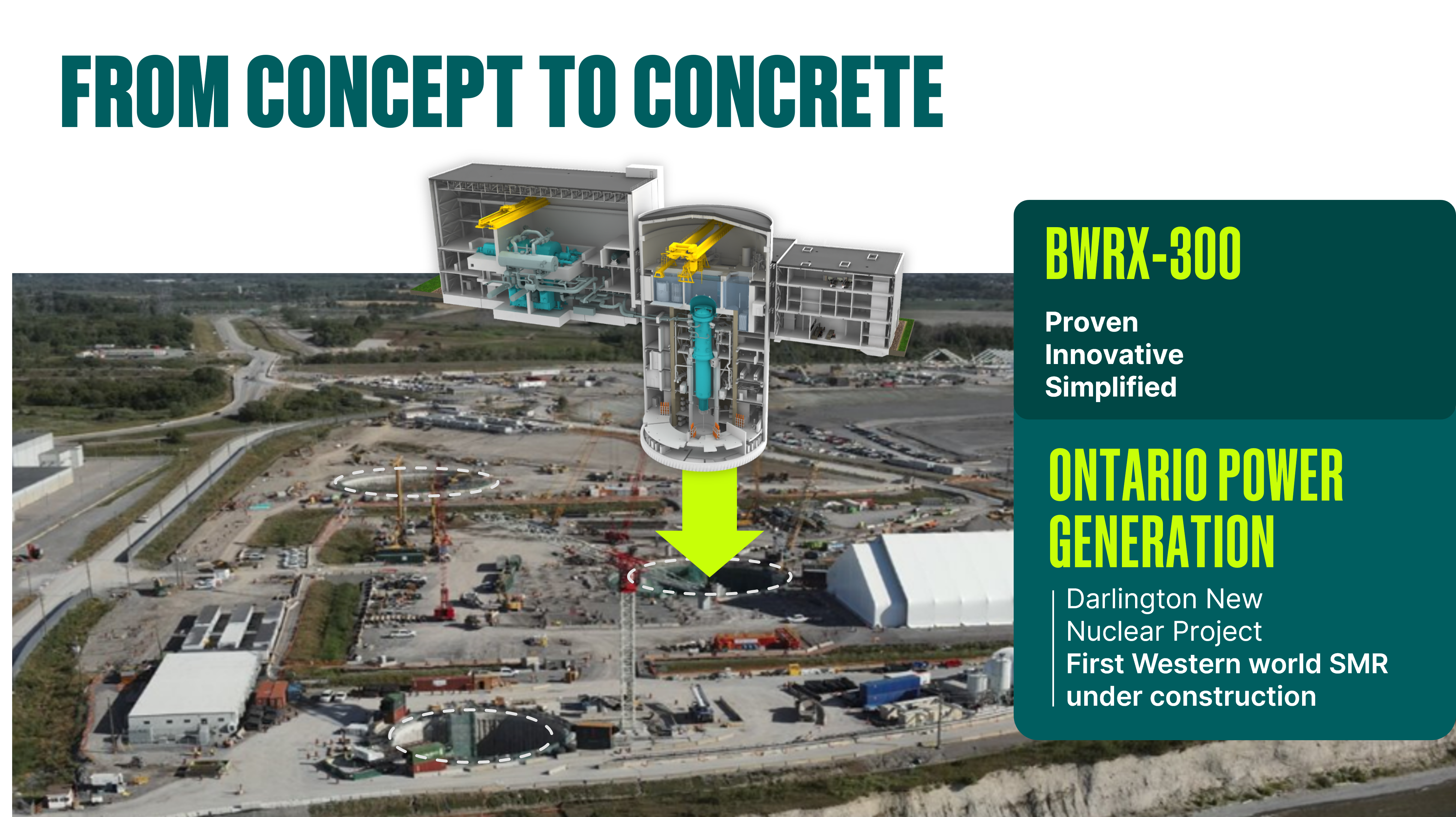
Beyond the Darlington, Ontario project, the Tennessee Valley Authority has submitted a construction permit application to deploy the BWRX-300 at its Clinch River site. Additionally, the U.S. and Japanese governments have agreed to invest up to $40 billion in future BWRX-300 deployment at two sites in Tennessee and Alabama.
In Poland, we are working with ORLEN Synthos Green Energy (OSGE) on the technical configuration of the BWRX-300 for potential deployment across six locations, totaling 24 BWRX-300 SMRs. The BWRX‑300 has also been down‑selected by Vattenfall as one of two finalists for new reactors adjacent to the Ringhals plant on the Värö Peninsula in Sweden. Fortum is evaluating the BWRX-300 as the only SMR option for deployment in Sweden and Finland, and in Estonia, Fermi Energia has selected the BWRX-300 for potential deployment.
Knowing you need carbon-free, dispatchable electricity is one thing. The harder part is whether you can actually build it at a cost that works and at a scale that fits your needs. SMRs like the BWRX-300 can provide carbon-free, dispatchable power that can be built at a scale and costs that work for utilities, countries, and grids of all sizes. Read Part two, Why the BWRX-300 SMR banked on proven nuclear technology, to discover the engineering decisions behind the BWRX-300, from proven technologies to deliberate configuration choices, that were built to support reliable, affordable operation.
1) The Future of Nuclear Energy in a Carbon-Constrained World: An Interdisciplinary MIT Study, MIT Energy Initiative, September 2018, https://energy.mit.edu/research/future-nuclear-energy-carbon-constrained-world/.
*Decarbonization, as used in this document, is intended to mean the reduction of carbon emissions on a kilogram per megawatt hour.
**Carbon-free, as used in this document, refers to the absence of carbon dioxide emissions during nuclear power generation and does not include indirect lifecycle emissions.

Chief Consulting Engineer, Power Plant Design and Design Authority, DNNP-1
GE Vernova Hitachi Nuclear Energy
Born in Sala, Sweden, Christer moved to the U.S. in 1995. He holds an M.S. in Mechanical Engineering from the Royal Institute of Technology in Stockholm and a Ph.D. in Nuclear Engineering from the University of Maryland. He began his career at the Palisades Nuclear Plant, serving in roles including safety analysis engineer, shift SRO, work control center manager, and shift manager. He joined GE Vernova Hitachi in 2008, supporting power uprates, new plant proposals, and advanced reactor design projects for both light‑water and sodium reactors. He is the co‑inventor and principal designer of the BWRX‑300 SMR. Currently, he serves as Chief Consulting Engineer for Power Plant Design at GE Vernova Hitachi, is Design Authority for DNNP‑1, and received the 2026 Swedish Nuclear Society Honorary Award.
Discover more
Contact us