

Gas Generator Health Monitoring (GHM)
Effective gas turbine maintenance depends on accurate operational and inspection data to identify potential issues, assess equipment condition, and reduce the risk of failures and unplanned downtime.

Search Gas Power
Upgrades
Your outcomes—delivered
These days, we're all trying to do more with less, but GE Vernova can help. Our upgrades and modernizations can help you get more from your existing assets. Discover the possibilities with our interactive upgrades selector.
Controls
Control Lifecare Services
Whether you need 24/7 technical support, live remote diagnostics, onsite field engineering, or parts management, we have you covered with GE Vernova's Controls Lifecare Services (CLS).
Podcast
Cutting Carbon - Season 9
Join Dr. Jeff Goldmeer, Brian Gutknecht, and special guests for the final season of our 3-part series as they discuss the roles digital and electrification will play in the energy transition.
Decarbonization in action
Explore the future of energy
See how GE Vernova's Gas Power business is helping to build a world that works.
Overview
Generator Health Monitoring (GHM) is an integrated, modular online monitoring suite for air-cooled, water-cooled, and hydrogen-cooled power plant generators. It provides continuous inspection and condition assessment to identify developing issues at an early stage.
GHM supports a condition-based maintenance strategy that can help improve generator reliability and availability, support outage planning, and extend equipment life while helping to reduce maintenance costs.
The GHM platform is a fully integrated, modular system with a user-friendly, web-based interface. A single care box replaces multiple standalone systems, allowing operators to monitor any combination of the following generator parameters in real time to assess equipment condition and maintenance needs:
The GHM platform is also compatible with most sensors manufactured and installed by third-party providers.
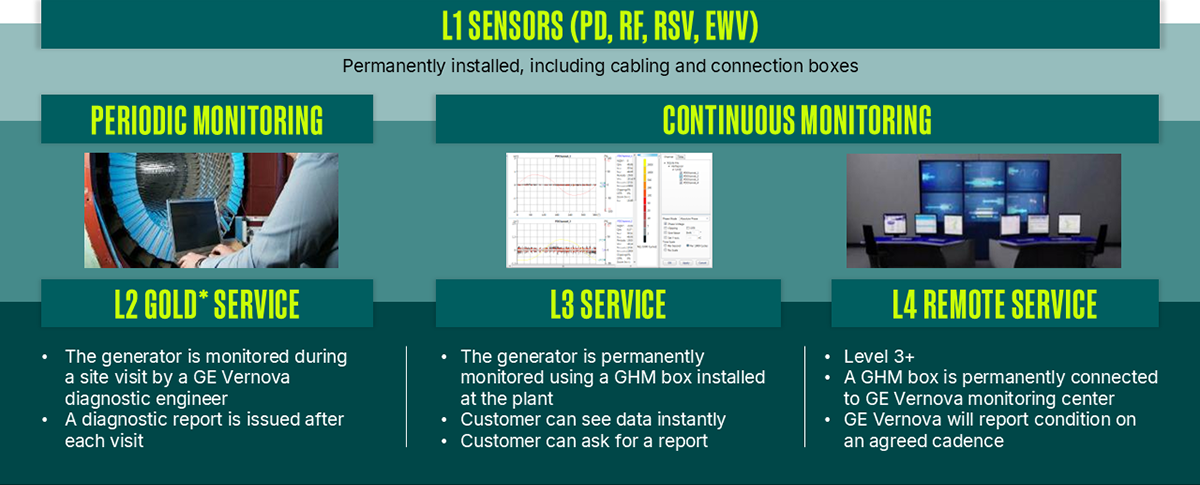
Permanently installed, including cabling and connection boxes (GE Vernova or most third party)
Webinar
As generator maintenance demands grow, proactive monitoring is more important than ever. Learn how Generator Health Monitoring helps detect issues earlier and supports smarter maintenance planning.
Paul Lapotre
Generator Global Sales Leader, GE Vernova
Pascal Decoussemaeker
Product Manager for Monitoring Systems, GE Vernova
Frequently asked questions
Detection lead time depends on the type of event. For lifecycle degradation events, such as rotor inter-turn short circuits and stator winding bar degradation, the time from first detection to a forced outage can range from one year to several years. During that window, continuous GHM monitoring allows operators to track whether the condition is worsening and helps guide the decision to execute a full rewind or local repairs at the next available outage. For faster-developing events, such as end winding damage and bearing damage, a forced outage can occur within a few months. These require faster action but are typically easier to repair; visual inspection and electrical testing should be prioritized at the earliest opportunity.
GHM data should also be reviewed after severe events, such as grid short circuits or heavy rainfall, both of which can accelerate generator degradation.
In most cases, the decision is not clear-cut. The generator is an important component of the power plant, but it does not typically determine planned outage intervals. When a turbine or boiler outage requires the unit to shut down, GHM measurement results can help prioritize generator maintenance activities.
GHM results, along with other inspection findings, can also support decisions to defer the replacement of a major component. Once that decision is made, online monitoring can help manage the risks associated with extended operation. Key indicators include rotor shaft voltage trends, partial discharge patterns, rotor flux waveform differences, and end winding vibration trends. These measurements can be tracked alongside daily KPIs to assess changes in generator condition.
Customer example
In May 2015, a customer discovered during a major overhaul that the stator winding was heavily contaminated by partial discharges. The customer had no replacement parts on hand and could not extend the outage by five months, and the next planned outage was five years away. This generator provided power to a refinery, so the situation called for close monitoring rather than an immediate shutdown.
To manage the risk, the customer and GE Vernova took the following steps:
As a result, the progression of the partial discharges was slowed. In May 2020, the complete renovation of the stator was able to take place during the major overhaul, avoiding a 60-day power shortage for the refinery.
Yes. GHM version 3 monitors physical phenomena, partial discharge, rotor flux, shaft voltage, and end-winding vibration, rather than being locked to a specific machine configuration, so it can be applied to legacy GE, legacy Alstom, and other OEM equipment.
However, integration on third-party equipment is more complex and time-consuming: the machine type must be thoroughly understood before sensors can be placed without affecting long-term operation. Currently, GE Vernova's focus is on legacy GE, Alstom, and OEM equipment.
For plants with a mix of GE Vernova and third-party generators, extending monitoring to third-party units is evaluated case by case, and development timelines for third-party projects and legacy equipment can vary.
There is no single answer. The right strategy depends on how the unit has been operated historically, its current condition, the expected future operating profile, and how many additional years of operation are planned.
GHM can be installed on older units, but the monitoring strategy must be developed around the specific unit. When the goal is to extend operation beyond original specified life, monitoring becomes a risk mitigation requirement rather than an optional add-on, since it provides the data needed to make informed decisions about the unit's continued operation.
One practical approach, common in multi-unit plants, is to store a spare rotor and a spare stator rewind set, monitor all units continuously, and use GHM data to determine which unit requires upgrades first. For plants that want a more formal starting point, GE Vernova can also prepare a risk-based health assessment for any specific unit upon request. This assessment is a separate offering, however, and is not provided through GE Vernova’s Gas Power business.
GHM is not a black box. There is a local HMI on-site, and data can be downloaded at the plant for more detailed local analysis and storage. Operators with the in-house expertise to interpret GHM data can do so independently at any time.
For plants operating with reduced on-site staffing, GE Vernova offers multiple remote monitoring service support levels. Under a level 4 service agreement, customers have 24/7 access to the GE Vernova M&D service desk. Without a service agreement, questions can be routed through the local account manager to the engineering team.
GE Vernova has more than 30 years of experience with generator health monitoring systems. Like all digital and electronic systems, the hardware requires periodic upgrades.
Version 3 is focused mainly on hardware improvements, as the software, HMI, and functionality in version 3 are currently the same as version 2. Version 3 offers greater storage capacity, better performance, and significantly more flexibility for future upgrades. The existing GHM sensors can be reused; only the on-site cabinet is replaced.
GHM version 2 is now in end-of-supply status. As of 2026, GE Vernova will stop offering version 2 soon and will be supplying GHM version 3 exclusively. Version 2 will continue to be supported for maintenance and issue resolution for a number of years, but operators running version 2 should be evaluating whether to upgrade.
Amodis and GHM version 1, the legacy GE and Alstom monitoring systems, are no longer supportable. If you are still running either system, upgrading to version 3 is recommended.
Yes, GHM is a modular system. Not every operator needs every module from day one. A common starting configuration is partial discharge monitoring and rotor flux monitoring, the two modules that cover the highest-priority lifecycle degradation risks. Additional modules can be added over time within the same cabinet architecture.
Contact us
*Trademark of GE Vernova and/or its affiliates.