
Search Gas Power
Recommended resources
Upgrades
Your outcomes—delivered
These days, we're all trying to do more with less, but GE Vernova can help. Our upgrades and modernizations can help you get more from your existing assets. Discover the possibilities with our interactive upgrades selector.

Controls
Control Lifecare Services
Whether you need 24/7 technical support, live remote diagnostics, onsite field engineering, or parts management, we have you covered with GE Vernova's Controls Lifecare Services (CLS).
Podcast
Cutting Carbon - Season 9
Join Dr. Jeff Goldmeer, Brian Gutknecht, and special guests for the final season of our 3-part series as they discuss the roles digital and electrification will play in the energy transition.

Decarbonization in action
Explore the future of energy
See how GE Vernova's Gas Power business is helping to build a world that works.
Prefer to listen?
Stream our audio version
When plant owners invest in a gas or steam turbine upgrade, they often find another opportunity inside the powertrain.
Turbine upgrades can unlock additional output, but if the generator cannot convert that added mechanical energy into electrical power, those megawatts remain trapped inside the machine.
You’ve unlocked the megawatts, but how can you get them on the grid?
Most of the F-class combined-cycle fleet was installed during the early 2000s build cycle, and many units were originally developed for steady baseload operation under different grid conditions than we see today. These units are now approaching major inspection and repair intervals, and operators face long-term planning decisions.
During scheduled major inspections, generator work is often treated as a replace-in-kind maintenance activity focused on restoring the machine to its original condition.
But, as plants invest significant capital into gas and steam turbine upgrades, the generator can become the limiting factor. Upgrades such as 7F.05, 7F.04-200, DLN 2.6+, AGP, and ASP can unlock meaningful output gains, but the generator must be able to convert that additional mechanical energy into electrical power.
When a turbine-generator unit is offline, plant owners have one of the best opportunities to modernize the generator and prepare the unit for how it will be operated.
The grid is changing, and generators are feeling the impact
The operating environment for existing plants has shifted significantly over the past decade. Units originally developed for steady baseload operations are now being pushed toward start-based operation and heavier cyclic duty as renewable penetration increases across the grid. At the same time, growing data center demand is increasing the need for dispatchable power generation that can respond quickly to changing load requirements.
In today's context, especially in the US, where we will see a huge demand increase over the next several years, getting every megawatt out of every plant is really going to be a critical piece in terms of helping to deliver near-term energy needs, specifically around data centers, but also around grid firming.
Matt Foreman
Steam Turbine and HRSG Platform Leader, GE Vernova
Those operating shifts introduce new stresses inside generators that were not originally engineered for frequent starts, stops, and load swings. As units cycle more frequently:
- Thermal expansion and contraction occur more often
- Load swings create additional mechanical stress
- Increased temperature profile in the unit due to increased output requirements
- Differential expansion between stator connection rings and end winding structures becomes more pronounced
- Internal components experience operating profiles beyond what many legacy systems were originally intended to handle
Over time, those stresses accumulate. As operating profiles shift toward load cycling, generators that once operated well at baseload can enter a higher-risk phase earlier than expected. That risk only increases as units age.
A useful comparison is an older vehicle being pushed into high-performance operation late in its life. A car with 150,000 miles may still run reliably under normal conditions, but repeated dragstrip use stresses critical components, accelerating wear and increasing the likelihood of failure. Generators subjected to aggressive cyclic operation late in their lifecycle face many similar challenges, with higher mechanical and thermal stresses reducing reliability margins over time.
A scheduled major outage is the right time to modernize your generator
Instead of treating each outage as an isolated maintenance event, operators can evaluate how the entire powertrain will operate over the next decade.
GE Vernova’s generator upgrade portfolio
Generator upgrades can be implemented as complete packages or targeted improvements, depending on plant objectives and the scope of the outage. Explore the upgrade options available for your generator, including stator rewind, rotor rewind, and rotor exchange. Select the path that best fits your needs below to learn more about each solution in detail.
Gas generator stator rewinds
Stator rewind upgrades can help extend generator life, improve reliability, and support higher operational flexibility across aging generator fleets.
Additional upgrades are in development to increase generator power output, particularly for the 7FH2. Future updates will be shared as they become available.
Stator rewinds and associated hardware
Gas turbine generators operate under intense thermal conditions, and cyclic operation can accelerate insulation aging, create hot spots, and increase mechanical wear across the stator system.
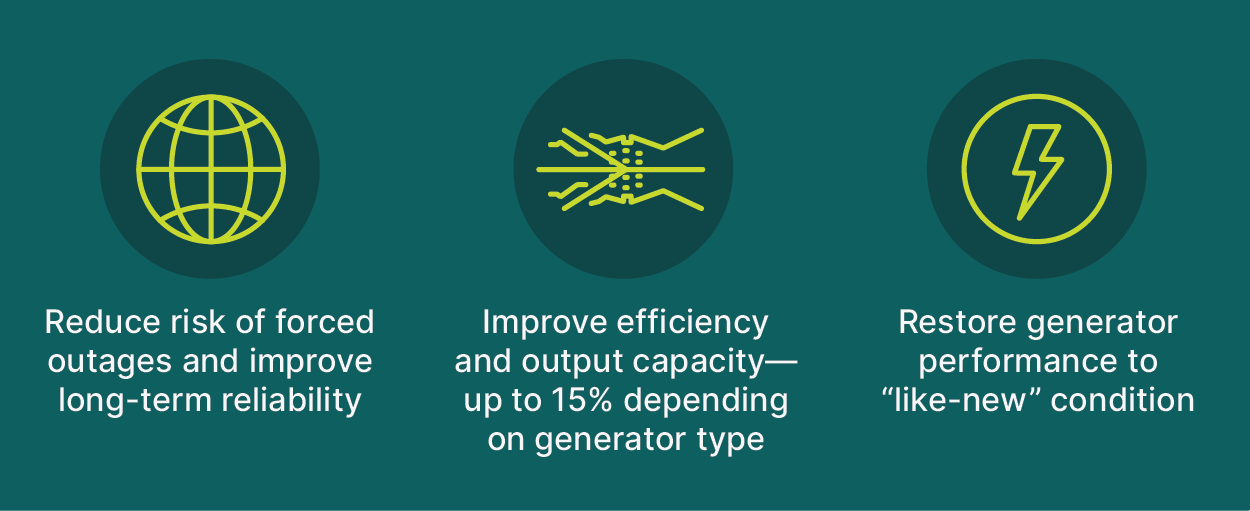
A stator rewind provides an opportunity to modernize core components while improving reliability and supporting long-term operating flexibility. GE Vernova’s stator rewinds and upgrades incorporate advanced insulation systems, improved end‑winding support, and validated manufacturing processes aiming to extend stator life, enhance reliability, and increase output while preserving long‑term asset value.
Want to see if this solution fits your unit? Explore the stator rewind solution in more detail.
Stator flex package upgrade
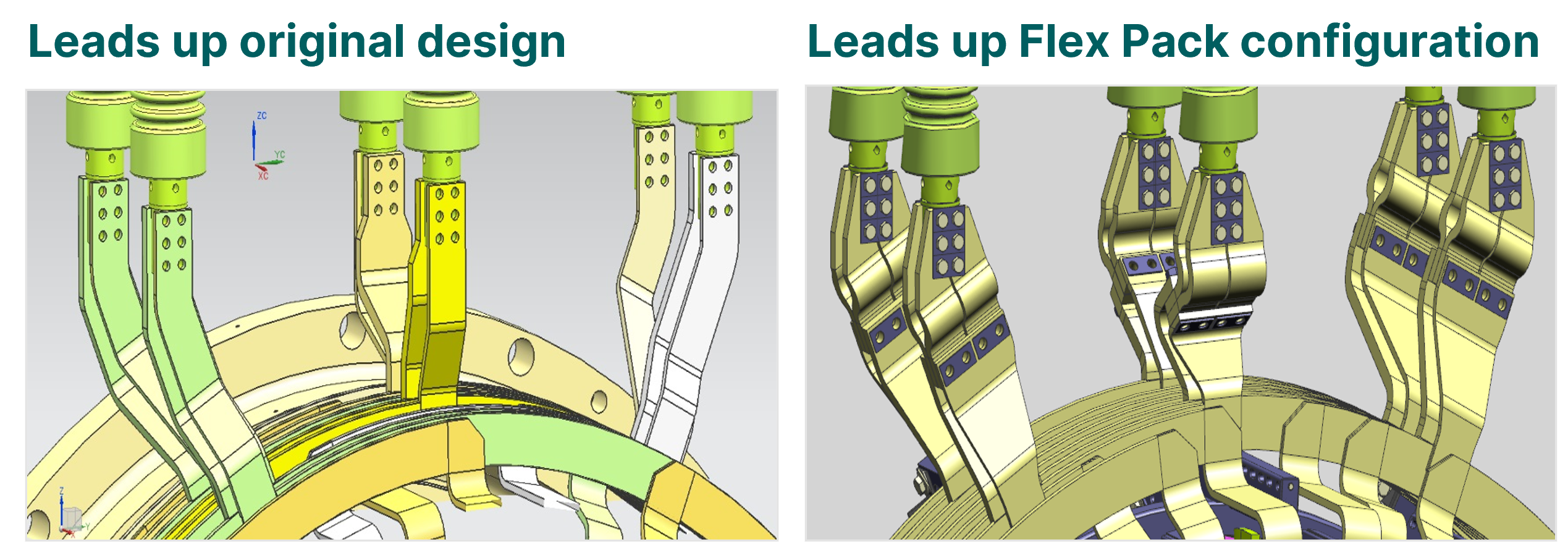
The stator flex pack is implemented alongside a stator rewind and is developed to allow generator components to move more independently during thermal expansion and load cycling.
The package includes flex leads and connection rings engineered to absorb movement during load cycles.
Benefits include:
- Improved compensation for differential expansion rates between connection rings and end windings
- Reduced structural stress across end winding assemblies and high voltage bushing (HVB) connections.
By allowing movement to occur more naturally throughout the load range, the package helps support durability under cyclic operating conditions.
Learn whether this solution is right for your generator configuration. Speak with an expert today.
Generator rotor rewinds
Rotor upgrade options can help plants address aging components, improve operational reliability, and support increased cyclic demands.
Rotor rewinds
As operating demands increase, the rotor can experience additional thermal and mechanical stress, which can impact long-term performance.
A rotor rewind replaces key winding components to restore integrity and help the generator operate reliably under current conditions.
This upgrade helps reduce the risk of forced outages, supports more flexible operation, and maintains overall generator performance. It is often considered when inspection data points to winding wear or when planning upgrades to meet evolving operating needs.
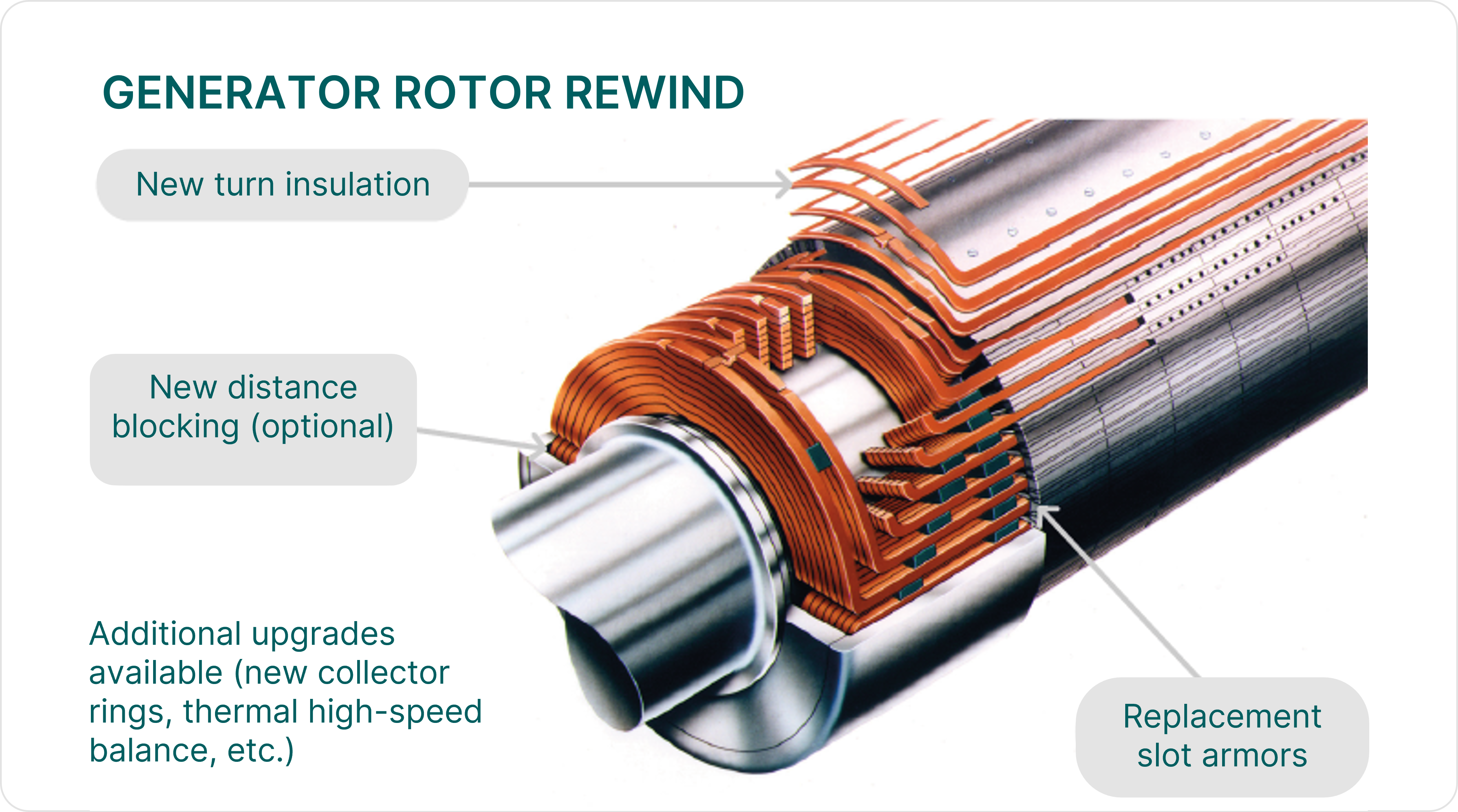
Want to see if this solution fits your unit? Explore the rotor rewind solution in more detail.
Rotor flex package upgrade
The rotor flex pack is implemented alongside a rotor rewind and is developed to improve rotor durability during cyclic operation and hot starts.
The package combines several features into a single modernization approach, including bonded-on all coils, glass-slot-insulated with adhesive, compliant centering ring blocks that allow controlled movement of coils, and slot exit relief.
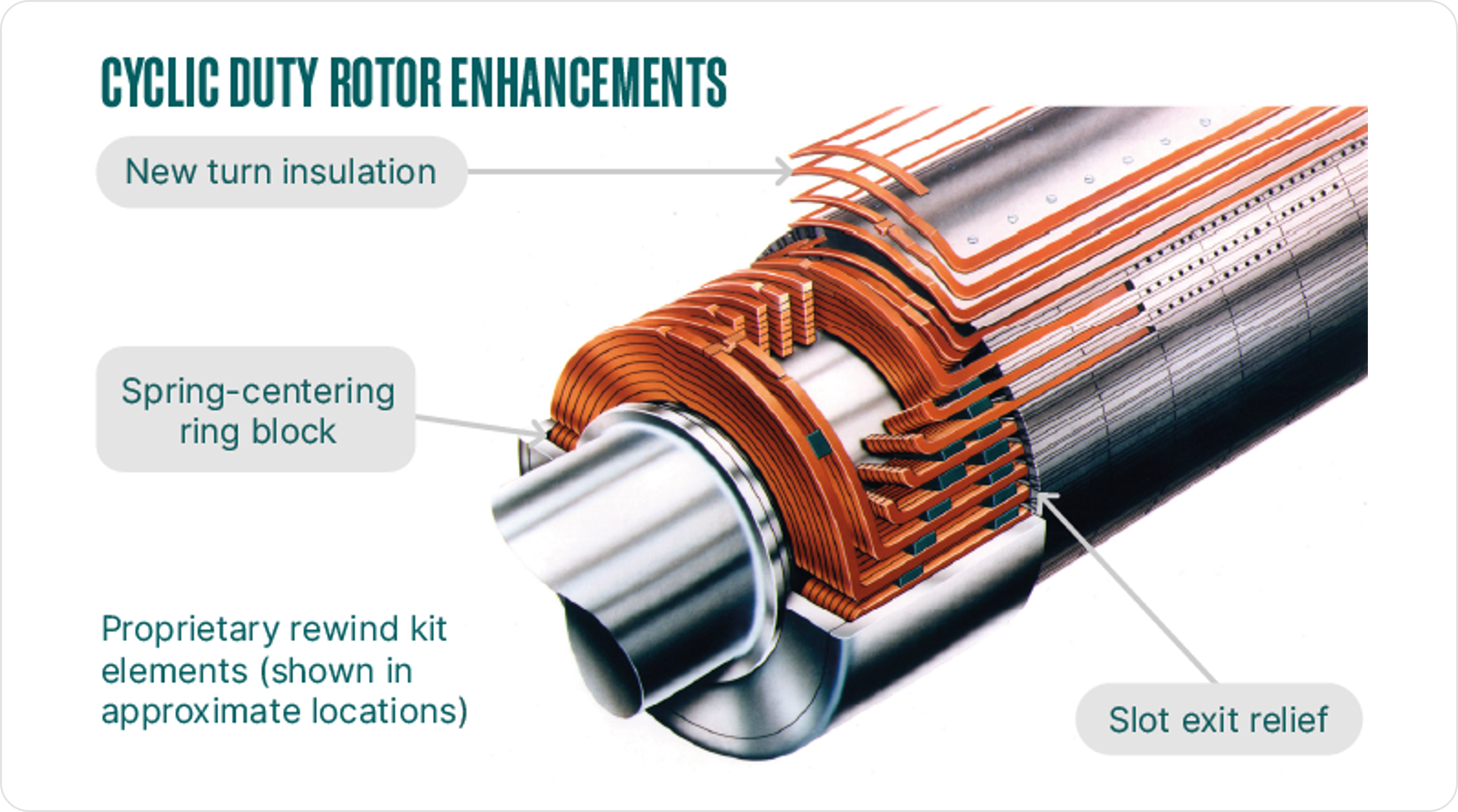
Benefits include:
- Reduced structural stress within the rotor end winding assembly
- Improved durability during frequent start-stop operation
- Better tolerance for evolving operating conditions
- Reduced exposure to thermal sensitivity issues
Connect with us today to speak with one of our experts and explore whether this upgrade is right for your generator.
Additional rotor rewind options
Even if you are not performing a full rewind, plants can still benefit from targeted modernization upgrades, like the Amortisseur modification to help prevent cooling hole blockage or the collector terminal seal upgrade to reduce hydrogen consumption.
Amortisseur and spring migration modifications
This modification option positively locks rotor components together using stepped creepage blocks and pins. These modifications help prevent rotors from eventually blocking cooling holes due to block migration. These cooling holes being blocked could eventually lead to thermal sensitivity due to unequal rotor cooling.
Collector terminal seal upgrades
The collector terminal seal upgrade was developed to improve hydrogen sealing performance and long-term durability under evolving operating conditions. This upgrade incorporates improved O-ring sealing configurations, upgraded insulation sleeve configurations, and VITON sealing materials, all developed to enhance long-term sealing durability under evolving operating conditions. Wave spring washers also help maintain more consistent sealing pressure throughout operation, helping to reduce hydrogen leakage and supporting long-term reliability.
However, both the Amortisseur modification and collector terminal seal upgrade are not always applicable to every equipment type. Connect with one of our experts to learn which upgrades are right for your generator.
Rotor exchange program
GE Vernova’s rotor exchange program allows operators to replace a generator rotor needing maintenance or repair with a fully refurbished, tested, and ready-to-install exchange rotor.
As demand for exchange assets increases, plants are encouraged to plan at least 12 months ahead for scheduled outages to help ensure exchange rotors are delivered well in advance to support a smooth, efficient outage schedule.
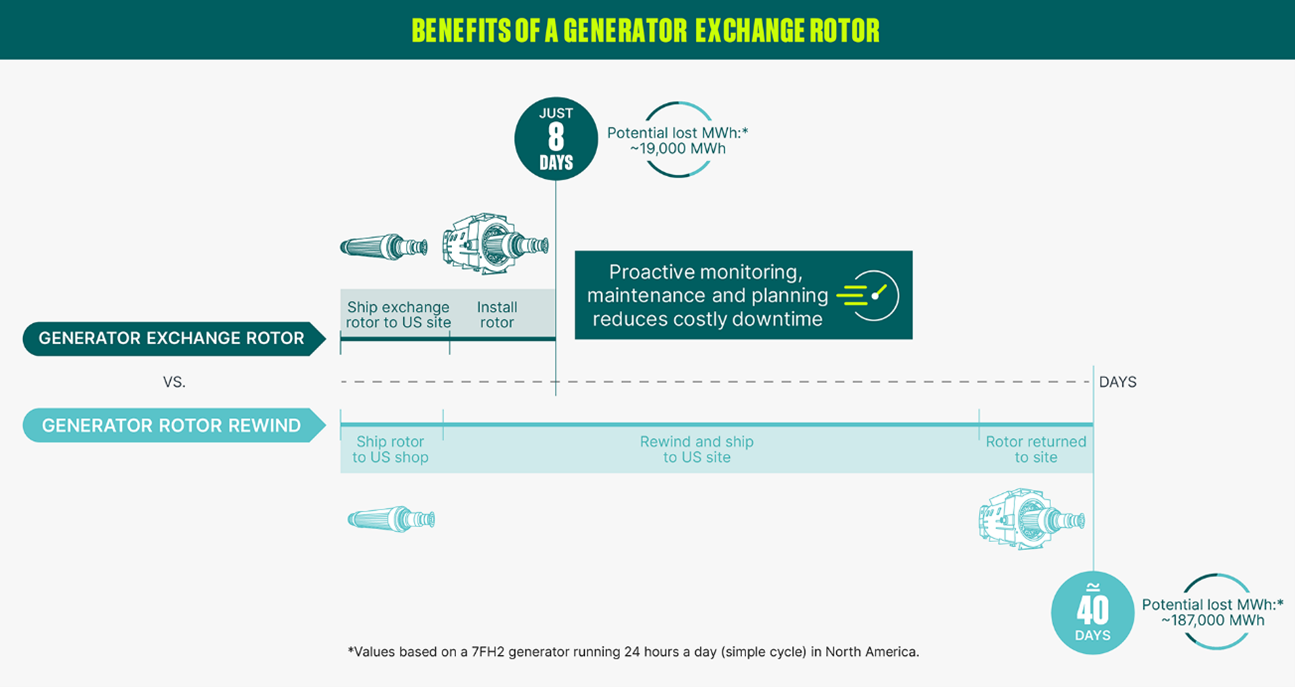
Want to see if this solution fits your unit? Explore the generator rotor exchange solution in more detail.
Don’t miss this opportunity to improve output and reliability
If you're concerned that a future turbine upgrade will leave your plant generator-limited, the next outage is the time to act. The cost of an unplanned forced outage, particularly for a plant being called on to respond to grid demands, is significant. Planning generator upgrades alongside scheduled outages, ordering capital parts, and securing outage dates well in advance is what separates plants that are ready for what's coming next from those that are caught reacting to it.
Upgrade beyond replace-in-kind maintenance
Upgrading your generator can help improve reliability and support how the plants are expected to run as operating conditions continue to evolve. Rather than treating outages as simple replace-in-kind maintenance events, operators can use these intervals to make sure the generator can handle the additional output and operating demands created by today’s grid conditions.
Before your next scheduled outage, contact GE Vernova for a generator technology assessment to learn what upgrades are right for your plant.

Chris Killian
Global Sales, Generator
GE Vernova
Learn more
You might also be interested in
Contact us